
Gladia Review, Pricing & Alternatives (2026)
Multilingual transcription and audio intelligence through one API
Last updated: October 26, 2026
What is Gladia?
Gladia is a French speech-to-text and audio intelligence API founded in 2022 for meeting products, media teams, contact centers, sales tools, and developers. It offers asynchronous and real-time transcription, multilingual support, speaker diarization, language detection, and audio-processing add-ons. Self-serve pricing starts at €0.16 per audio hour for asynchronous Solaria-3, with €50 in introductory credits. Enterprise pricing is custom, and Gladia does not publish a USD conversion.
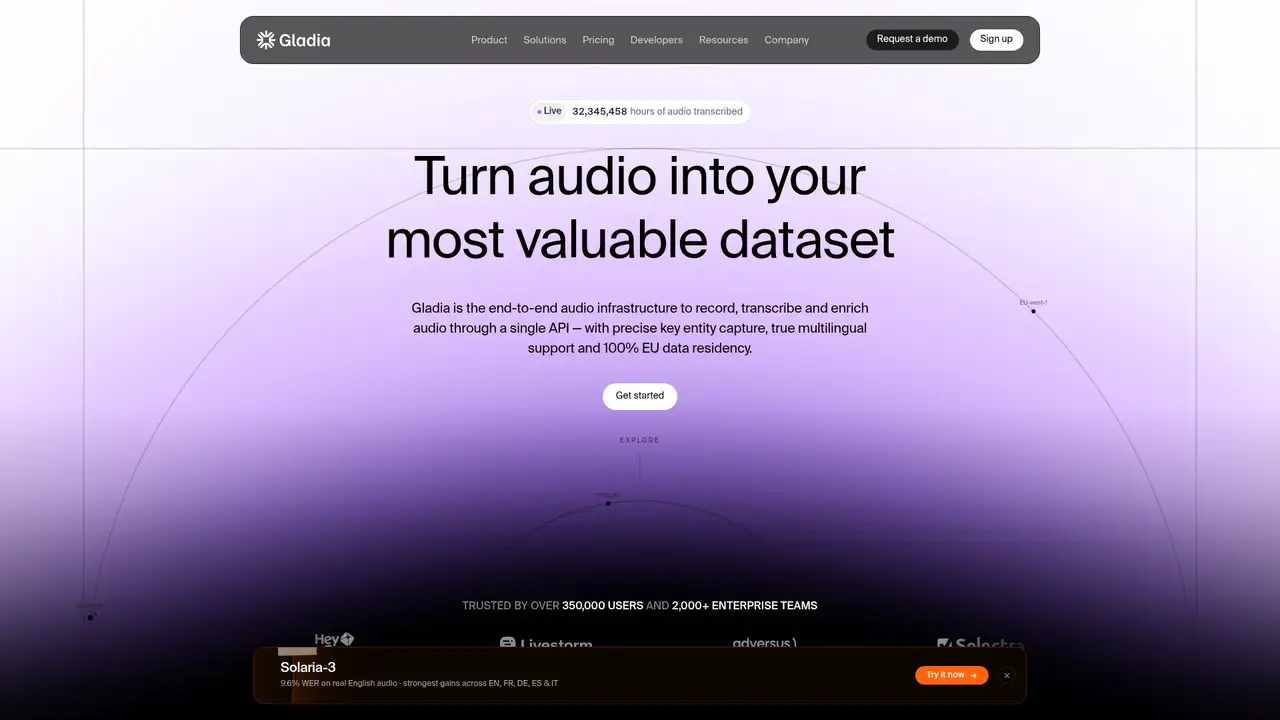
Gladia is a Paris-based audio AI company founded in 2022 by Jean-Louis Quéguiner and Jonathan Soto. Its first asynchronous transcription and audio intelligence API launched in June 2023, based on a proprietary version of Whisper ASR. Gladia announced a $16 million Series A in October 2024, bringing total funding to $20.3 million. The company said its API had more than 600 customers and 70,000 users. Its target customers include meeting assistants, contact-center platforms, sales tools, media services, and other products that process recorded or live audio. This background matters for teams assessing continuity, scale, and intended use. Gladia is positioned as infrastructure for embedding audio processing, rather than as a consumer transcription application or standalone meeting workspace.
A typical workflow sends a file, audio URL, or live stream to Gladia’s API and receives a transcript through polling or callbacks. The service offers automatic language detection, code-switching, speaker diarization, timestamps, custom vocabulary, and name consistency. Gladia says its speech recognition supports more than 100 languages. Audio Intelligence add-ons cover summarization, translation, sentiment analysis, named entity recognition, PII redaction, and Audio to LLM. Solaria-3 is for pre-recorded audio, while real-time transcription uses a separate rate. In practice, developers can select asynchronous processing when delayed results are acceptable, or maintain a live session when applications need arriving transcript text. The available controls also support workflows that connect transcripts with downstream analysis, records, or user-facing features.
Gladia’s hosted models are proprietary. Its model documentation identifies Solaria-1 as the default model and describes Solaria-3 as its highest-accuracy model for European real-world audio, available for pre-recorded audio only. Recent releases include Solaria-3 in June 2026, PII Redaction and ISO 27001 and ISO 27701 certification updates in March 2026, and Zero Data Retention in February 2026. Gladia also released Audio to LLM generally in April 2026 and published an open speech-recognition benchmark in March 2026. Its SDKs and normalization library do not make the speech models open source. Consequently, teams wanting hosted model access can use the API, whereas teams requiring deployable speech weights should recognize that the documented models are proprietary.
Gladia uses prepaid credits rather than subscriptions. Self-serve asynchronous transcription starts at €0.16 per hour for Solaria-3 and costs €0.27 per hour for Solaria-1 at the lowest listed volume band. Real-time transcription costs €0.68 per hour. Monthly volume above 10,000 hours lowers Solaria-3 to €0.12 per hour, while add-ons cost extra. New accounts receive €50 in credits valid for one year. Self-serve allows 25 concurrent asynchronous jobs and 30 concurrent real-time sessions. Enterprise pricing is custom and includes unlimited concurrency, a 99.9% uptime SLA, custom hosting, custom models, and zero data retention. Buyers should therefore estimate both transcription and add-on usage, while checking whether concurrency limits fit expected workloads before selecting self-serve.
Gladia’s main limitation is product fit: Solaria-3 is pre-recorded only, and the service does not provide an offline speech engine. AssemblyAI, Deepgram, and OpenAI Speech-to-Text are direct alternatives, so buyers should compare supported languages, streaming behavior, data controls, concurrency, accuracy for target audio, and current rates before choosing. Gladia says self-serve model training is enabled by default, with free opt-out, while Enterprise is opted out by default. Its privacy notice also says uploaded data should not include specified sensitive information, including protected health information. Pick Gladia for a hosted API with multilingual coverage, European privacy controls, and usage-based billing, especially when those priorities outweigh offline processing or a pre-recorded-only model option.
Who is Gladia best for?
- Teams adding multilingual transcription to meeting products.
- Contact centers processing accented or multilingual audio.
- Media workflows requiring timestamps and speaker diarization.
- Developers preferring prepaid, usage-based API billing.
Gladia Pricing (2026)
Pricing model: Usage-based. All prices in USD.
| Plan | Price | What you get |
|---|---|---|
| Self-serve | €0.16/hour starting | Prepaid credits. Solaria-3 async starts at €0.16/hour, Solaria-1 at €0.27/hour, and real-time transcription at €0.68/hour. Includes 25 concurrent async requests and 30 concurrent real-time requests. |
| Enterprise | Custom | Includes unlimited concurrent requests, a 99.9% uptime SLA, custom models and fine-tuning, custom hosting, no model training by default, and zero data retention. |
Pros and Cons
Pros
- Solaria-1 supports more than 100 languages.
- The API supports asynchronous and real-time transcription.
- Core transcription includes diarization and custom vocabulary.
- Enterprise includes custom hosting and zero data retention.
Cons
- Solaria-3 is available for pre-recorded audio only.
- Audio Intelligence features carry separate charges.
- The speech models are proprietary and hosted.
Who should look elsewhere?
- Buyers requiring an offline speech engine.
- Teams requiring Solaria-3 for live streaming.
- Projects needing a permanent free plan.
Technical Details
Frequently Asked Questions
How much does Gladia cost?
Self-serve starts at €0.16 per audio hour for asynchronous Solaria-3 and €0.27 per hour for Solaria-1 at the lowest listed volume band. Real-time transcription costs €0.68 per hour. Add-ons cost extra, and higher monthly volume reduces Solaria-3 rates. Enterprise pricing is custom. Gladia publishes euro prices and does not publish a USD conversion.
Does Gladia have a free plan?
Gladia does not publish a permanent free plan. New accounts receive €50 in credits valid for one year, which can cover about 312 hours of asynchronous Solaria-3 transcription at the starting rate. After credits are used, customers top up to continue. Top-ups of at least €1,000 receive additional credits, and those top-up credits do not expire.
How does Gladia compare with AssemblyAI?
Both are hosted speech APIs offering asynchronous and real-time transcription. Gladia says Solaria-1 supports more than 100 languages and offers audio-processing add-ons, while AssemblyAI provides its own speech model and feature set. A practical comparison should focus on language coverage, streaming requirements, privacy controls, concurrency, accuracy for target audio, and current pricing.
Does Gladia train on customer audio?
Gladia’s pricing page says self-serve model training is enabled by default, with a free opt-out available at any time. Enterprise is opted out by default. Enterprise also offers zero data retention, while Gladia says essential API metadata remains retained for billing, service quality, reliability, and security. Customers should review the privacy notice and contract for their recording and data requirements.
Can businesses use Gladia commercially?
Yes. Gladia markets its API for meeting assistants, contact centers, sales tools, media workflows, and other business products. Self-serve customers pay for processed audio through prepaid credits, while Enterprise customers receive custom commercial terms. Customers remain responsible for lawful recording, consent, retention, and personal-data handling. Gladia’s privacy notice says uploaded audio should not contain specified sensitive information, including protected health information.
Best Gladia Alternatives in 2026
These tools do the same job as Gladia, with different pricing, limits and trade-offs.