
Codebuff Review, Pricing & Alternatives (2026)
A terminal coding agent that edits repositories through chat
Last updated: October 26, 2026
What is Codebuff?
Codebuff is a terminal coding agent made by Freebuff for developers who want repository-aware edits, command execution, tests, and code review from a CLI. Its published Strong plans start at $100/month for 1x usage, while usage-based billing costs $0.01 per credit. The client is open source under Apache License 2.0.
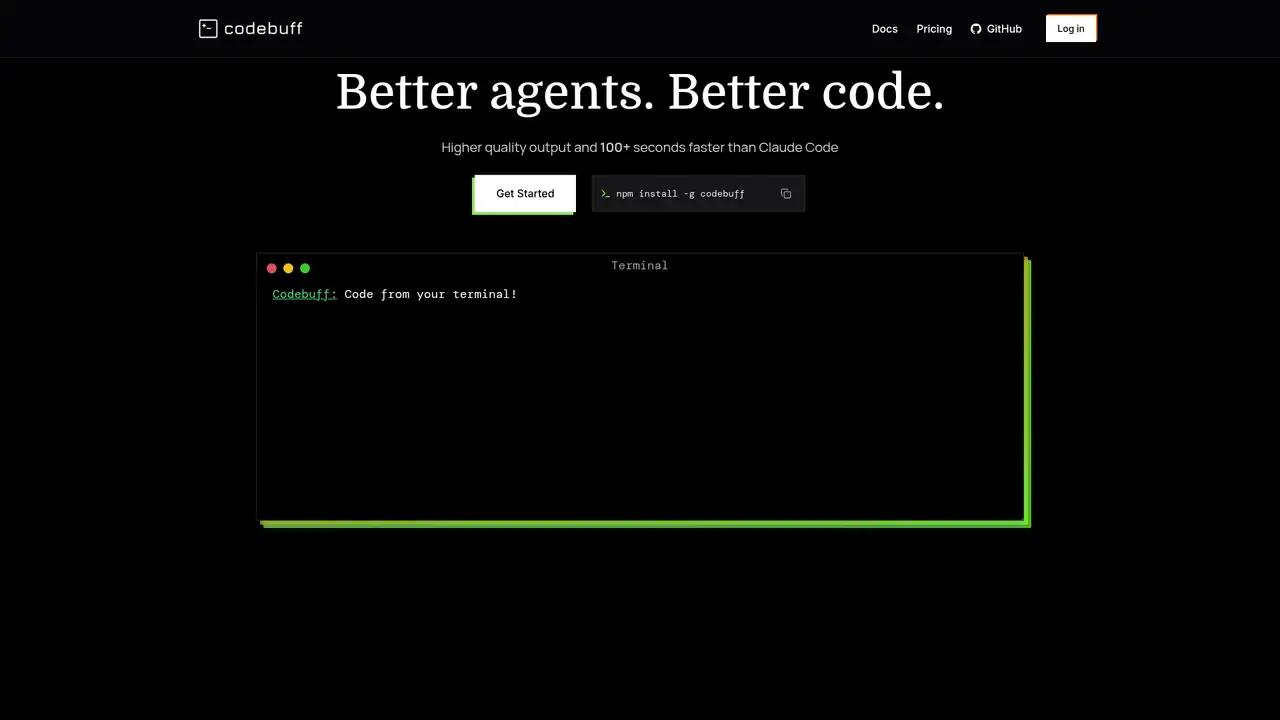
Codebuff is a command-line coding agent from Freebuff, a Fall 2024 Y Combinator startup. Developers describe features, bugs, tests, reviews, or configuration changes in a terminal, while the agent selects relevant repository files, edits them, runs commands, and executes tests. Its July 2024 repository and December 2024 public launch indicate an early product, while Y Combinator lists founders James Grugett and Dawson Chen, a four-person team, and active status. The client is open source under Apache License 2.0, with TypeScript code and support for multiple languages. That license supports commercial use of the published client, but hosted inference remains separate. Buyers should also note that no funding amount is published, and repository context is processed through Freebuff and external model providers rather than locally, creating privacy and provider-dependency considerations for adoption.
A typical session starts in a project directory after installing the CLI, so setup centers on the repository rather than a separate editor workspace. The user describes a feature, bug, test, review, or configuration change, and Codebuff can select relevant files automatically before reading instructions, editing files, installing packages, running terminal commands, executing tests, or answering repository questions. It follows.gitignore and supports.codebuffignore for additional exclusions, helping limit accidental context exposure. Knowledge files, including knowledge.md, AGENTS.md, and CLAUDE.md, preserve project-specific patterns, constraints, and commands; init can create a knowledge file and codebuff.json for development processes. Because agents can run commands and modify code, Docker-based isolation is available for scoped copies. Checkpoints provide an operational safeguard by allowing users to undo changes or reset conversations.
Codebuff’s orchestrator divides repository work among agents that find files, reason about tasks, write code, run commands, and review results in parallel. The FAQ names Claude Opus 4.7 for Default and Max orchestration, GPT-5.6 Luna for Lite, and Claude Opus 4.7, GPT-5.4, or Gemini 3.1 Flash Lite for task-specific agents. In practice, model selection is part of the workflow rather than a separate configuration exercise: Lite targets lighter orchestration, while Max can compare multiple implementations. The 2025 launch archive also records browser console log reading, checkpoints, project initialization, and a custom file-selection model. Checkpoints matter when agents make broad edits because they provide a route back to an earlier state. Codebuff separates its terminal client, agent definitions, and hosted model services, so updating the client does not remove dependence on its inference service.
The current pricing page lists three Strong subscriptions: $100 per month for 1x usage, $200 per month for 2.5x usage, and $500 per month for 7x usage. It also offers usage-based billing at $0.01 per credit. Because credits are consumed according to task complexity, these plans do not translate into a predictable number of repository edits, tests, or reviews. The page says users can see the credits consumed by each task, which supports monitoring but not reliable advance budgeting. An April 2025 announcement described $5 top-ups, optional automatic top-up, nonexpiring purchased credits, and 500 free monthly credits for new accounts. However, the current page lists paid subscriptions and pay-as-you-go billing, so the older free-credit offer should not be treated as a current plan when estimating costs or configuring spending controls.
Codebuff's main limitation is that repository work passes through a hosted service and external model providers. Freebuff says it uses messages, agent traces, and files to operate the service, may analyze usage for advertising and ad-model training, and may use submissions for AI training when a model or feature permits it. That makes privacy review and repository scoping part of setup, especially for confidential code. Its documentation recommends Docker for isolation, while.gitignore and.codebuffignore can restrict file discovery. Aider offers a provider-agnostic terminal workflow, Claude Code is Anthropic's terminal agent, and Cline is an open-source coding agent for supported editors. Codebuff also requires budgeting: subscriptions begin at $100 monthly, while credit costs vary by task complexity. It suits developers who value automatic discovery, parallel specialist agents, and checkpointed terminal edits.
Who is Codebuff best for?
- Terminal-first developers who prefer conversational repository changes.
- Large repositories where automatic file selection matters.
- Users who want parallel specialist agents for coding tasks.
- Developers comfortable sending project context to hosted models.
Codebuff Pricing (2026)
Pricing model: Usage-based. All prices in USD.
| Plan | Price | What you get |
|---|---|---|
| Strong 1x | $100/month | Provides 1x usage. Credit consumption varies with task complexity. |
| Strong 2.5x | $200/month | Provides 2.5x usage. Credit consumption varies with task complexity. |
| Strong 7x | $500/month | Provides 7x usage. Credit consumption varies with task complexity. |
| Pay as you go | $0.01/credit | Credits are consumed by task complexity. Purchased credits do not expire. |
Pros and Cons
Pros
- Automatic file selection can reduce manual repository triage.
- Parallel specialist agents divide discovery, coding, and review work.
- Checkpoints provide a documented path for undoing changes.
- The client repository uses Apache License 2.0.
Cons
- Hosted processing creates data-use and provider-dependency concerns.
- The lowest published Strong subscription costs $100 monthly.
- Task-based credit consumption makes spending difficult to predict.
Who should look elsewhere?
- Teams that require local inference or self-hosted processing.
- Organizations that prohibit cloud handling of repository content.
- Users seeking a fixed, unlimited monthly task allowance.
Technical Details
Frequently Asked Questions
How much does Codebuff cost?
Codebuff lists Strong subscriptions at $100 per month for 1x usage, $200 per month for 2.5x usage, and $500 per month for 7x usage. The pricing page also lists usage-based billing at $0.01 per credit. Credits are consumed according to task complexity, so the plans do not represent a fixed number of requests or coding tasks.
Does Codebuff have a free plan?
An April 2025 announcement described 500 free monthly credits for new accounts, plus paid credit top-ups. The current pricing page lists Strong subscriptions and pay-as-you-go credits rather than a free plan. The announcement also said purchased credits do not expire. Users should check the current pricing page before assuming free credits are available.
How does Codebuff compare with Claude Code?
Both products provide terminal-based coding agents. Codebuff documents automatic file selection, parallel specialized agents, checkpoints, and several model families. Claude Code is Anthropic's terminal product and centers on Anthropic's models and workflow. Codebuff is the closer match for users prioritizing multi-agent orchestration, while Claude Code is the more focused choice for an Anthropic-centered setup.
Does Codebuff train on user code?
Codebuff's documentation says Freebuff uses messages, agent traces, and files to operate the service. It may analyze data for advertising and ad-model training, and it may use submissions for AI training when a model or feature says that use is allowed. The documentation also describes restricted partner evaluation of connected repositories. Teams should review the current privacy terms before sending confidential code.
Can I use Codebuff commercially?
The Codebuff repository is licensed under Apache License 2.0, which permits commercial use subject to the license's conditions. That license applies to the published client code. It does not make Codebuff's hosted inference self-hosted, and hosted use remains subject to the service's pricing, privacy documentation, provider terms, and other applicable rules.
Best Codebuff Alternatives in 2026
These tools do the same job as Codebuff, with different pricing, limits and trade-offs.
Open-source AI pair programming in a Git-aware terminal
An agentic coding assistant for terminal, IDE, desktop, and web

Open coding agent for editors, terminals, desktops, and custom apps
AI coding workspace with repository context and software agents

Open coding agents with local, cloud, and enterprise deployment options