
OpenHands Review, Pricing & Alternatives (2026)
Open coding agents with local, cloud, and enterprise deployment options
Last updated: October 26, 2026
What is OpenHands?
OpenHands is an open-source software engineering agent platform supported by All Hands AI, Inc. It serves developers, automation builders, and teams needing deployment control. Agent Canvas is free to self-host, while Teams starts at $499 per month for up to 10 users. The platform combines GUI, CLI, SDK, API, automation, and model choice.
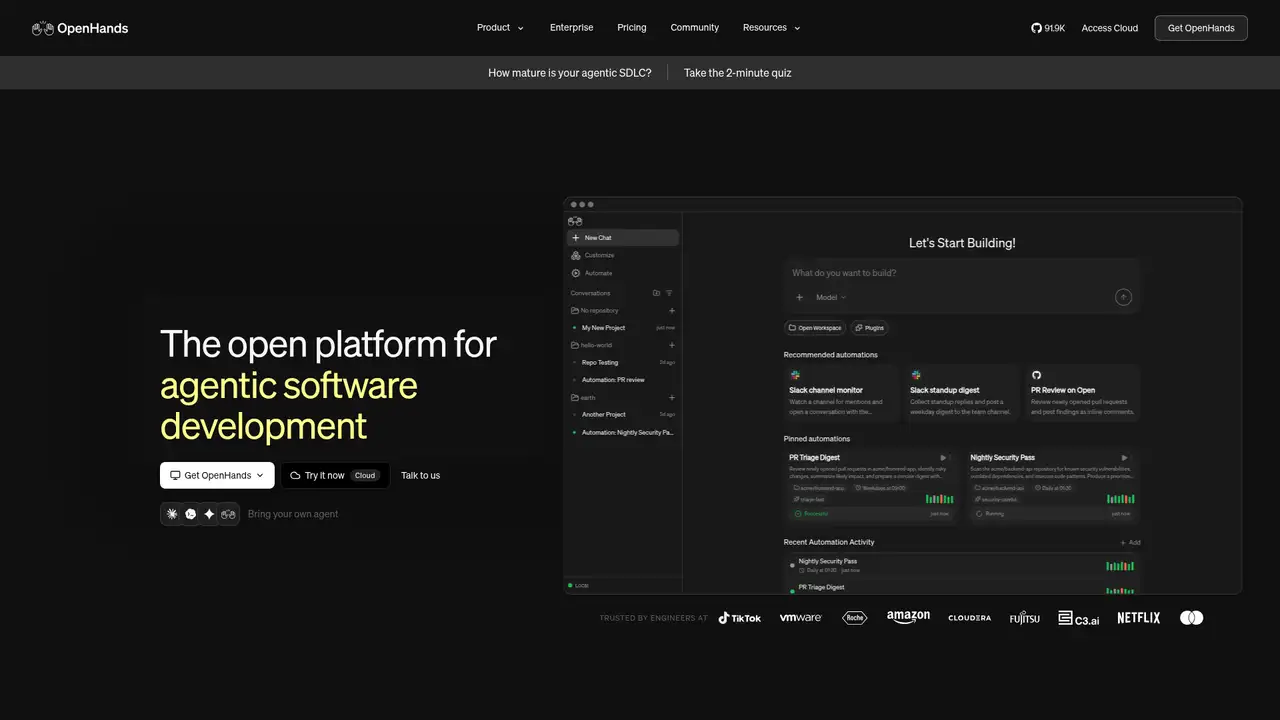
OpenHands is an open-source platform for software-engineering agents, supported by All Hands AI, Inc., not a company named OpenHands, Inc. Official documentation identifies Xingyao Wang, Graham Neubig, and Robert Brennan as founders. All Hands AI announced the project in spring 2024 under the name OpenDevin, making OpenHands a rebrand rather than a shutdown or acquisition. The company announced a $5 million seed round on September 5, 2024, followed by an $18.8 million Series A led by Madrona; official community material says funding exceeds $20 million. GitHub lists OpenHands version 1.33.0 as released on October 23, 2026, with updates including MARS web, DigitalOcean sessions, automation rendering, secret masking, and documentation. The OpenHands suite includes Agent Canvas, local GUI and CLI clients, the Software Agent SDK, Agent Server, Automation Server, Sandbox Server, OpenHands Cloud, and OpenHands Enterprise.
OpenHands covers interactive development and repeatable engineering operations across several product surfaces. Agent Canvas manages conversations, files, terminals, model settings, backends, and automations through a browser interface. The local GUI and CLI support interactive work, while the Software Agent SDK lets developers embed agents in Python applications. Agent Server exposes conversations, tools, and workspaces through REST and WebSocket APIs. Automation Server handles scheduled and event-driven runs connected to GitHub, Slack, Jira, or repository workflows. Agents operate inside configured workspaces or sandboxes, produce code changes, and can support reviewed pull requests. The platform supports provider and model configuration, including local or hosted backends, and its release activity includes automation-rendering corrections, secret masking, provider-profile controls, agent-profile settings, and improvements for cloud and DigitalOcean sessions.
OpenHands is model agnostic rather than tied to a single vendor. Its documentation lists Claude, GPT, fine-tuned models, proprietary models, and third-party agents including Codex and Claude. LiteLLM manages provider connections, while compatible local services can include Ollama, LM Studio, SGLang, vLLM, and other OpenAI-compatible gateways. Agent Canvas accepts direct provider keys, OpenHands hosted model access, signed-in ACP subscriptions, and local model connections. Local execution supports Docker, a virtual machine, Modal, or another configured backend. The October 23, 2026 release, version 1.33.0, added MARS web and lock-to-cloud launch options, persistent DigitalOcean sign-in, smaller default virtual machines, automation rendering corrections, and secret masking. Most models require an API key, although a local unauthenticated server can use a placeholder key.
Agent Canvas is free, open source, and available for local self-hosting, with shared identity and community support. The local option includes selected MCP support but excludes multi-user identity and RBAC and SSO. Teams costs $499 per month for up to 10 users, plus $50 monthly for each additional seat. It includes a 30-day trial, one organization, multi-user identity and RBAC, BYO LLM key support, integrations, automations, budgeting and usage controls, SSO/SAML, and best-effort email support. Teams is limited to 5,000 sessions each month. Enterprise uses custom pricing and offers unlimited seats and usage, an enterprise agreement, standard or premium support, and a customer-success manager. Separate Cloud descriptions list either a $20 free trial with pay-as-you-go usage or a $20 monthly subscription with model choice and BYOK. Provider charges may remain separate for BYOK or paid hosted models.
OpenHands suits developers who want control over agents across local machines, private infrastructure, or managed services. The core repository is MIT licensed, but the self-hosted Cloud Helm chart is source-available under the Polyform Free Trial license, permitting use for 30 days per year before an organizational commercial license is required. Local self-hosting can keep code and data within the operator’s infrastructure, while Enterprise supports Kubernetes deployment in a customer VPC and managed Cloud follows applicable privacy terms. The basic local setup targets a single user, so multi-tenant production use requires additional authentication, isolation, and scalability controls. Direct machine backends may expose files, commands, and credentials to agents. Compared with Cursor, GitHub Copilot, and Devin, OpenHands emphasizes model choice, programmable workflows, and deployment control. Choose OpenHands if self-hosting, governance, and configurable agent infrastructure matter more than a guided hosted experience.
Who is OpenHands best for?
- Developers building programmable coding agents.
- Teams needing self-hosted execution.
- Organizations requiring model choice.
- Automation across many repositories.
OpenHands Pricing (2026)
Pricing model: Freemium. All prices in USD.
| Plan | Price | What you get |
|---|---|---|
| Agent Canvas | $0 | Free, open source, and free to self-host locally; shared identity, community support, selected MCP only, and no multi-user identity, RBAC, or SSO. |
| Teams | $499/month | Up to 10 users, plus $50/month per additional seat; self-hosted, one organization, 30-day trial, and 5,000 sessions per month. |
| Enterprise | Custom pricing | Unlimited seats, unlimited users, uncapped usage, enterprise agreement, self-hosted deployment, support options, and customer success manager. |
Pros and Cons
Pros
- It supports GUI, CLI, SDK, and API workflows.
- It works with many model providers.
- It offers local and customer VPC deployment.
- It includes automation and governance features.
Cons
- Pricing information spans multiple product pages.
- Local agents require careful isolation.
- Commercial components use separate licenses.
Who should look elsewhere?
- Users wanting a simple editor plugin.
- Teams avoiding infrastructure management.
- Projects requiring one fixed model vendor.
Technical Details
Frequently Asked Questions
How much does OpenHands cost?
Agent Canvas is free to use and self-host locally. Teams costs $499 per month for up to 10 users, with additional seats at $50 per month and a 5,000-session monthly cap. Enterprise uses custom pricing. Official Cloud material also lists a $20 free trial plus pay-as-you-go usage and a separate $20 monthly subscription description.
Can I use OpenHands for free?
Yes. Agent Canvas is free, open source, and self-hostable for local use. The free option supports shared identity and selected MCP features, but it lacks multi-user identity, RBAC, SSO, and several team controls. Users may still pay model providers when connecting external APIs or using paid hosted models.
How does OpenHands compare with Cursor?
Cursor is an editor-centered product, while OpenHands provides GUI, CLI, SDK, API, automation, and self-hosting options. OpenHands supports more deployment and model choices, though it can require more setup and operational decisions. OpenHands fits buyers prioritizing programmable agents, infrastructure control, or repository-scale automation over a tightly integrated editor experience.
Does OpenHands train on my code?
OpenHands provides deployment-dependent privacy rather than one universal promise. Local deployments can keep code and data under the operator's infrastructure, while Enterprise supports customer VPC deployment. Managed Cloud follows its applicable terms. External model providers may receive prompts and code when their APIs are used, so configuration and provider policies determine handling.
Can I use OpenHands commercially?
The core OpenHands project is MIT licensed, supporting commercial use under that license's conditions. Commercial Cloud self-hosting components are separate and use a Polyform Free Trial license, allowing 30 days per year before an organizational license is required. Code ownership and commercial licensing are separate issues, so deployment terms, model terms, and repository licenses should be reviewed.
Best OpenHands Alternatives in 2026
These tools do the same job as OpenHands, with different pricing, limits and trade-offs.
AI coding workspace with repository context and software agents
AI coding assistance across editors, terminals, and GitHub

A hosted software engineer for delegated repository work
An agent-native code editor unified with Cognition's Devin platform
An agentic coding assistant for terminal, IDE, desktop, and web