
Attention Insight Review, Pricing & Alternatives (2026)
Predictive eye-tracking for designs, websites, ads, and video
Last updated: October 26, 2026
What is Attention Insight?
Attention Insight is a hosted predictive eye-tracking service for designers, marketers, agencies, and product teams. It analyzes images, URLs, and video with heatmaps, focus maps, scores, reports, plugins, and an API, without recruiting participants. Paid access starts at €29/month, and a 14-day trial includes 10 or 15 credits.
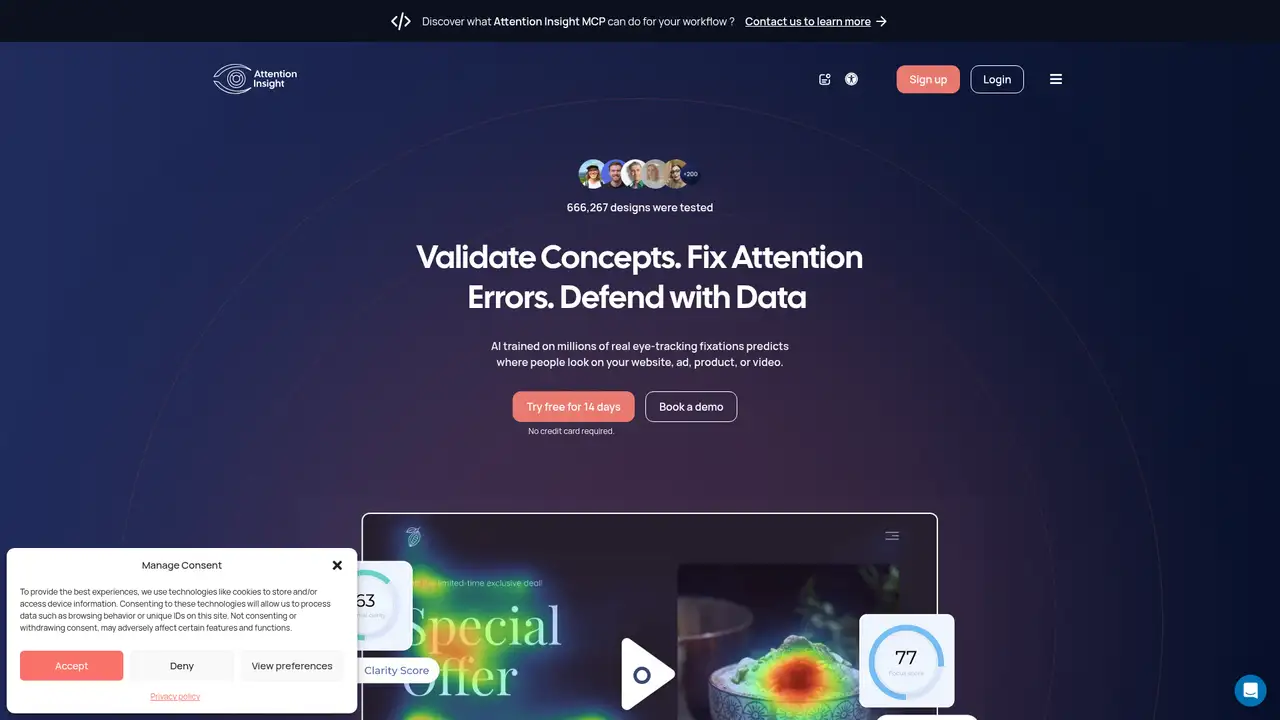
Attention Insight is a hosted predictive eye-tracking service operated by UAB Attention Insight in Vilnius, with the legal entity incorporated in 2019 and Kamilė Jokubaitė as director and CEO. It analyzes images, web pages, and video, producing heatmaps, focus maps, attention percentages, clarity scores, contrast maps, comparisons, and reports for designers, marketers, agencies, publishers, and product teams. Its models were trained on millions of eye-tracking fixations, and the company reports accuracy of up to 96 percent, though these outputs remain estimates rather than observed user behavior. Plans start at €29 monthly for 40 credits, while Pro costs €119 for 200 credits and API access. Credits apply to analyses and API use, so costs can rise with frequent testing. The service is useful for early visual decisions, but usability testing remains necessary for validating behavior, comprehension, and conversion.
A typical analysis starts with an image, website URL, or video upload and returns a heatmap of predicted attention plus a focus map showing what viewers may notice or miss during the first three to five seconds. Users can mark headlines, logos, or calls to action as areas of interest, then review attention percentage, focus and clarity scores, contrast, and other visual results. Side by side comparison helps teams assess alternative designs before release, while PDF and PowerPoint reports make findings easier to share with clients. Figma, Chrome, Photoshop, Adobe Express, and InDesign integrations place testing inside common workflows, and the API supports product integrations. Credit limits affect planning: one credit covers one image or URL analysis, with up to three sections, while video testing and API requests consume credits under plan-specific allowances.
Attention Insight says its models were trained on approximately 5.5 million eye-tracking fixations and more than 550 million gaze points. The technology page attributes the system to a deep-learning convolutional neural network and reports 92.5% accuracy on 300 general images in an MIT and Tuebingen saliency benchmark, with results reaching 96% across designs. These figures describe company-reported validation, not a guarantee for every design or audience. In practice, the platform can produce rapid attention estimates without recruiting participants, helping teams compare layouts before launch, but its predictions cannot show comprehension, task success, or user behavior. Additional tools include AI recommendations, video testing, WCAG 2.2 contrast maps, and visual-performance scores. The 2025 terms update is the most recent legal revision; the company names no foundation model and lists no dated 2026 product release.
Attention Insight’s plans differ mainly by credits, seats, video capacity, and integration access. Basic costs €29 monthly for one seat and 40 credits, but includes a watermark and no listed API access. Pro costs €119 for two seats and 200 credits, removes the watermark, and adds API access plus about three minutes of quick video testing. Hero costs €299 for two seats, 3,000 API transactions, and up to 30 minutes of video testing, with added onboarding and support. Enterprise has custom seats, video terms, integrations, and support, but no published price. The 14-day trial provides 10 or 15 credits. One credit covers an image, URL, AI recommendation, one second of video, or four API transactions. Annual billing appears to reduce listed prices by 20% before VAT, so usage levels should guide plan selection. Prices are published in euros rather than USD.
Predictive maps make Attention Insight useful for checking visual hierarchy before launch, but they estimate attention rather than observe behavior. The company presents the service as a supplement to traditional research, so teams should still test whether people understand and use a finished product. Credit-based plans can also make recurring analysis less predictable than a flat-fee design tool, especially when projects require multiple images, viewports, videos, or API calls. Attention Insight differs from Hotjar because it predicts attention instead of collecting mouse-tracking data from live visitors. It differs from Maze, which focuses on user research and prototype testing. EyeQuant is the closest named alternative for predictive attention analysis. Choose Attention Insight for fast pre-launch comparisons, measurable visual hierarchy checks, client reports, or API-based scoring, especially when live behavioral data is not yet available.
Who is Attention Insight best for?
- Designers checking visual hierarchy before publishing campaigns.
- Agencies preparing client-ready attention reports.
- Marketers comparing advertising and landing-page variants.
- Product teams embedding attention metrics through an API.
Attention Insight Pricing (2026)
Pricing model: Paid. All prices in USD.
| Plan | Price | What you get |
|---|---|---|
| Basic | €29/month | One user seat and 40 credits. One credit covers one image or URL analysis up to three viewports, or one AI recommendation. |
| Pro | €119/month | Two seats and 200 credits, plus no watermark, approximately three minutes of quick video testing, and API access. |
| Hero | €299/month | Two seats, 30 minutes of video fair use, and 3,000 API transactions. The plan includes SSO, onboarding, and support. |
| Enterprise | Custom | Custom seats, video allowance, integrations, SSO, dedicated account management, and support. |
Pros and Cons
Pros
- Heatmaps, focus maps, scores, reports, and recommendations share one workflow.
- Plugins connect analyses with Figma and Adobe tools.
- The API adds attention metrics to other products.
- Uploaded images are not used to train its deep-learning algorithms.
Cons
- Credit consumption complicates forecasting for frequent analysis.
- Predictive results cannot replace observed user research.
- The public pricing page shows monthly and discounted figures together.
Who should look elsewhere?
- Teams requiring observed behavior from real users.
- Researchers running moderated usability studies.
- Users seeking permanent free access with unlimited analysis.
Technical Details
Frequently Asked Questions
How much does Attention Insight cost?
The pricing page lists Basic at €29/month, Pro at €119/month, and Hero at €299/month. Enterprise uses custom seats and support. Basic includes 40 credits, Pro includes 200, and Hero includes 3,000 API transactions. Annual billing receives a 20% discount before VAT. The displayed €23 and €250 figures correspond to discounted pricing, according to the page layout.
Does Attention Insight have a free plan?
Attention Insight offers a 14-day trial rather than a permanent free plan. The terms say the trial includes 10 or 15 credits, and no payment information is required. After the trial, continued use requires a paid subscription. Credits apply to image and URL analysis, AI recommendations, video seconds, API transactions, and plugin usage.
How does Attention Insight compare with EyeQuant?
EyeQuant is the closest specialist alternative. Attention Insight offers predictive heatmaps, focus maps, clarity and focus scores, reports, video testing, plugins, and an API. Both are predictive attention tools. EyeQuant does not publish prices, so compare them on a trial with your own designs.
Does Attention Insight train on uploaded images?
The privacy policy says Attention Insight does not use uploaded images to train its deep-learning algorithms. For AI recommendations, it may send images and some metadata without client identification to OpenAI. The policy says OpenAI does not use data received through its API for training. Uploaded data may be accessed by authorized employees with explicit permission to investigate reported issues.
Can companies use Attention Insight commercially?
The service supports commercial design, marketing, agency, and product workflows, and paid plans include reports, sharing, video analysis, or API features depending on tier. The terms prohibit reselling, sublicensing, or commercializing the Services without permission. Companies should review the current terms and plan limits before using the service for client work or confidential material.
Best Attention Insight Alternatives in 2026
These tools do the same job as Attention Insight, with different pricing, limits and trade-offs.