
Maze Review, Pricing & Alternatives (2026)
Product research with testing, recruitment, interviews, and reports
Last updated: October 22, 2026
What is Maze?
Maze is a product research platform for product, design, and research teams. It combines prototype, website, mobile, survey, interview, card sorting, and tree testing workflows with participant recruitment and reporting. A Free plan costs $0/month. Paid pricing is custom or shown at checkout, depending on seats, studies, features, and panel usage.
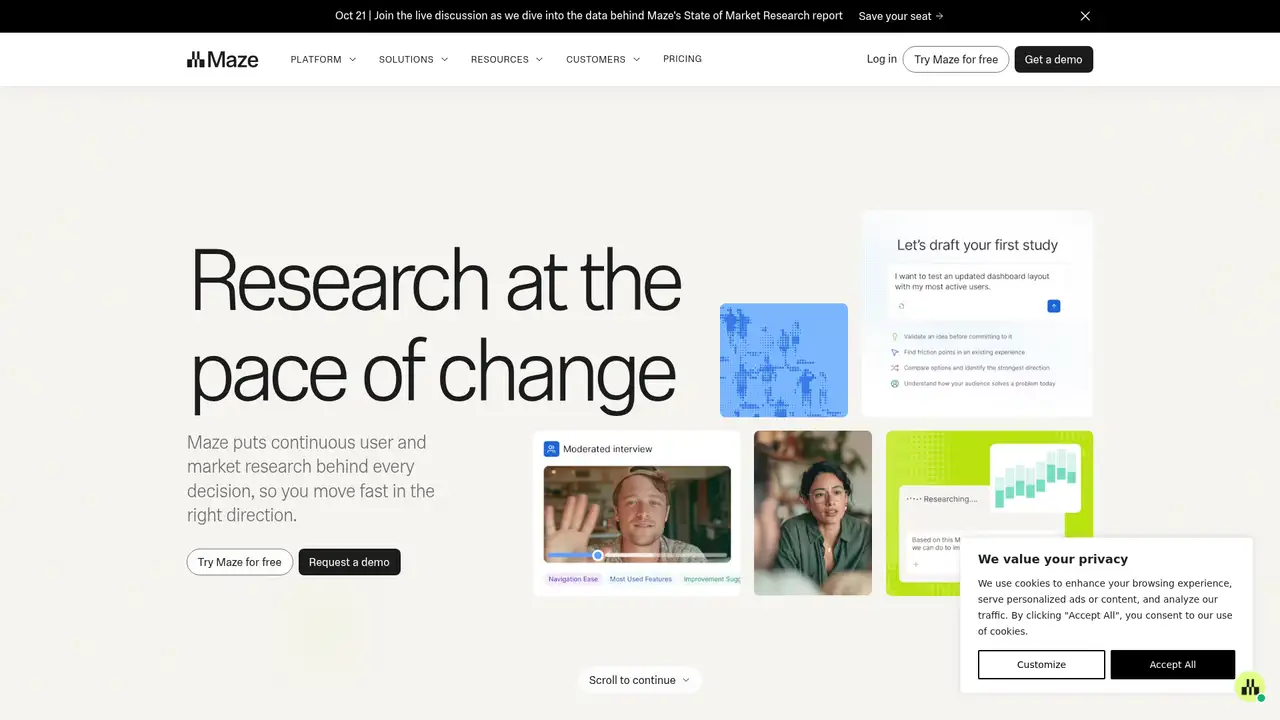
Maze is a product research platform for product, design, and research teams. Founded in 2018 by Jonathan Widawski and Thomas Mary, the London based company was formerly known as Maze.Design, Inc. Maze says more than 60,000 teams use the service, and its panel covers more than 5 million participants worldwide. Participants come from more than 130 countries and can be filtered across more than 400 demographic attributes. The platform supports prototype, website, mobile, survey, interview, card sorting, and tree testing workflows. Its audience includes designers, product managers, researchers, and product leaders who need evidence during product development. Maze is active, available on the web, and offers an API for teams that need connected workflows.
A typical Maze study begins with a research goal, a prototype, a website, an app, or a question set. The builder uses blocks for tasks, surveys, conditional logic, screening, card sorting, tree testing, five second tests, and ratings. Teams can import prototypes from Figma, Adobe XD, and Sketch, then share a link or recruit through Maze Panel. Interview Studies add scheduling, recordings, transcripts, observers, and highlight reels on eligible plans. Reports combine quantitative results with audio, video, text responses, clips, filters, exports, and shareable findings. Teams can also recruit their own customers through links, databases, or contextual prompts. This broad method coverage supports recurring mixed method research without requiring separate tools for every study type or reporting need.
Maze offers AI study creation, AI Moderator, AI conversation blocks, and Maze MCP, although it does not identify one underlying model for its AI features. In July 2026, the AI conversation block added adaptive follow up questions to unmoderated studies, connecting observed behavior with participant explanations. An August 2026 release opened MCP to Enterprise teams and added screener result blocks, element click reporting, usage dashboards, and up to eight AI Moderator learning goals. Maze’s 2025 releases included observer rooms, transcripts in more than 58 languages, governance controls, highlight reels, an AI Moderator beta, and a mobile testing app. Teams should review Maze’s privacy policy, data processing terms, security documentation, and AI terms before uploading sensitive research or enabling these features.
Maze has a Free plan costing $0/month, intended for individuals with limited features after the trial. New accounts receive premium access for 30 days or three studies, with no credit card required. Paid pricing is custom or shown at checkout, depending on seats, studies, features, and panel usage. Costs can vary by study allowances, advanced features, AI access, moderated research, governance, and panel credits. Enterprise access includes negotiated features and usage. Buyers should confirm monthly or annual billing, included studies, seats, credits, security controls, governance, AI access, participant permissions, data retention, and overage terms before purchase. Maze is less suitable for buyers needing published prices for every paid plan, a self hosted deployment, or one simple survey without research operations.
Maze suits teams running recurring prototype and usability studies, combining surveys, interviews, and behavioral testing, or recruiting participants through targeted panel filters. Lyssna is a simpler option for prototype and survey testing. UserTesting offers a large contributor network and recorded feedback, while Lookback focuses more closely on interviews and usability sessions. Maze combines testing, recruitment, analysis, reporting, moderated research, unmoderated research, and AI assistance in one workspace, but panel recruitment and advanced features can add usage costs. Choose Maze over Lyssna when mixed methods and recurring studies matter, or over UserTesting when one workspace matters more than recorded contributor feedback. Pick Maze if your team wants recruitment, AI assistance, and reporting together.
Who is Maze best for?
- Product teams running recurring prototype and usability studies.
- Researchers combining surveys, interviews, and behavioral testing.
- Organizations recruiting participants through targeted panel filters.
- Teams wanting AI assistance for study creation and analysis.
Maze Pricing (2026)
Pricing model: Freemium. All prices in USD.
| Plan | Price | What you get |
|---|---|---|
| Free | $0/month | Limited features for individuals after the trial. New accounts receive premium access for 30 days or three studies. |
| Paid access | Custom | Maze does not publish one universal price. Confirm monthly or annual billing, seats, studies, features, panel credits, and overage terms. |
| Enterprise | Custom | Enterprise access includes negotiated features and usage. Confirm annual billing, security controls, governance, AI access, and panel terms with Maze. |
Pros and Cons
Pros
- Maze combines testing, recruitment, analysis, and reporting.
- Its panel covers more than 5 million participants worldwide.
- AI supports study creation and adaptive follow up conversations.
- It supports moderated and unmoderated research methods.
Cons
- Maze does not publish one universal paid subscription price.
- Panel recruitment and advanced features can add usage costs.
- Some governance and interview capabilities require higher plans.
Who should look elsewhere?
- Teams requiring a self hosted research platform.
- Buyers needing published prices for every paid plan.
- People running one simple survey without research operations.
Technical Details
Frequently Asked Questions
How much does Maze cost?
Maze has a Free plan priced at $0/month. Paid pricing depends on seats, studies, features, AI access, moderated research, and panel credits, and Maze does not publish one universal paid price. New accounts receive premium access for 30 days or three studies without a credit card. Confirm monthly or annual billing and usage terms before purchase.
Does Maze have a free plan?
Yes. Maze offers a Free plan for individuals at $0/month. New accounts receive a premium trial for 30 days or three studies, without a credit card. After the trial, the account switches to Free with limited features. Collaborators, SSO, workspaces, some AI features, and other premium capabilities require a paid plan.
Is Maze better than UserTesting?
Maze suits teams combining prototype tests, surveys, information architecture studies, interviews, reporting, and recruitment in one workspace. UserTesting focuses on feedback from its contributor network through moderated and unmoderated tests. Maze may fit recurring mixed method research better, while UserTesting may fit teams prioritizing recorded contributor feedback and broad audience access.
Does Maze train AI on customer research data?
Maze publishes AI study creation, AI Moderator, AI conversation, and MCP features, but its product pages do not state a blanket policy that all customer research trains a general model. Teams should review Maze’s current privacy policy, data processing terms, security documentation, and AI terms before uploading sensitive research or enabling AI features.
Can companies use Maze commercially?
Yes. Maze sells its platform to product teams and organizations for professional research. Commercial use follows the applicable plan and terms, including limits on studies, collaborators, recruitment, features, and panel credits. Enterprise customers should confirm data processing, retention, participant permissions, AI terms, billing cadence, and any usage charges in their order documents.