
Argil Review, Pricing & Alternatives (2026)
Avatar-led video production with product scenes, B-roll, and an API
Last updated: October 26, 2026
What is Argil?
Argil is an AI video platform for creators, marketing teams, and developers making avatar-led explainers, product showcases, and generated scenes. Its public entry plan is Classic at $39 per month, with credits for video, voice, and editing features. Higher plans add more credits, avatar options, support, and API access.
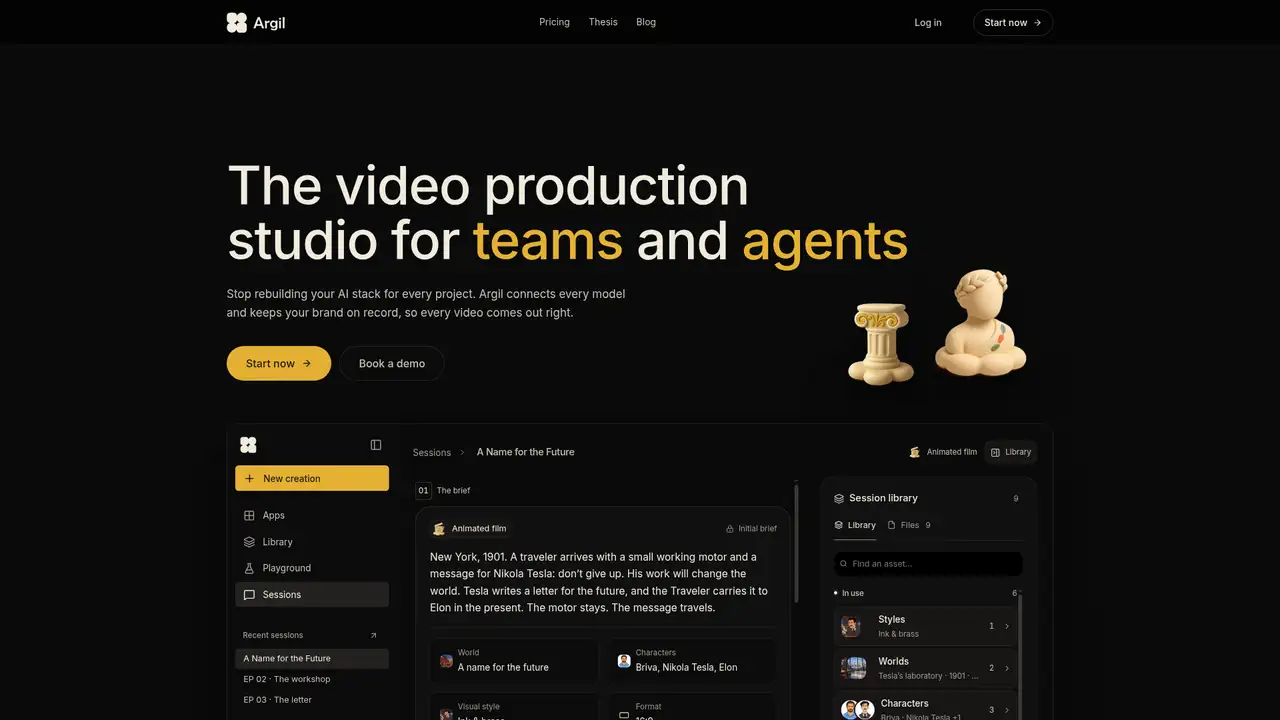
Argil makes AI avatar videos for creators, marketing teams, and developers. Laodis Menard and Brivael Le Pogam founded the company, and Seedcamp reports €4.9 million in disclosed pre-seed and seed funding from 2023 and 2024. Argil joined Y Combinator’s 2024 summer batch after a November 2023 pivot. Its product began with life-like avatar presentations and now includes product showcases, automatic captions, B-roll, backgrounds, style editing, Magic Editing, and the Fictions playground. Fictions can place a person or avatar into an arbitrary scene from one picture, using VEO3 and Hailuo. The result is a service aimed at teams that need presenter-led videos and more visually varied marketing material in the same workspace.
A typical Argil workflow starts with an avatar, a script, and presentation settings. Users can train an avatar or select one from Argil’s library, then add subtitles, gestures, zoom keyframes, B-roll, music, and backgrounds before rendering. Argil says avatar videos can be generated in about two minutes. Its API turns that sequence into an application workflow: list avatars and voices, create a video, request rendering, poll until the job reaches DONE, then download, share, or publish the result. The video endpoint supports ARGIL_V1 and ARGIL_ATOM, 16:9 and 9:16 output, subtitles, gestures, zoom keyframes, B-roll, and background music. API credentials are created in the app and passed as an x-api-key, which makes server-side secret storage important.
Argil combines its avatar systems with third-party generative video models. The API exposes ARGIL_V1 and ARGIL_ATOM, while Fictions names VEO3 and Hailuo. In February 2025, Argil announced a newer avatar model focused on preserving a person’s style and improving lip sync. It also announced an avatar builder and the ability to make an avatar hold or interact with a product. A company LinkedIn post reported more than 1,000 trained avatars and 5,000 new accounts in two days. Those announcements point to a product direction beyond scripted talking heads. Teams can start with a repeatable presenter workflow, then add generated scenes or product interactions when a conventional avatar frame is too limited.
Argil uses monthly credits rather than a single unlimited-video allowance. The Fictions page lists Classic at $39 per month billed monthly, with 1,600 credits, 10 avatar styles, more than 100 Argil avatars, Magic Editing, and Fictions. Argil’s subscription documentation lists Classic at 1,500 credits, while Pro and Scale have 6,000 and 18,000 credits. The product-showcase page identifies Pro at $149 per month, and the pricing page places $499 beside the 18,000-credit tier. Atom video costs 160 credits per minute, voice costs 20 credits per minute, AI-image B-roll costs 10 credits, and stock-video B-roll costs 20 credits. Pay-as-you-go credits do not expire, and API access begins with Classic and higher plans.
Pricing clarity is Argil’s clearest weakness because the Classic credit allowance differs between its current product page and documentation, while some displayed prices do not clearly show billing cadence. The privacy policy says Argil does not sell or rent face data and does not use face data to train general-purpose public foundation models for third parties. It also says usage data, including generations, models, workflows, and trainings, is collected to provide and improve the product. Synthesia is the closer enterprise avatar comparison, HeyGen offers another broad avatar-video workflow, and Tavus is stronger for personalized video and API-led outreach. Pick Argil when avatar production, product scenes, and generative video need to share one workflow.
Who is Argil best for?
- Marketing teams producing avatar-led product videos at scale.
- Creators combining presenters with captions, B-roll, and generated scenes.
- Developers building programmable avatar-video rendering workflows.
- Teams needing product interactions inside avatar-led videos.
Argil Pricing (2026)
Pricing model: Freemium. All prices in USD.
| Plan | Price | What you get |
|---|---|---|
| Classic | $39/month | The Fictions page lists 1,600 monthly credits, 10 avatar styles, 100+ Argil avatars, Magic Editing, and Fictions. Documentation lists 1,500 credits. |
| Pro | $149/month | The product-showcase page identifies 6,000 monthly credits, unlimited avatar styles, Seedance 2.0 videos, priority support, and API access. |
| Scale | $499/month | The displayed tier is associated with 18,000 monthly credits. Documentation adds three workspace seats and priority support. |
| Enterprise | Custom | Custom credit limits, custom avatar development, dedicated support, and custom integrations are available. |
Pros and Cons
Pros
- The API supports avatar listing, rendering, polling, and publishing workflows.
- Fictions adds generated scenes using VEO3 and Hailuo.
- Credit rates cover video, voice, B-roll, and avatar royalties.
- Product showcases let avatars hold or interact with products.
Cons
- Classic credit totals differ between the product page and documentation.
- Some displayed prices do not clearly identify billing cadence.
- The privacy policy is not a blanket no-training promise.
Who should look elsewhere?
- Teams requiring a single, unambiguous public pricing schedule.
- Buyers seeking a complete public commercial-output license.
- Users wanting a general-purpose video editor without avatar workflows.
Technical Details
Frequently Asked Questions
How much does Argil cost?
Argil’s Fictions pricing page lists Classic at $39 per month when billed monthly. It places $149 beside a 6,000-credit tier and $499 beside an 18,000-credit tier, but does not clearly label every billing cadence. Documentation lists Classic, Pro, Scale, and Enterprise. Buyers should verify the current checkout totals and annual terms before subscribing.
Does Argil have a free plan?
Argil’s public pricing materials describe paid subscription tiers rather than a clearly defined permanent free plan. Classic is the published entry tier and uses monthly credits. Pay-as-you-go credits do not expire, although the public documentation does not publish a definitive dollar price for that option. API access starts with Classic and higher plans.
How does Argil compare with Synthesia?
Synthesia is a closer fit for polished enterprise avatar presentations. Argil covers that use case while adding Fictions, product showcases, B-roll, backgrounds, and named generative video models including VEO3 and Hailuo. Argil also exposes programmable rendering through its API. Choose Argil when generated scenes and product-focused creative work matter alongside presenter videos.
Does Argil train on user data?
Argil says it does not sell or rent face data and does not use face data to train general-purpose public foundation models for third parties. Its privacy policy says usage data, including generations, models, workflows, and trainings, is collected to provide and improve the product. That language does not promise that no customer content informs any internal model.
Can Argil videos be used commercially?
Argil markets its videos for posting, publishing, and API-driven distribution, but it does not publish a standalone commercial-output license. Commercial users should confirm actor and likeness permissions, model-provider restrictions, and contractual rights before campaigns go live. This is especially important for trained people, customer talent, and recognizable brands.
Best Argil Alternatives in 2026
These tools do the same job as Argil, with different pricing, limits and trade-offs.
AI presenters, dubbing, and training videos for business teams
AI avatars, translation, and prompt-based video production

Real-time AI humans through a multimodal video API

AI avatar videos and interactive agents from text, images, and audio
Generative media tools for video, images, audio, and production workflows