
Arcads Review, Pricing & Alternatives (2026)
AI avatars and generative video tools for creators and marketing teams
Last updated: October 26, 2026
What is Arcads?
Argil is an AI video platform for creators, marketing teams and developers who need avatar videos, product showcases and scene-based generation. It combines trained avatars, synthetic voices, captions, B-roll, editing tools and an API for programmable rendering. Public plans start at $39/month billed monthly, with a 1,600-credit Classic tier.
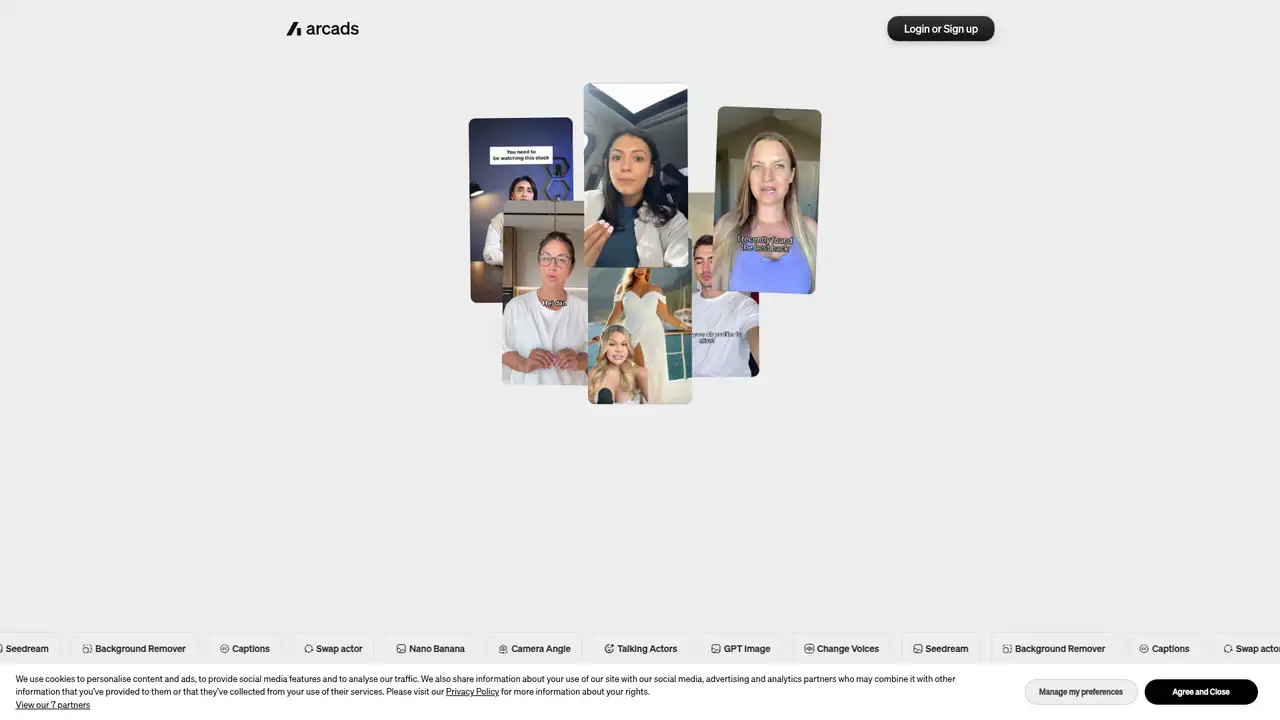
Argil is an AI video platform from Argil, Inc., founded by Laodis Menard and Brivael Le Pogam. Seedcamp reported a €4.9 million financing round in November 2024, following a €1 million pre-seed round in 2023, and Maddyness reported that the company joined Y Combinator’s 2024 summer batch after a November 2023 pivot. Argil targets creators, marketing teams and developers producing avatar-led videos, product showcases and synthetic-media scenes. Its current product pages cover AI avatars, UGC formats, automatic captions, B-roll, background generation, style editing, Magic Editing and the Fictions playground. The platform also supports programmable video rendering through an API, making it relevant to teams that need repeatable production rather than isolated exports.
Argil’s typical workflow starts with an avatar, voice and script, then moves through rendering and post-production. Users can create or select an avatar, provide a script by text or voice, choose a format such as 16:9 or 9:16, and add subtitles, gestures, zoom keyframes, B-roll or background music. Fictions can place a person or avatar into generated scenes from one picture, using models including VEO3 and Hailuo. The API follows a more structured process: list avatars and voices, create a video, request rendering, poll until the job reaches DONE, then download, share or publish the result. Magic Editing and style tools support further changes when a first render needs different framing, background treatment or supporting visuals.
Argil combines its own avatar and rendering workflows with named generative models rather than exposing one single model for every task. The API reference lists ARGIL_V1 and ARGIL_ATOM, with controls for aspect ratio, subtitles, gestures, zoom and supporting media. Argil’s February 2025 product announcement, reported by Maddyness, described a newer model focused on preserving a person’s style and improving lip sync. Current Fictions pages add VEO3, Hailuo and Seedance-based scene generation, showing a broader direction beyond the original talking-avatar workflow. Argil also supports avatar creation and training, while its credentials documentation warns that API keys can generate videos featuring the user’s avatar. The platform therefore combines identity-based video production with model-assisted backgrounds, motion and product presentation.
Argil’s public subscription schedule lists Classic, Pro, Scale and Enterprise. The current Fictions page shows Classic at $39/month billed monthly with 1,600 credits, 10 avatar styles, more than 100 Argil avatars, Magic Video Editing and the Fictions playground. The subscription documentation lists Classic at 1,500 credits, creating a published allowance discrepancy that users should check at checkout. Pro provides 6,000 credits, Scale provides 18,000, and Enterprise uses custom limits and support. Classic and higher plans can access the API. Pay-as-you-go credits do not expire, and documented API rates include 160 credits per minute for Atom video, 20 per minute for voice, 10 for AI-image B-roll, 20 for stock-video B-roll and 20 per V1 avatar royalty.
Argil’s main constraint is that avatar production and generative scenes still require credit planning, especially when teams combine rendering, voice, B-roll and repeated revisions. Its public pages also present inconsistent Classic credit totals, while complete annual and pay-as-you-go dollar prices are not published in the cited documentation. Argil’s privacy policy says face data is not sold or rented and is not used to train general-purpose public foundation models for third parties, but it does not create a blanket exclusion for every internal model or provider. Synthesia and HeyGen are stronger comparisons for enterprise presenter videos, while Tavus is closer for personalized avatar APIs and D-ID for API-led avatar generation. Pick Argil for avatar production with generative scenes and programmable rendering.
Who is Arcads best for?
- Marketing teams producing avatar-led product videos.
- Creators combining talking avatars with generated scenes.
- Developers building repeatable video-rendering workflows.
- Brands needing captions, B-roll and multilingual production.
Arcads Pricing (2026)
Pricing model: Freemium. All prices in USD.
| Plan | Price | What you get |
|---|---|---|
| Classic | $39/month | The current Fictions page lists 1,600 credits monthly, 10 avatar styles, 100+ Argil avatars, Magic Video Editing and Fictions. Subscription documentation lists 1,500 credits. |
| Pro | Not published | 6,000 credits monthly. Includes Classic features, API access, immediate full credit top-up on upgrade and additional workspace capabilities. |
| Scale | Not published | 18,000 credits monthly. Includes three workspace seats, Classic and Pro features, API access and priority support. |
| Enterprise | Custom | Custom credit limits, custom avatar development, dedicated support and custom integrations. |
| Pay-as-you-go | Not published | Credits do not expire. Documented rates include 160 credits per Atom video minute, 20 per voice minute, 10 per AI-image B-roll and 20 per stock-video B-roll. |
Pros and Cons
Pros
- The API supports avatar, voice and rendered-video workflows.
- Fictions places avatars into generated scenes from one image.
- Documented controls include subtitles, gestures and zoom keyframes.
- Pay-as-you-go credits do not expire.
Cons
- Published Classic credit allowances are inconsistent.
- Several higher-tier prices are not publicly listed.
- Provider policies can affect data handling and output rights.
Who should look elsewhere?
- Teams requiring fully published annual and usage prices.
- Projects needing a broad exclusive-output guarantee.
- Users seeking only conventional text-to-video generation.
Technical Details
Frequently Asked Questions
How much does Argil cost?
Argil’s current Fictions page lists Classic at $39 per month when billed monthly, with 1,600 credits. Pro and Scale list 6,000 and 18,000 monthly credits, but their current dollar prices are not published in the cited documentation. Enterprise pricing is custom. Argil also offers pay-as-you-go credits, whose documented dollar rate is not published.
Does Argil offer a free plan?
The cited Argil pricing pages describe paid Classic, Pro, Scale and Enterprise plans rather than a permanent free plan. Classic is the published entry subscription. Argil also documents pay-as-you-go credits that do not expire, which gives occasional users an alternative to a recurring subscription, although the public documentation does not state the corresponding dollar price.
How does Argil compare with HeyGen?
HeyGen is a close alternative for presenter-style avatar videos, while Argil adds a documented API workflow, Fictions scene generation, product showcases, B-roll controls and programmable rendering. Argil is a stronger fit when a team needs avatar videos mixed with generated environments or automated production steps. HeyGen may be preferable for teams focused mainly on polished presenter videos.
Does Argil train on customer data?
Argil says it does not sell or rent face data and does not use face data to train general-purpose public foundation models for third parties. Its privacy policy also describes product usage data, including generations, models, workflows and trainings, as collected to provide and improve the service. That wording is narrower than a blanket promise excluding all training.
Can Argil videos be used commercially?
Argil markets the service for creator and marketing video production, including product showcases and publishing through the API. Argil does not publish a standalone commercial-output license covering every avatar, likeness and model-provider scenario. Teams should review Argil’s contract, avatar permissions and third-party model terms before using generated videos in paid campaigns.
Best Arcads Alternatives in 2026
These tools do the same job as Arcads, with different pricing, limits and trade-offs.
AI presenters, dubbing, and training videos for business teams
AI avatars, translation, and prompt-based video production

Real-time AI humans through a multimodal video API

AI avatar videos and interactive agents from text, images, and audio
Generative media tools for video, images, audio, and production workflows

Short-form AI video with credit plans and frame controls