
Amp Review, Pricing & Alternatives (2026)
Remote coding agents with provider choice and self-hosted runners
Last updated: October 22, 2026
What is Amp?
Amp is a terminal and web coding agent for developers and teams that need persistent remote work. Its free Hobby tier supports BYOK, linked ChatGPT or Claude subscriptions, and unlimited self-hosted Orbs. Individual costs $20/month and includes 45,000 minutes of Amp-hosted Orb time, while model inference and hosted compute can add usage charges.
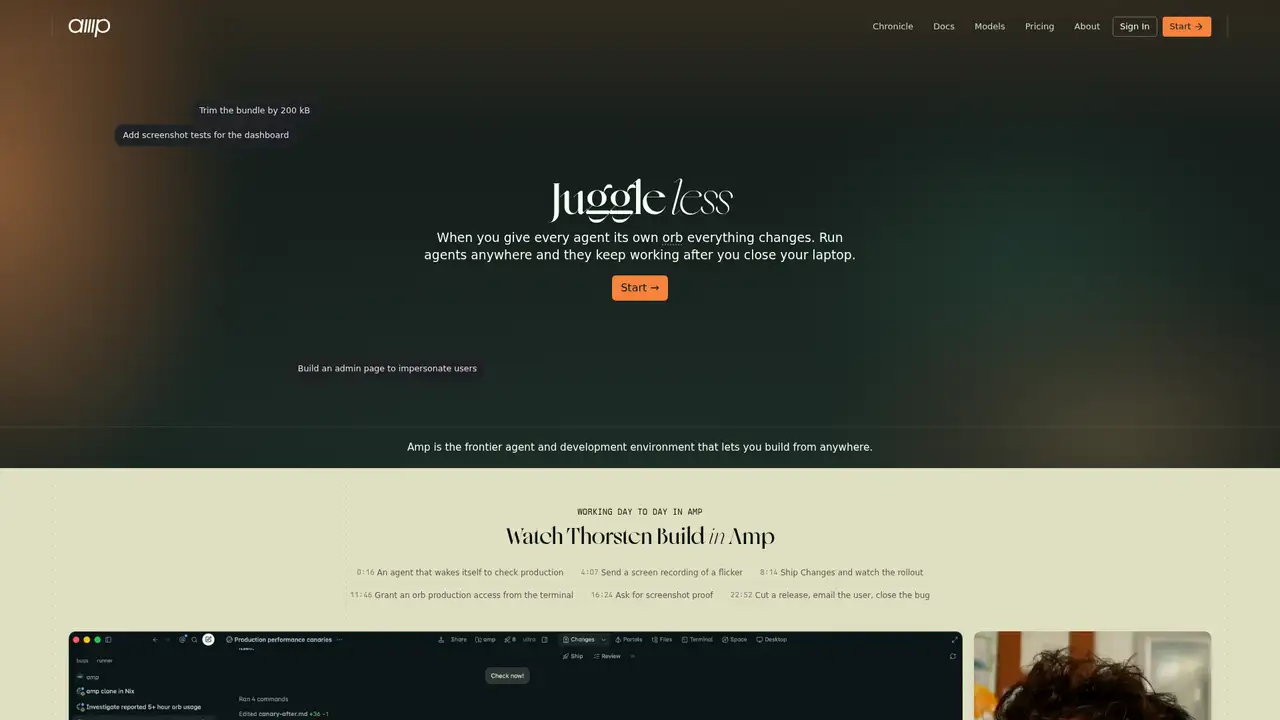
Amp is a terminal and web coding agent made by Amp Frontier Corporation, which became independent from Sourcegraph in December 2025. Its main unit is the Orb, a remote computer where an agent receives a repository, tools, and a task. Users can resume threads from the web, terminal, or phone, and agents can continue after the client closes. Amp also supports runners on a user’s own computers. The company publishes product and pricing information, but it does not publish a standalone user count or funding total on the cited pages. The product is aimed at developers who want persistent agent work, remote execution, and access to several model providers rather than a single model subscription.
A typical Amp workflow starts with a repository and a thread. The agent can inspect files, use tools, edit code, run tests, and work through configured GitHub integrations. Each thread can use an Orb, which separates agent work from the developer’s local machine and can keep running when the client is closed. Amp supports shared threads, multiplayer work, permissions, portals, plugins, skills, analytics, pooled credits, and model routing for teams. The terminal client provides configuration and usage commands, while the web interface provides thread history and remote control. Orb size affects usage speed. Amp also supports self-hosted Orbs and user-owned runners, giving teams a way to keep compute outside Amp’s hosted infrastructure.
Amp supplies the agent, tools, thread interface, and Orb execution layer, while inference can come from Amp or a configured provider. Its routing documentation lists Anthropic, OpenAI, Google, Meta, xAI, Bedrock, Vertex, Azure AI Foundry, OpenRouter, and other compatible endpoints. Users can select models and modes through the Dial or configure routing rules. The company’s September 2026 Free Agent update made BYOK and linked subscriptions available without Amp token fees or limits, apart from Enterprise terms. The pricing documentation mentions GPT-6 and GPT-5.6 subscription access, although model availability depends on the connection. This split matters: remote execution, model inference, and provider retention are separate parts of the workflow.
Hobby costs $0 per month and includes all product features, pay-as-you-go Amp-hosted Orbs, unlimited free self-hosted Orbs, linked subscriptions, and BYOK without Amp token fees or limits. Individual costs $20 per month and includes 45,000 minutes of Amp-hosted Orb time, plus unlimited self-hosted Orbs and the same provider options. Teams has no extra workspace charge, supports members on different tiers, and adds shared threads, permissions, billing, pooled credits, analytics, and shared routing. Enterprise is custom and adds SCIM, spend controls, audit and network controls, regional endpoints, higher quotas, and priority support. Model usage can consume paid credits, while Orb minutes are billed separately. Purchased credits expire after twelve months.
Amp’s strongest distinction is persistent remote work, but its billing is more involved than a single editor subscription because model credits and Orb minutes are separate. Users sending code through external providers must also consider those providers’ retention and training settings. Amp says it does not train on User Content without opt-in, and its terms prohibit sensitive regulated data. Claude Code is a closer terminal comparison, Codex CLI is more focused on a local OpenAI workflow, and Cursor centers on an editor. Choose Amp for remote parallel agents, shared threads, self-managed runners, and provider flexibility; choose the alternatives when local execution or an editor-first workflow matters more. Who should pick it: developers and teams needing persistent remote agents.
Who is Amp best for?
- Developers who want agents running after they close a terminal.
- Teams sharing threads, portals, plugins, and model routing.
- Users who need hosted or self-hosted remote environments.
- Engineers who already pay for ChatGPT or Claude subscriptions.
Amp Pricing (2026)
Pricing model: Freemium. All prices in USD.
| Plan | Price | What you get |
|---|---|---|
| Hobby | $0/month | All product features, pay-as-you-go Amp-hosted Orbs, unlimited self-hosted Orbs, and BYOK or linked subscriptions without Amp token fees or limits. |
| Individual | $20/month | Includes 45,000 minutes of Amp-hosted Orb time, unlimited self-hosted Orbs, and BYOK or linked subscriptions without Amp token fees or limits. |
| Teams | $0/month | No extra-charge team workspace; members can use Hobby, Megawatt, or Gigawatt tiers with shared threads, billing, permissions, and pooled credits. |
| Enterprise | Custom | Adds SCIM, spend controls, audit and network controls, custom self-hosted Orbs, higher quotas, regional endpoints, and priority support. |
Pros and Cons
Pros
- Remote Orbs continue agent work after the client closes.
- BYOK and linked subscriptions reduce provider lock-in.
- Self-hosted Orbs have no Amp fee.
- Teams can share threads, billing, and routing.
Cons
- Hosted Orb minutes and model credits use separate budgets.
- Provider retention rules still apply to linked connections.
- Amp terms prohibit sensitive regulated data.
Who should look elsewhere?
- Users unwilling to send code context to remote services.
- Teams needing one fixed price for all model usage.
- Projects that must process regulated sensitive data in Amp.
Technical Details
Frequently Asked Questions
How much does Amp cost?
Amp Hobby is free, with pay-as-you-go charges for Amp-hosted Orbs. Individual costs $20 per month and includes 45,000 minutes of hosted Orb time. Teams has no extra workspace charge, while Enterprise pricing is custom. Model usage can use Amp credits, provider API keys, or linked subscriptions, and hosted Orb minutes are billed separately.
Does Amp have a free plan?
Yes. Hobby costs $0 per month and includes all product features, unlimited self-hosted Orbs, linked ChatGPT or Claude subscriptions, and BYOK without Amp token fees or limits. Amp-hosted Orbs remain pay as you go. Teams also has no extra workspace charge, although model usage, hosted compute, and optional paid tiers can create costs.
How does Amp compare with Claude Code?
Amp emphasizes persistent remote Orbs, shared threads, self-hosted runners, and routing across providers. Claude Code is a terminal coding agent centered on Anthropic’s Claude models and local development workflows. Amp is a better fit for remote continuation and team sharing, while Claude Code is a more direct choice for developers who want a focused terminal client around Claude.
Does Amp train on user code?
Amp says it does not use User Content to train AI models unless a user opts in. Its Free Agent update also says zero and minimal data retention applies to Amp users and workspaces. Provider connections remain separate: linked subscriptions, API keys, and gateways can have their own retention and training settings, which users must review.
Can Amp be used commercially?
Amp can be used by commercial teams through its Teams and Enterprise offerings, subject to its terms, provider conditions, and any Enterprise order form. Amp says users retain ownership of User Content and adopted Outputs. Teams should review repository permissions, model-provider licenses, privacy obligations, and the prohibition on storing sensitive regulated data before production use.
Best Amp Alternatives in 2026
These tools do the same job as Amp, with different pricing, limits and trade-offs.
An agentic coding assistant for terminal, IDE, desktop, and web

Terminal coding agent with sandbox controls and OpenAI model access
AI coding workspace with repository context and software agents

Open coding agent for editors, terminals, desktops, and custom apps
AI coding assistance across editors, terminals, and GitHub