
Amazon Polly Review, Pricing & Alternatives (2026)
AWS's pay-per-character text-to-speech API with standard, neural and generative voices
Last updated: October 19, 2026
What is Amazon Polly?
Amazon Polly is the text-to-speech service inside AWS, turning text or SSML into speech through an API billed per character. It suits developers already on AWS who need predictable, cheap speech at scale. Standard voices cost $4 per million characters, and new accounts get a monthly free tier plus up to $200 in AWS credits.
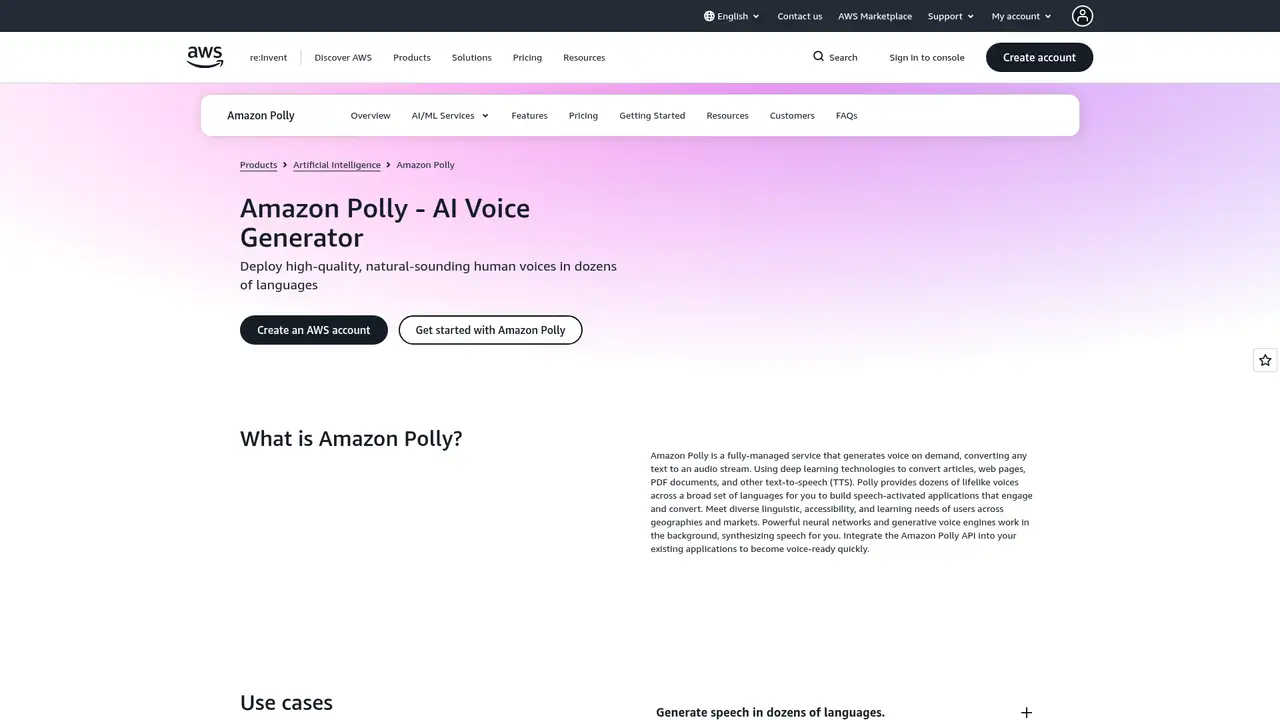
Amazon Polly launched at AWS re:Invent in November 2016 and is one of the oldest cloud text-to-speech services still in active development. It sits alongside Amazon Transcribe and Amazon Lex in the AWS AI services group, and it powers voices in Alexa features, Amazon Connect contact centers and thousands of third-party apps. Polly has no studio or editor of its own. You call it from the AWS console, the command line, an SDK or another AWS service such as Lambda, and it returns an MP3, OGG or PCM audio stream. Because it is part of AWS, it inherits the platform's compliance coverage, regional data residency, IAM permissions and consolidated billing. That makes it a default choice for teams whose infrastructure already runs on AWS and who want speech without adding another vendor.
A request sends plain text or SSML, a voice ID, an engine and an output format. SSML tags control pauses, emphasis, pronunciation, speaking rate and pitch, and Polly adds its own tags for breathing sounds and a newscaster speaking style on some neural voices. Lexicons let you define how brand names or acronyms should be pronounced across every request. Speech Marks return timing metadata for each word, sentence or viseme, which apps use to highlight text in sync with audio or drive an avatar's lip movements. For long content, asynchronous synthesis tasks write the output to an S3 bucket instead of streaming it. Audio can be cached and replayed at no extra charge, which keeps costs down for apps that repeat the same prompts.
Polly offers four engines. Standard voices use concatenative synthesis and sound dated but cost the least. Neural voices, added in 2019, use a neural network for more natural prosody and are the common default. Long-form voices, launched in 2023, are tuned for articles and audiobooks where listeners notice monotony over minutes. Generative voices, introduced in 2024, run on a large speech model AWS describes as the most expressive and conversational, and they suit chatbots and voice assistants. Across engines Polly covers roughly 40 languages and variants and more than 100 voices, though generative and long-form voices exist only for a subset of languages. Brand Voice, a custom neural voice built with the AWS team, is available by engagement for companies that want a unique narrator.
Billing is per character processed, with no subscription. Standard voices cost $4 per million characters, neural $16, generative $30 and long-form $100, according to the pricing page; GovCloud rates are about 20% higher. AWS's example: a typical 6,500-character news article costs about three cents with neural voices and 65 cents with long-form. The always-free allowance gives 5 million standard characters a month. Neural, long-form and generative voices get 1 million, 500,000 and 100,000 free characters a month for the first 12 months. Since July 2025 new AWS accounts also receive up to $200 in Free Tier credits that apply to Polly. Costs climb mainly with the long-form engine, which is six times the neural rate, and with Speech Marks, which are billed as additional characters.
Polly's weakness is voice quality at the top end. Its generative voices are good, but independent rankings such as the Artificial Analysis TTS leaderboard place ElevenLabs, Cartesia and newer models ahead on naturalness, and Polly has no instant voice cloning. Google Cloud Text-to-Speech offers more languages and Chirp 3 HD voices at similar prices, while Azure AI Speech has the largest neural voice catalogue and a custom neural voice program. For a developer already on AWS, Polly's strengths are the 5 million free standard characters, IAM-based security, S3 output and predictable per-character billing with no seats or plans. Choose Polly for IVR prompts, accessibility features, notifications and high-volume narration inside AWS. Choose ElevenLabs or Cartesia when the voice itself is the product.
Who is Amazon Polly best for?
- Developers already on AWS who want speech without signing up for another vendor.
- IVR menus and Amazon Connect contact centers that need cheap, reliable prompts.
- Reading apps that need word-level timing to highlight text as it is spoken.
- High-volume notification or accessibility audio where cost per character matters most.
Amazon Polly Pricing (2026)
Pricing model: Usage-based. All prices in USD.
| Plan | Price | What you get |
|---|---|---|
| Free tier | $0 | 5M standard characters a month. First 12 months also include 1M neural, 500K long-form and 100K generative characters a month. |
| Standard voices | $4 per 1M characters | Concatenative voices, lowest cost. Speech Marks billed at the same rate. |
| Neural voices | $16 per 1M characters | Natural-sounding neural voices; the common default for apps and IVR. |
| Generative voices | $30 per 1M characters | Most expressive, conversational voices for assistants and chatbots. Available in fewer languages. |
| Long-form voices | $100 per 1M characters | Voices tuned for articles and audiobooks. Limited language coverage. |
Pros and Cons
Pros
- 5 million free standard characters every month, with no expiry.
- Pay-per-character billing with no seats, plans or minimums.
- Speech Marks give word and viseme timing for highlighting and lip sync.
- Inherits AWS IAM, regional data residency and compliance certifications.
Cons
- No voice cloning and no self-serve custom voices.
- Generative and long-form voices cover only a subset of languages.
- Content may be used for service improvement unless your organisation opts out.
Who should look elsewhere?
- Creators who want a visual editor or voiceover studio.
- Projects that need instant voice cloning from a short recording.
- Teams chasing the most human-sounding voices on current leaderboards.
Technical Details
Frequently Asked Questions
How much does Amazon Polly cost?
Amazon Polly charges per character processed. Standard voices cost $4 per million characters, neural voices $16, generative voices $30 and long-form voices $100. There is no monthly fee. A typical 6,500-character news article costs about three cents with neural voices. Speech Marks requests are billed at the same per-character rate as speech.
Is Amazon Polly free?
Partly. Every AWS account gets 5 million standard-voice characters a month free with no time limit. For the first 12 months you also get 1 million neural, 500,000 long-form and 100,000 generative characters a month. New accounts created after July 15, 2025 receive up to $200 in AWS Free Tier credits that can be spent on Polly.
Amazon Polly vs Google Cloud Text-to-Speech: which is better?
Both are pay-per-character APIs from major clouds. Google offers more languages and its Chirp 3 HD voices sound more natural in many tests, while Polly has a larger permanent free tier for standard voices and tight integration with AWS services such as Lambda, S3 and Amazon Connect. Pick the one that matches the cloud your application already runs on.
Does Amazon use my Polly text to train its models?
It can, unless you opt out. Amazon Polly is on the list of AWS AI services that may store and use customer content for service improvement, including model training, and that content may be stored outside the region you call. Organisations can opt out for Polly or for every AI service with an AWS Organizations AI services opt-out policy, which also deletes previously stored copies.
Can I use Amazon Polly audio commercially?
Yes. AWS lets you use Polly-generated speech in commercial products, including apps, videos, e-learning and phone systems, and you can cache and replay the audio without paying again. Restrictions in the AWS Service Terms cover redistributing the voices as a standalone speech service. Check those terms if you plan to resell synthesized speech to other developers.
Sources
Best Amazon Polly Alternatives in 2026
These tools do the same job as Amazon Polly, with different pricing, limits and trade-offs.