Agno Review, Pricing & Alternatives (2026)
Open source Python tools for building and operating agent platforms
Last updated: October 26, 2026
What is Agno?
Agno is a Python SDK and self-hostable AgentOS runtime for teams building agents, teams, and workflows. It suits developers who want control over models, data, databases, and deployment. The Free plan costs $0 per month, while Pro costs $150 per month for one live connection, three seats, basic RBAC, and email support.
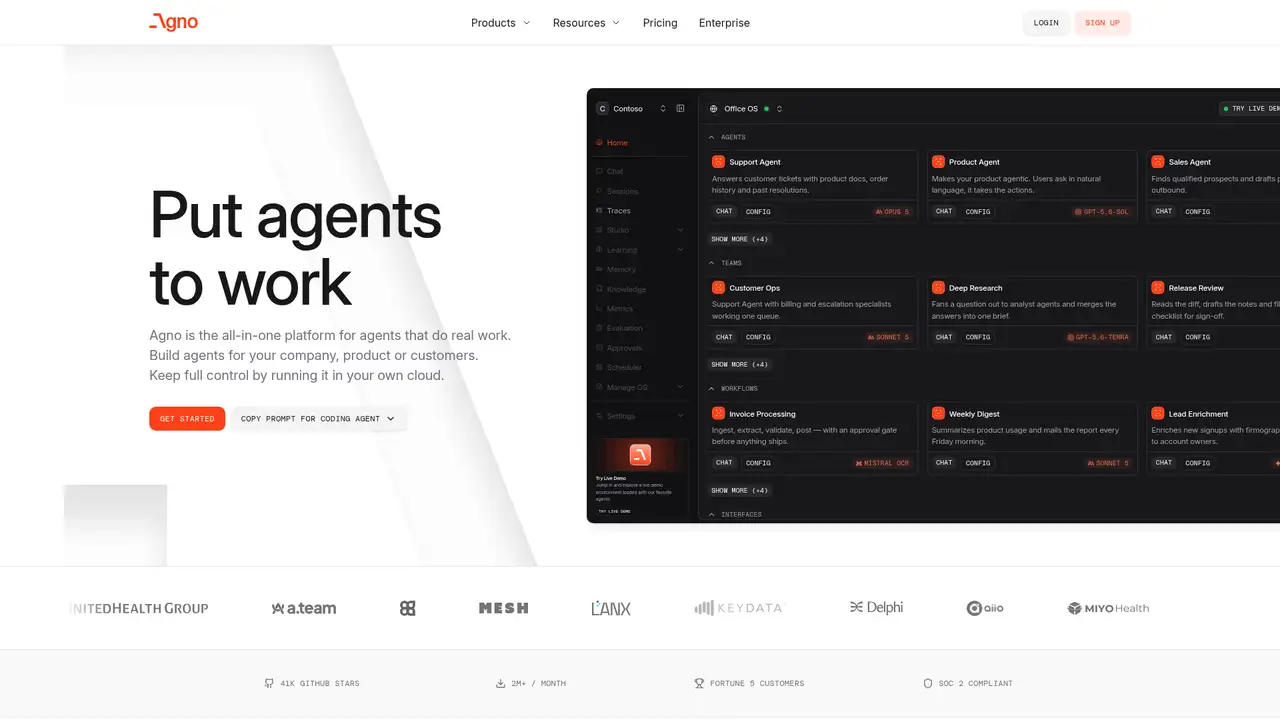
Agno is an open source Python SDK and self-hostable runtime for building agent platforms. The project was formerly known as Phidata before adopting the Agno name in January 2025. Its main primitives are agents, teams, and workflows. Agents combine models, instructions, and tools, teams coordinate multiple agents, and workflows define sequential, parallel, conditional, looping, or nested steps. The SDK supports more than 30 model providers and more than 100 integrations, along with multimodal input and output, structured Pydantic based I/O, memory, knowledge, sessions, learning, guardrails, and state. Developers choose their model vendors, databases, and deployment environment instead of buying bundled inference. PitchBook lists Agno as founded in 2023, private, with nine employees and $5.4 million in funding.
A typical Agno project starts with an agent configured with a model, instructions, and tools. Teams coordinate agents when a task needs several roles, while workflows organize application logic into code-defined pipelines. AgentOS supplies the runtime layer and is built with FastAPI. It exposes REST, streaming, WebSocket, MCP, A2A, AG-UI, Slack, Telegram, and WhatsApp interfaces. The runtime also provides sessions, memory and knowledge storage, background execution, checkpointing, cancellation, approvals, schedules, tracing, evaluations, and JWT authorization. Studio adds a visual editor for composing, testing, versioning, and publishing agents, teams, and workflows. The Control Plane manages AgentOS instances. Agno keeps that management layer separate from the runtime, allowing the runtime to remain in customer infrastructure.
Agno separates its open source runtime from its hosted management service. The SDK and AgentOS have no Agno charges for events, tokens, compute, storage, retention, or egress. Developers connect supported model providers and expose agents through REST, MCP, or chat interfaces. The project changed its name from Phidata to Agno in January 2025, with namespaces moving from phi to agno and the command line interface changing from phi to ag. Documentation lists AgentOS capabilities such as checkpointing, human approval, scheduling, JWT authorization, and integrations with Claude Code, Codex, and Cursor. This structure gives developers a Python implementation layer for building agents and a separate operational layer for deployed systems, while leaving model and infrastructure costs with customers.
Agno's Free plan costs $0 per month and includes unlimited usage and retention, local AgentOS connections, the local Control Plane, Studio, sessions, traces, memory, knowledge, learnings, metrics, evaluations, approvals, scheduling, templates, and community support. Pro costs $150 per month and adds one live AgentOS connection, three team seats, basic role-based access control, and email support. Extra seats cost $30 per month each, and extra live connections cost $95 per month each. SAML SSO is a $300 per month add-on on Pro, while Enterprise pricing is custom. Enterprise adds end-user management, audit logs, identity and roles, custom resource-scoped RBAC, support commitments, security reviews, compliance support, and optional self-hosted Control Plane services.
Agno leaves deployment choices and several security responsibilities with the customer. Users select model providers, databases, infrastructure, authentication settings, and application controls. AgentOS can validate JWTs, enforce endpoint scopes, use service-account tokens, assign roles, and enable per-user data isolation. Isolation is off by default, so custom handlers need explicit scope helpers. Agno's Trust Center reports encryption in transit and at rest, access controls, MFA for critical services, scanning, backups, and disaster-recovery practices. LangGraph focuses on graph-based orchestration, while CrewAI emphasizes teams of agents, and AutoGen centers on multi-agent conversation patterns. Pick Agno if you want a Python-first open-source runtime with optional hosted management and control over deployment. This approach suits teams willing to configure infrastructure and application security themselves.
Who is Agno best for?
- Python teams choosing their own models, databases, and infrastructure.
- Organizations building agents, teams, and workflows on an open source runtime.
- Developers exposing agents through REST, MCP, and chat interfaces.
- Teams needing hosted monitoring for live AgentOS deployments.
Agno Pricing (2026)
Pricing model: Freemium. All prices in USD.
| Plan | Price | What you get |
|---|---|---|
| Free | $0/month | Unlimited usage and retention, local AgentOS connections, and community support. The Control Plane is local only. |
| Pro | $150/month | Includes one live AgentOS connection and three team seats. Extra seats cost $30/month and extra live connections cost $95/month. |
| Enterprise | Custom | Adds end-user governance, custom RBAC, audit logs, support commitments, compliance support, and optional self-hosted Control Plane services. |
Pros and Cons
Pros
- The open source runtime has no Agno event, token, compute, storage, or egress fees.
- Python primitives cover agents, teams, workflows, memory, knowledge, and state.
- Pro includes one live connection, three seats, and basic RBAC.
- AgentOS supports REST, MCP, streaming, WebSocket, and chat interfaces.
Cons
- Model provider and infrastructure bills remain separate from Agno pricing.
- Free Control Plane connections are local rather than live deployments.
- Per-user isolation is off by default and requires deliberate configuration.
Who should look elsewhere?
- Teams wanting bundled model inference and fully managed deployment.
- Buyers requiring public Enterprise pricing before procurement.
- Developers unwilling to manage databases, infrastructure, authentication, and model accounts.
Technical Details
Frequently Asked Questions
How much does Agno cost?
Agno has a Free plan priced at $0 per month and a Pro plan priced at $150 per month. Pro includes one live AgentOS connection, three team seats, basic role-based access control, and email support. Additional seats cost $30 per month each, additional live connections cost $95 per month each, and SAML SSO costs $300 per month. Enterprise pricing is custom.
Does Agno have a free plan?
Yes. The Free plan includes the open source SDK and AgentOS runtime, unlimited usage and retention, local AgentOS connections, the Control Plane, Studio, sessions, traces, memory, knowledge, evaluations, approvals, scheduling, templates, and community support. The Control Plane is local only on Free, while Pro connects it to one live AgentOS deployment.
How does Agno compare with LangGraph?
Agno provides Python primitives for agents, teams, workflows, memory, knowledge, and AgentOS deployment, with a separate Control Plane for operations. LangGraph focuses on graph-based agent orchestration. Agno's Free plan includes local management, while Pro adds live connections, seats, and RBAC. The choice depends on the desired orchestration model and operating workflow.
Does Agno train on user data?
Agno's pricing page says customer data stays in the customer's cloud and that Agno does not hold a copy. AgentOS can run in customer infrastructure, with data stored in the customer's database. The Trust Center reports encryption, access controls, MFA for critical services, scanning, backups, and disaster recovery practices. Model provider data handling remains subject to each provider's terms.
Can Agno agents be used commercially?
Agno's SDK and AgentOS are open source and can serve agents through REST, MCP, Slack, and other interfaces. The pricing page says serving agents costs nothing on any plan. Commercial deployments still involve the customer's model provider, infrastructure, security setup, and applicable licenses. Enterprise adds end-user management, audit logs, identity, custom RBAC, and compliance support.
Best Agno Alternatives in 2026
These tools do the same job as Agno, with different pricing, limits and trade-offs.

Build and run collaborative AI agents with Python-native control
Open-source framework for building model-powered agents

Open-source context engineering for RAG, agents, and workflows
Open-source SDK for.NET and Python agents, successor to Semantic Kernel and AutoGen