
Zebracat Review, Pricing & Alternatives (2026)
AI video creation with avatars, voice tools, translation and generative models
Last updated: October 26, 2026
What is Zebracat?
Zebracat is an AI video platform for marketers and creators who make narrated, avatar-led, translated and generative videos. Paid plans start at $39/month, or $23/month billed yearly, while the free tier supports limited personal or testing use. Its API adds automated video workflows, translation, voice cloning, asset handling and webhooks.
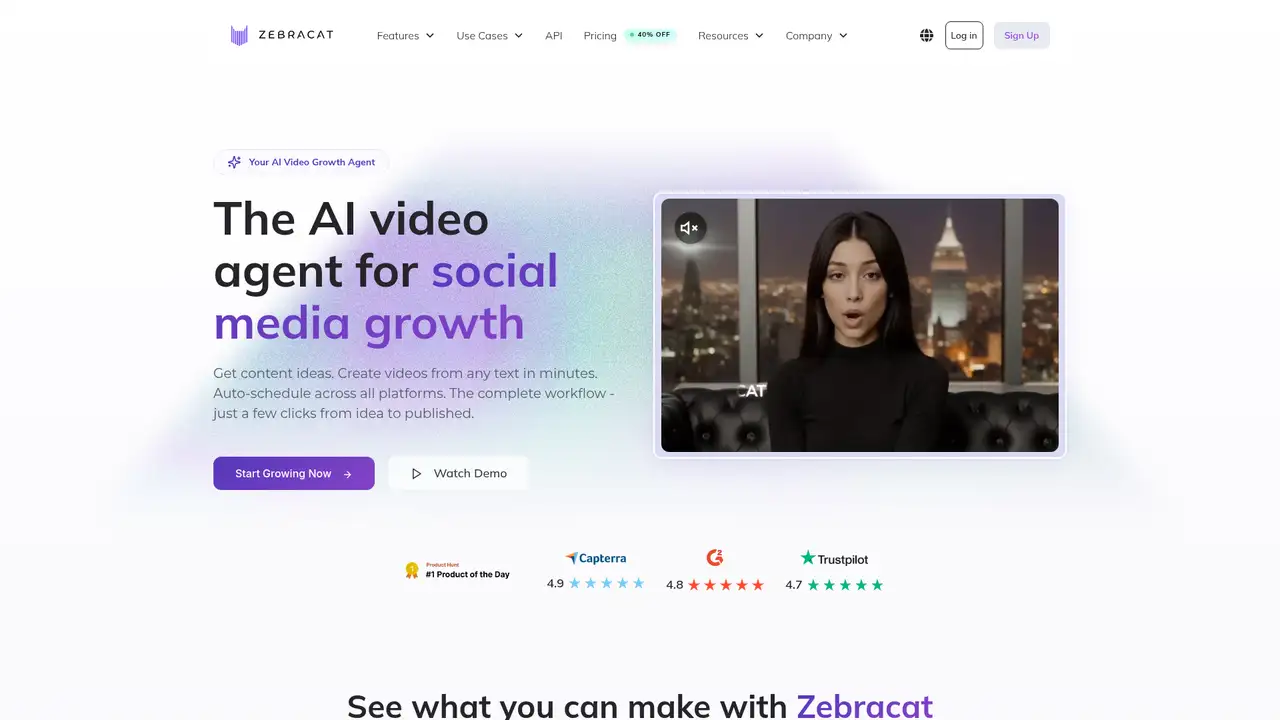
Zebracat is a Berlin-based AI video platform for marketers and creators, offering script, blog, idea and audio-to-video production with generated visuals, stock media, narration, avatars, captions and translation. Product Hunt records its public launch on June 25, 2024, and Zebracat 2.0 on December 10, 2024. Dealroom lists a 2021 launch, while LinkedIn lists 2022, so the founding year remains unclear. Dealroom reports 11 to 50 employees and a $115,000 Entrepreneurs First seed round. The company sells consumer subscriptions, enterprise services and API access. Its paid plans include commercial-use rights, while the free tier is limited to personal or testing projects. Zebracat remains active in the video creation category, with a public API and enterprise infrastructure, and is best understood as a production tool for marketing teams rather than a full replacement for professional editing software.
A typical project starts with a written prompt, script, blog URL, idea or audio upload. Zebracat then assembles visuals, music, narration, captions and, where selected, an avatar or cloned voice. Users can revise the result, translate it, change assets and export the finished video. Paid subscriptions add brand kits, custom avatars, voice clones, premium avatars, faster processing and longer output limits. This workflow suits social posts, explainers, product announcements and multilingual marketing because much of the assembly happens before detailed editing. The API exposes smaller components such as images, music, voice-over, avatars and animation, as well as complete agentic video pipelines. Its documentation also describes webhooks, asset management, status checks and translation.
Zebracat’s current stack combines open-source and proprietary systems for text-to-speech, visuals, and video generation, according to its help center. The model menu advertises Veo 3, Kling, Nano Banana, Seedance, and Pixverse. Company activity in 2025 highlighted Kling 2.5, voice cloning, story styles, and added editor controls. Its API covers idea, script, blog, and audio-to-video workflows, plus translation, asset management, status checks, webhooks, and usage reporting. The API also exposes separate image, music, voice-over, avatar, and animation components. An MCP endpoint connects with Claude Desktop, Claude Code, Cursor, and Windsurf, with documentation showing 15 tools in an example response. Zebracat says the API is hosted in Germany and GDPR-compliant. Enterprise API customers receive a 99.9% uptime SLA, while public documentation does not disclose a per-minute rate.
The free tier supports up to five videos, standard voices, 720p output and a 30-second maximum per video. It is limited to personal or testing use. Cat Mode costs $39/month, or $23/month billed yearly, and includes 15 videos, 350 generative credits, one brand kit and 1080p output. Super Cat costs $99/month, or $59/month yearly, with 40 videos, 1,400 credits, five custom avatars and five voice clones monthly. Unlimited Cat costs $199/month, or $119/month yearly, and advertises unlimited generation alongside 3,600 monthly credits. Enterprise starts at $599/month. API access starts at $10 pay as you go, with billing based on generated video duration and resolution rather than a published per-minute rate.
Zebracat is a practical choice for teams producing narrated, avatar-led or multilingual marketing videos, but it is less suited to editors who need detailed timeline, compositing or export control. Software Advice reviews include complaints about bugs, export reliability, cost and limited fine control, while Wavel’s review emphasizes ease of use and fast avatar production. HeyGen and Synthesia are closer competitors for presenter-led business video. Creatify is more focused on advertising workflows, testing and performance feedback, while Runway and similar model platforms focus more on generative video creation. Zebracat’s API is useful for automation, though its public pricing does not show a per-minute rate. Pick Zebracat for accessible multilingual marketing production with integrated avatars and voice tools.
Who is Zebracat best for?
- Marketers producing narrated social videos at volume.
- Creators needing avatars, voice cloning and translation.
- Teams automating video workflows through an API.
- Businesses publishing multilingual marketing content.
Zebracat Pricing (2026)
Pricing model: Freemium. All prices in USD.
| Plan | Price | What you get |
|---|---|---|
| Free | Free | Up to five videos, 720p, standard voices and a 30-second maximum per video. Personal or testing use only. |
| Cat Mode | $39/month | Annual billing is $23/month equivalent. Includes 15 videos, 350 generative credits, one brand kit and 1080p output. |
| Super Cat | $99/month | Annual billing is $59/month equivalent. Includes 40 videos, 1,400 credits, five custom avatars and five voice clones monthly. |
| Unlimited Cat | $199/month | Annual billing is $119/month equivalent. Advertises unlimited generation and also lists 3,600 generative credits monthly. |
| Enterprise | $599+/month | Includes custom credits, priority processing, enterprise avatars and voice clones, custom models, roles, permissions and a success manager. |
| API Pay-as-you-go | From $10 | Billed per generated video according to duration and resolution. Enterprise API pricing is custom. |
Pros and Cons
Pros
- Paid subscriptions include commercial publishing rights.
- Avatars, voice cloning and translation share one workflow.
- The API supports complete agentic video pipelines.
- Annual billing lowers subscription prices.
Cons
- Free videos are limited to personal or testing use.
- The API does not publish a per-minute rate.
- Reviews report bugs and limited fine editing control.
Who should look elsewhere?
- Editors needing detailed timeline and compositing control.
- Teams requiring a published customer-data training policy.
- Users seeking a fully self-hosted video generation system.
Technical Details
Frequently Asked Questions
How much does Zebracat cost?
Zebracat has a free tier for personal or testing use. Cat Mode costs $39/month, or $23/month billed yearly. Super Cat costs $99/month, or $59/month yearly. Unlimited Cat costs $199/month, or $119/month yearly. Enterprise starts at $599/month, while API access starts at $10 pay as you go and varies with generated video duration and resolution.
Does Zebracat have a free plan?
Yes. The free tier supports up to five videos, standard voices, 720p output and a maximum length of 30 seconds per video. It is intended for personal or testing use. Paid subscriptions add commercial publishing rights, higher resolution, longer videos, premium models, additional credits and tools such as custom avatars and voice cloning.
How does Zebracat compare with HeyGen?
Zebracat combines generative visuals, stock media, music, narration, avatars, voice cloning, captions, editing and translation. HeyGen is a closer fit when presenter-led avatar video is the main requirement. Zebracat offers a broader mix of generative video and marketing tools, while reviews describe less detailed editing control than specialized production software.
Does Zebracat train its models on customer data?
Zebracat publishes information about GDPR and CCPA compliance, encryption in transit and at rest, user controls and security audits. It does not publish a clear statement confirming or denying whether customer prompts, uploads or outputs are used to train models. Organizations handling sensitive material should review the applicable terms before uploading it.
Can Zebracat videos be used commercially?
Paid subscribers receive commercial publishing rights and may publish, share and monetize videos, subject to platform terms and rights in uploaded material. The free tier is limited to personal or testing use. Zebracat says its platform visuals, music and voiceovers are licensed or royalty-free, but users remain responsible for permissions covering their own inputs and likenesses.
Sources
- Zebracat official website
- Zebracat pricing
- Zebracat API documentation
- Zebracat help center
- Wavel Zebracat review
- Zebracat product, pricing and documentation
- Zebracat product, pricing and documentation
- Zebracat product, pricing and documentation
- Zebracat product, pricing and documentation
- Zebracat product, pricing and documentation
Best Zebracat Alternatives in 2026
These tools do the same job as Zebracat, with different pricing, limits and trade-offs.
AI avatars, translation, and prompt-based video production
AI presenters, dubbing, and training videos for business teams
Generative media tools for video, images, audio, and production workflows
Prompt, image, and reference assets become short generated videos.
AI production and testing for performance-focused video advertising
AI video generation with text, image, motion and audio controls