
PixVerse Review, Pricing & Alternatives (2026)
Prompt, image, and reference assets become short generated videos.
Last updated: October 26, 2026
What is PixVerse?
PixVerse is a Singapore-operated AI video platform for creators, marketers, and developers making prompt-to-video, image-to-video, edited, and API-generated clips. A free Basic account includes daily credits, while paid web access starts at $10 monthly or $8 monthly with annual billing. API access uses a separate credit system.
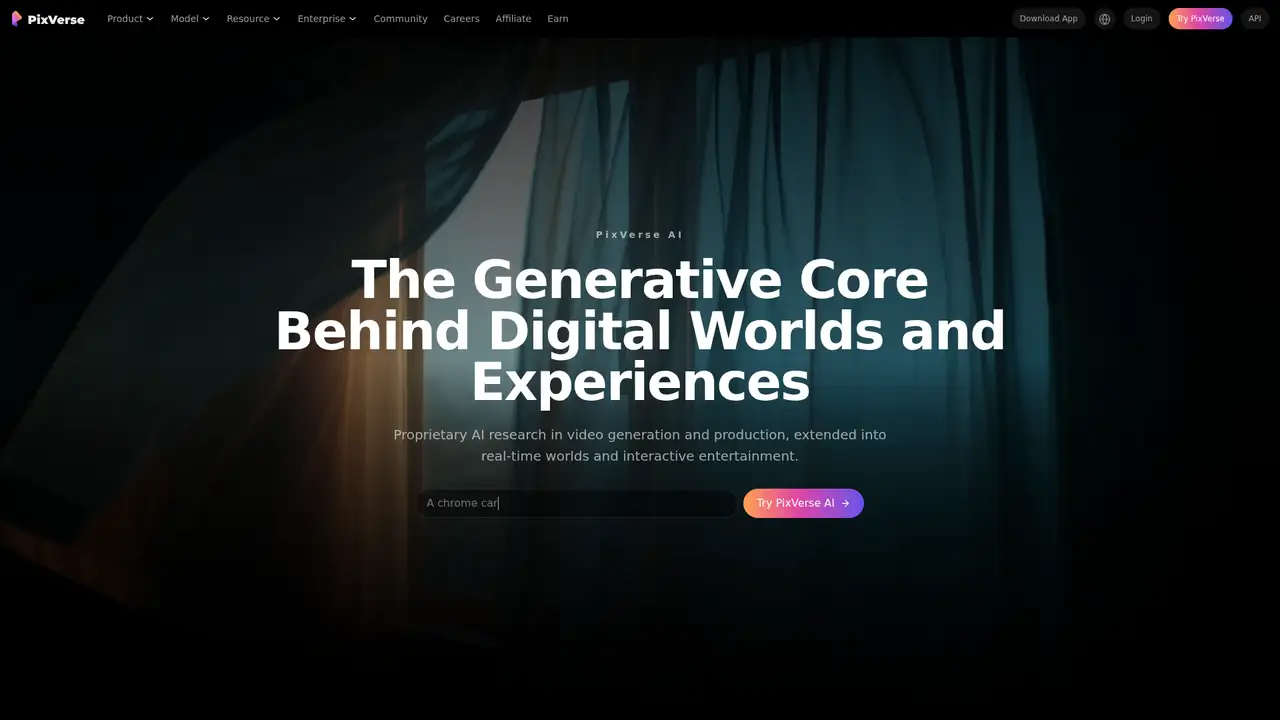
PixVerse is an AI video service operated by Singapore company AIVORA PTE. LTD., which says it was founded in 2023. Changhu Wang is identified as co-founder and CEO, while Jaden Xie is co-founder and president. PixVerse reported more than 100 million users across over 175 countries and announced a $60 million Series B led by Alibaba in September 2025. Its offerings include a web generator, Canvas, Agent, Marketing Hub, enterprise workflows, and developer APIs. This range lets individuals generate clips while teams organize marketing production and integrate video creation into software. The service is oriented toward short social, marketing, and concept videos, making it less suited to editors who need long-form timeline construction and detailed conventional postproduction control.
A typical PixVerse job can start with a text prompt, an uploaded image, reference assets, or an existing clip, giving users several ways to define the source material. They choose a generation mode, model, duration, resolution, and optional audio, then inspect the estimated credit cost before submission. Text to video, image to video, extension, effects, reference driven creation, lip sync, avatars, and editing tools cover both generation and targeted modification. For developers, asynchronous jobs, status polling, webhooks, and documentation support applications that submit work and track results without waiting for immediate completion. Credit accounting requires care because web membership credits and API credits are separate. PixVerse also says failed web generations receive automatic refunds under its billing rules.
PixVerse publishes model families including PixVerse V6, V5.6, V5, C1, and R2, but their capabilities differ across duration, audio, reference inputs, and resolution. These differences affect both the available output formats and the credits required for a generation. API documentation provides pricing examples for V6 and V5.6, giving developers a basis for estimating request costs. The product page also presents PixVerse models beside partner models such as Seedance, Kling, MiniMax, FLUX, Wan, and Gemini, and PixVerse sells API access separately. PixVerse’s 2025 Series B announcement describes proprietary video models and international expansion. Because access and rates can change, production integrations should consult the current API catalog before selecting a model or calculating costs.
PixVerse’s tiers set clear tradeoffs between cost, credit volume, image quality, and parallel work. Basic supports limited testing at 540p, with daily credits and two concurrent generations, while Standard adds 720p, more credits, and a third simultaneous job for $10 monthly or $8 with annual billing. Pro raises capacity to 6,000 credits and 4K output, making it better suited to heavier production at $30 monthly or $24 annually. Premium and Ultra provide larger credit pools, priced at $60 and $199 monthly respectively, with lower annual rates. Team Ultra shares 25,000 credits across seats, so consumption is pooled rather than assigned per user. Because API credits are separate, web subscriptions do not cover developer requests, and plan value depends on each generation’s settings.
PixVerse is a poor fit for teams needing one stable unit cost because credit use changes with the model, duration, resolution, audio, and reference mode, making project estimates less consistent. Daily and membership credits expire, while bonus credits do not, so unused allowances may not carry into later work. Public API terms restrict some commercial uses without written authorization, which can require review before deployment. The privacy policy describes aggregated and anonymized service improvement and model training uses, while paid platform terms require written consent for training customer data, creating different checks for web and paid platform workflows. Runway, Kling AI, and Luma Dream Machine are direct alternatives, while Hedra is stronger for character focused work. Choose PixVerse for rapid short form generation, effects, and reference driven creation.
Who is PixVerse best for?
- Short-form social teams producing prompt and image-driven clips.
- Creators wanting effects, references, and several generation modes in one web app.
- Developers integrating asynchronous video generation through an API.
- Marketing teams needing shared assets and higher-resolution web output.
PixVerse Pricing (2026)
Pricing model: Freemium. All prices in USD.
| Plan | Price | What you get |
|---|---|---|
| Basic | $0 | 60 initial credits, 30 daily credits, up to 540p, and two concurrent generations. |
| Standard | $10/month | Annual billing is $8 monthly, charged as $96 yearly; includes 1,200 monthly credits, 60 daily credits, up to 720p, and three concurrent generations. |
| Pro | $30/month | Annual billing is $24 monthly, charged as $288 yearly; includes 6,000 monthly credits, up to 4K, and five concurrent generations. |
| Premium | $60/month | Annual billing is $48 monthly, charged as $576 yearly; includes 15,000 monthly credits, up to 4K, and eight concurrent generations. |
| Ultra | $199/month | Annual billing is $149 monthly, charged as $1,788 yearly; includes 25,000 monthly credits, up to 4K, and eight concurrent generations. |
| Team Ultra | $199/seat/month | Annual billing is $149 per seat monthly, charged yearly; includes a shared 25,000-credit pool, 12 concurrent generations, roles, and centralized billing. |
| API Essential | $100/month | The published example includes 22,250 API credits; API credits cannot be used in the web app. |
| API Scale | $1,500/month | The published example includes 360,000 API credits; allowances and volume terms can change. |
| API Business | $6,000/month | The published example includes 1,636,365 API credits; enterprise customization is available. |
| API credit packs | $10 to $5,000 | Published packs range from 2,000 to 1,000,000 credits; 225 credits equals approximately $1. |
Pros and Cons
Pros
- PixVerse combines prompt, image, reference, effect, and extension workflows.
- Paid web tiers provide output up to 4K.
- The API supports status checks and webhooks for asynchronous jobs.
- The free tier provides recurring daily credits for experimentation.
Cons
- Credit expiry and model-dependent rates complicate forecasting.
- Web and API memberships use separate credit systems.
- Public API terms restrict some commercial uses without written authorization.
Who should look elsewhere?
- Editors needing a full long-form timeline and precise manual cuts.
- Teams requiring one stable per-second price across all models.
- Organizations needing blanket no-training terms on the public consumer service.
Technical Details
Frequently Asked Questions
Does PixVerse have a free plan?
Yes. Basic is free and includes 60 initial credits, 30 daily credits, output up to 540p, and two concurrent generations. Daily credits renew daily and expire if unused. Membership credits refresh every 30 days and also expire at the next cycle. Paid tiers add more credits, higher resolution, more concurrent jobs, and additional discounts.
How much does PixVerse cost?
The web service ranges from free Basic to Standard at $10 monthly, Pro at $30, Premium at $60, Ultra at a displayed $199, and Team Ultra at $199 per seat. Annual billing displays lower monthly equivalents. API pricing is separate, beginning with a published $100 monthly Essential plan. Credit packs range from $10 to $5,000.
PixVerse or Runway, which is better?
PixVerse fits users who prioritize effects, reference-driven clips, and a credit-based workflow with free daily credits. Runway is a closer fit for users seeking a broader creative editing suite and established video-production workflow. The better choice depends on the required models, duration, output controls, commercial terms, and how well each service handles representative footage.
Does PixVerse train on uploaded content?
PixVerse's public privacy policy describes aggregated and anonymized data use for service improvement, including model training and optimization, subject to available controls. Its paid-platform terms say customer data and output will not train or fine-tune an AI model without prior written consent. Review the applicable agreement before uploading confidential material or client-owned content.
Can PixVerse outputs be used commercially?
Commercial use depends on the applicable plan, service terms, project authorization, and rights in source material. PixVerse says it does not claim ownership of outputs, but users remain responsible for music, likeness, trademark, and other third-party rights. Its API terms restrict some profit-making uses without written authorization, so confirm permission before advertising or client publication.
Best PixVerse Alternatives in 2026
These tools do the same job as PixVerse, with different pricing, limits and trade-offs.
Generative media tools for video, images, audio, and production workflows

AI video generation with text, image, motion and audio controls
Create and transform video, images, audio, and more with generative AI.
Production video generation with keyframes, HDR and clip editing

Generate characters, scenes, voices, and visual media from one studio.