
UX Pilot Review, Pricing & Alternatives (2026)
Prompt-driven UI design with Figma, code, flows and review tools
Last updated: October 26, 2026
What is UX Pilot?
UX Pilot is an AI design platform for product teams, designers, founders and product managers. It turns prompts, PRDs, sketches and references into wireframes, high-fidelity screens, flows and React prototypes, with Figma and code export. It offers a free plan, while paid access starts at $19 per month billed annually.
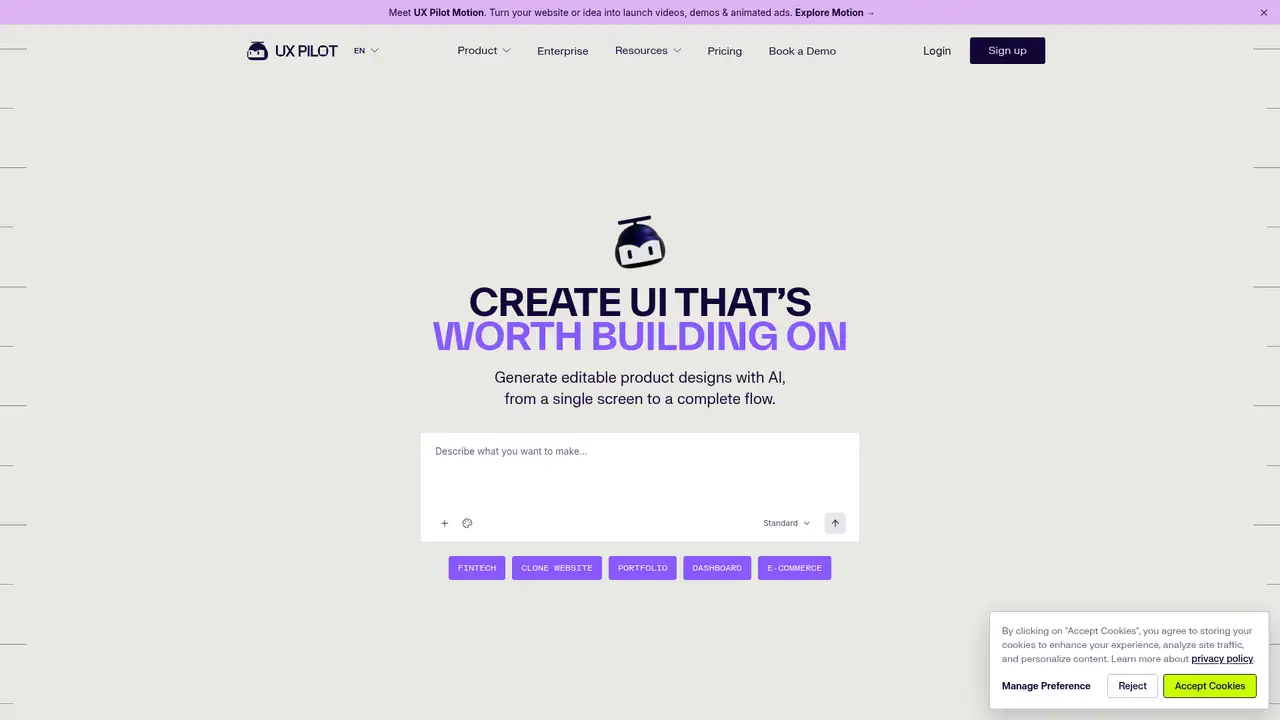
UX Pilot is a browser-based AI design service founded by Adam Fard in 2023 for product teams, designers, founders, and product managers. It turns prompts, PRDs, sketches, screenshots, or website references into wireframes, high-fidelity screens, connected flows, design-system layouts, and React prototypes. Users can generate four design directions, refine results, review interfaces with predictive heatmaps, and move work into Figma through Nodey and two-way synchronization. Code export supports HTML, CSS, and React, making the service relevant beyond early mockups, although generated work still requires human review. UX Pilot is hosted rather than self-managed, and it does not publish a named foundation model or model card. The company reports more than one million users and designs generated by 2026. Credit limits, changing token costs, and paid-plan requirements for commercial use affect budgeting and deployment decisions.
A project can start with a prompt, PRD, sketch, screenshot, or website reference, producing four design directions for comparison. Users can refine results through chat, connect screens into journeys with Autoflow, and review concepts using predictive heatmaps and automated design checks before handoff. Nodey works within Figma and creates editable native layers, while Simple Sync reuses imported components for greater consistency. React Focus Mode generates interactive React prototypes, supports canvas edits, and exports HTML, CSS, and React code. Figma export, two-way synchronization, and GitHub sync connect the work with established design and development workflows. In practice, this supports a path from early exploration to a reviewable prototype and developer handoff, although credit-based usage can limit repeated experimentation.
UX Pilot’s undisclosed foundation model limits independent assessment of its output quality. The company describes a custom model for complex interface work, but it provides no model card or independent benchmark results, while its terms allow token requirements to change with computational costs and other factors. The product’s practical value therefore rests more on workflow coverage than on transparent model performance. Nodey, two-way Figma synchronization, React Focus Mode, design-system support, predictive heatmaps and automated design review can connect ideation, refinement and handoff in one hosted service. UX Pilot also claims that its enterprise design-system service exceeds 95 percent for on-brand accuracy and component usage, but this figure is not independently verified. Published materials do not identify a dated 2025 or 2026 release announcement for these capabilities, so buyers should treat them as current vendor-described features rather than independently established results.
UX Pilot’s pricing is straightforward, but its credit rules affect project planning. The free tier needs no card and supplies 45 credits, though its designs are limited to personal, non-commercial use. Standard costs $19 monthly when billed annually and provides 420 credits, while Pro costs $29 and provides 750. Enterprise pricing is custom. Monthly plan credits roll over, allowing unused capacity to support later work, but those accumulated credits become inaccessible after cancellation until the subscription is reactivated. Separately purchased credits remain available while the subscription is active and do not expire during that period. Standard and Pro subscribers receive commercial rights for designs created during active paid periods, with those rights continuing afterward under the terms. Because unused subscription time is nonrefundable, cancellation timing and credit use require attention.
UX Pilot combines prompt-based screen generation, connected flows, Figma handoff, review tools, and React prototypes in one hosted service. Its four design variations can support early comparison, while Autoflow helps teams build connected journeys rather than isolated mockups. Nodey and two-way Figma sync preserve editable work, and React Focus Mode provides an interactive path toward engineering handoff. The tradeoff is less transparency about model selection, variable token requirements, hosted-only access, and no refunds. Uizard is better suited to beginners and quick, basic wireframes, but is less capable with complex instructions and detailed flows. Claude Design creates web pages and marketing assets from prompts, yet does not export to Figma and has no free plan. Product teams needing editable Figma files, multi-screen flows, and React prototypes should choose UX Pilot.
Who is UX Pilot best for?
- Product teams turning requirements into connected screen flows.
- Designers who need editable Figma output.
- Founders prototyping React interactions quickly.
- Teams with an existing component library.
UX Pilot Pricing (2026)
Pricing model: Freemium. All prices in USD.
| Plan | Price | What you get |
|---|---|---|
| Free | $0 | 45 credits; no credit card required. Personal, non-commercial use only. |
| Standard | $19/month billed annually | 420 monthly credits. Includes core design generation and exports. |
| Pro | $29/month billed annually | 750 monthly credits. Includes higher project allowances and advanced features. |
| Enterprise | Custom | Includes enterprise design-system support, integrations, roles, onboarding and priority support. |
Pros and Cons
Pros
- Generates four interface variations per run.
- Supports Figma export and two-way synchronization.
- Combines flows, review, heatmaps and React prototypes.
- Paid plans grant commercial-use rights for generated designs.
Cons
- Credit requirements can change by model and task.
- Free designs cannot be used commercially.
- The service does not offer self-hosting.
Who should look elsewhere?
- Teams requiring self-hosted design generation.
- Users needing unlimited free commercial output.
- Buyers seeking a named, independently benchmarked model.
Technical Details
Frequently Asked Questions
How much does UX Pilot cost?
UX Pilot has a free plan, Standard at $19 per month billed annually with 420 monthly credits, Pro at $29 per month billed annually with 750 monthly credits, and Enterprise pricing listed as custom. The terms say UX Pilot may modify pricing and plan features with notice. The plans page provides the current purchase details.
Is UX Pilot free?
Yes. The Free plan requires no credit card and includes 45 credits. Free users may generate designs for personal, non-commercial purposes. Commercial-use rights apply to Standard and Pro subscribers for designs generated during active paid subscription periods. UX Pilot does not describe the Free plan as unlimited.
How does UX Pilot compare with Uizard?
UX Pilot's comparison describes it as suited to high-fidelity designs, complex tasks, connected flows and two-way Figma synchronization. The same comparison positions Uizard for quick, basic wireframes and simple prototypes. UX Pilot therefore fits teams prioritizing detailed product design and handoff, while Uizard fits users seeking a simpler starting point.
Does UX Pilot train on customer designs?
UX Pilot's terms say it may use anonymized usage data, including clicks, navigation patterns and interaction metrics, to improve its services. The terms also say UX Pilot does not train its AI models using generated designs or confidential information. The company retains the right to monitor usage patterns for abuse prevention and fair use.
Can I use UX Pilot designs commercially?
Free-plan users may use generated designs only for personal, non-commercial purposes. Standard and Pro subscribers receive a non-exclusive, non-transferable commercial-use license for designs generated during active paid subscription periods. The terms say that license continues perpetually for those designs after termination. UX Pilot does not provide refunds for unused subscription time.
Best UX Pilot Alternatives in 2026
These tools do the same job as UX Pilot, with different pricing, limits and trade-offs.