
TurboLearn AI Review, Pricing & Alternatives (2026)
Turn lectures, PDFs, videos, and recordings into structured study materials.
rebranded: TurboLearn AI became Turbo AI in 2026. The company says the name and domain changed, while accounts, data, mobile apps, pricing, and features remained the same.
Last updated: October 26, 2026
What is TurboLearn AI?
TurboLearn AI, now Turbo AI, is a study platform for students who want lectures, PDFs, videos, and recordings turned into notes, flashcards, quizzes, and podcasts. It has a free tier, while the July 2026 comparison lists paid access at $20/month or $120/year. The service is designed for organized course review rather than broad general assistance.
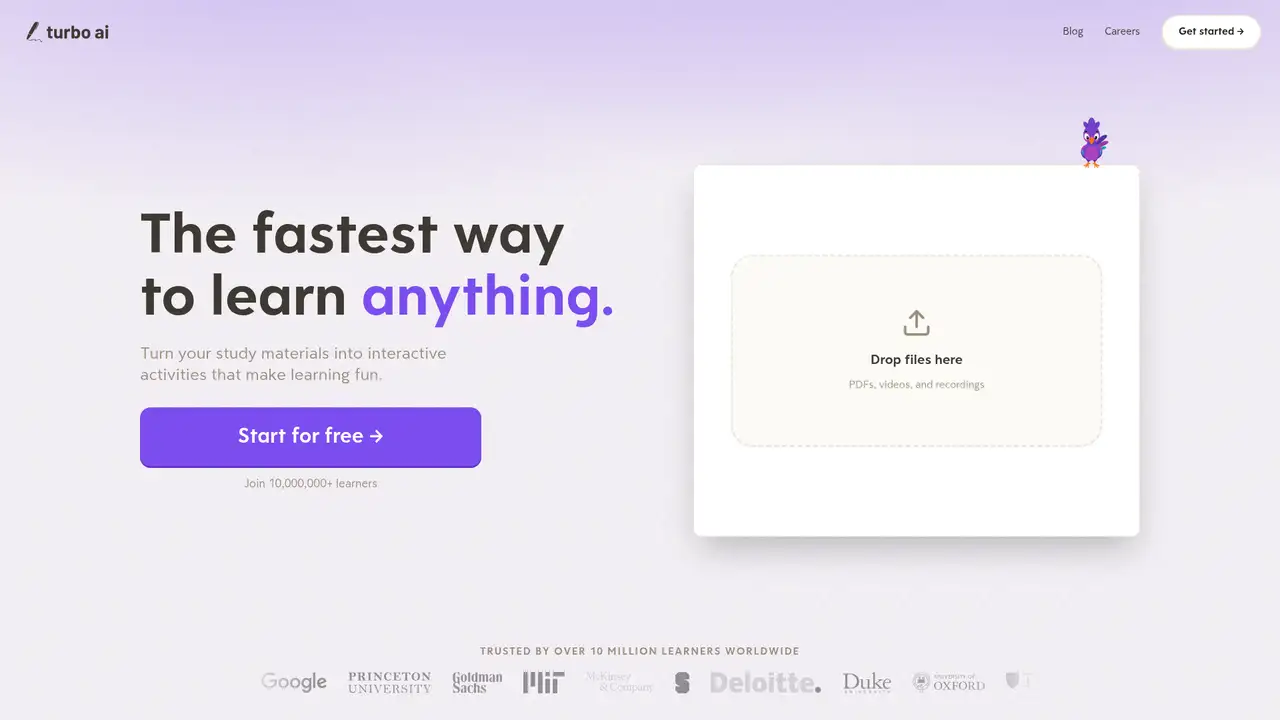
TurboLearn AI is an AI study and note-taking service from TurboLearn, Inc., now operating as Turbo AI. The product launched in December 2023 or early 2024, depending on whether launch refers to the first public release or the founders’ account of its start. The company says it has passed 5 million users and generated more than 15 million notes. TechCrunch reported in October 2025 that founders Rudy Arora and Sarthak Dhawan had grown the service to 5 million users, with eight-figure annual recurring revenue, 20,000 daily new users, a 15-person Los Angeles team, and $750,000 raised. Earlier reporting said TurboLearn reached 500,000 users after its December launch and won Northwestern’s 2024 VentureCat competition.
Turbo AI, formerly Turbolearn, centers on turning recorded lectures or uploaded PDFs, YouTube videos, audio, and documents into editable notes. Its AI identifies key concepts and can create flashcards, quizzes, podcasts, and chat assistance linked to the study material. Folders support course organization, while the editor enables changes and sharing. Turbo AI also advertises live collaboration, comments, pre-made study guides, and access across web and mobile. This structure can reduce the repeated prompting required by a general chatbot, but it places students in a narrower, course-centered workflow. Mindgrasp offers a broader set of supported materials, including slides and web content, plus an AI Tutor, though plan details vary. With an index of 4, Turbo AI suits students who prioritize organized, editable study materials from lectures and documents.
Turbo AI, formerly TurboLearn AI, uses multiple third-party AI providers rather than one permanent underlying model, and its terms say providers may change. It supports lecture recording and uploads of PDFs, YouTube videos, audio, and documents, then creates editable notes, flashcards, quizzes, podcasts, and chat assistance. The company claims more than 15 million notes generated, but this is not an independent measurement. Turbo’s free tier offers core features, while paid plans add unlimited processing, advanced study tools, and collaboration. Its terms do not clearly grant broad commercial rights to generated material. Mindgrasp offers similar uploads, live recording, notes, summaries, flashcards, quizzes, and AI tutoring, with tier-based features and some pricing inconsistencies. Choose Turbo AI for structured study materials and Mindgrasp for broader input options and tutoring.
Turbo AI advertises a free tier with note generation, flashcards, and quizzes. Current terms list Free, Pro, and Unlimited tiers, with monthly or annual renewal, but the public pages reviewed here do not provide a complete current price table for each tier. A September 2025 announcement described Premium at $9.99 per month billed annually or $19.99 monthly, with unlimited AI processing, advanced study tools, and enhanced collaboration. The company’s 2026 comparison lists $20 monthly or $10 monthly billed annually, which indicates pricing has changed. Paid access can therefore add unlimited processing and advanced tools, while free use remains useful for trying the core workflow. Existing content remains after downgrade, subject to free-tier limits.
The main limitation is scope: Turbo AI centers on turning lectures, PDFs, videos, audio, and other course materials into notes, flashcards, quizzes, podcasts, and study assistance, rather than covering the broader writing, coding, research, and web tasks associated with ChatGPT. NotebookLM is a closer alternative for source-grounded document conversations, while Quizlet focuses more on flashcards, games, and review. Turbo AI’s terms do not grant a broad commercial-use license for generated material, so commercial use remains unconfirmed. Its privacy policy states that submitted content may be processed by service providers and retained as needed, with deletion subject to exceptions. Students should check recording permissions, intellectual-property requirements, and copyright rules before uploading class material. Choose Turbo AI if you want an automated pipeline from lectures and readings to organized review activities.
Who is TurboLearn AI best for?
- Students turning lectures and PDFs into review materials.
- Learners who want editable notes plus quizzes and flashcards.
- People organizing several classes in folders across devices.
- Students who prefer a structured study workflow.
TurboLearn AI Pricing (2026)
Pricing model: Freemium. All prices in USD.
| Plan | Price | What you get |
|---|---|---|
| Free | $0 | Includes note generation, flashcards, and quizzes. Current usage limits are displayed in the account. |
| Pro | Custom | Listed in current terms with monthly or annual renewal. Current price, features, and usage limits are displayed in the account. |
| Unlimited | Custom | Listed in current terms with monthly or annual renewal. The July 2026 comparison lists Turbo at $20/month or $120/year without assigning the rate to this tier. |
Pros and Cons
Pros
- It turns recordings, PDFs, videos, and documents into editable notes.
- Flashcards, quizzes, podcasts, and chat extend the workflow.
- Folders and synchronized access support ongoing course organization.
- The free tier covers core note and study-material generation.
Cons
- Current pages do not show prices for every named tier.
- The terms restrict use to personal, noncommercial education.
- The privacy policy permits AI tool training and service improvement.
Who should look elsewhere?
- Users seeking a general assistant for coding or broad research.
- Organizations requiring documented commercial-use permission.
- Students unable to obtain permission to record or upload course material.
Technical Details
Frequently Asked Questions
How much does TurboLearn AI cost?
TurboLearn AI is now Turbo AI. It has a free tier, while current account pricing is shown for paid plans. A July 2026 comparison lists Turbo at $20 per month with monthly billing or $120 per year with annual billing, without assigning either rate to Pro or Unlimited. A September 2025 announcement listed different Premium prices, so older figures should not be treated as current.
Does TurboLearn AI have a free plan?
Yes. Turbo’s homepage says the free tier includes note generation, flashcards, and quizzes. Current terms also list Free, Pro, and Unlimited. The account displays current free-tier limits. The service accepts recordings, PDFs, videos, and documents, then turns them into notes and study activities, although recording and copyright rules still apply.
Turbo AI or ChatGPT, which is better for studying?
Turbo is organized around a course workflow: add material, receive notes, and create flashcards, quizzes, or podcasts. ChatGPT is a general assistant with broader explanations and unrelated capabilities. Turbo is the more focused choice for recurring review of lectures and readings. ChatGPT is better when studying also involves coding, writing, web tasks, or explanations across unrelated subjects.
Does Turbo AI train on user data?
Turbo’s privacy policy says personal information may be used to manage and improve the service, including training AI tools. Uploaded content can also be transmitted to third-party providers to fulfill requests. The policy advises users not to upload sensitive information. Students should review institutional recording rules and avoid submitting confidential material.
Can Turbo AI be used commercially?
Turbo’s terms grant a limited license for personal, noncommercial educational use. They also require compliance with intellectual-property, privacy, copyright, and acceptable-use rules. The standard terms do not grant broad commercial permission for generated materials. Commercial publication, resale, or business distribution should not rely on the consumer license.
Best TurboLearn AI Alternatives in 2026
These tools do the same job as TurboLearn AI, with different pricing, limits and trade-offs.

Source-grounded research, study aids, and multimedia summaries

Flashcards, adaptive practice, and AI study tools for students
General-purpose AI assistance for writing, research, coding, and work
Long-context AI assistant for writing, research, and code

Turn class materials into guided study sessions