
towrite.ai Review, Pricing & Alternatives (2026)
Citation-aware drafting for academic researchers
Last updated: October 22, 2026
What is towrite.ai?
towrite.ai is a hosted academic writing workspace combining research agents, source-linked drafting, citation review, and export. Free costs $0, Pro costs $19.90 monthly, and Max costs $99.90 monthly. It suits academic writers who value provenance and integrated workflows, but model details, security information, and privacy wording require careful review before sensitive materials are uploaded.
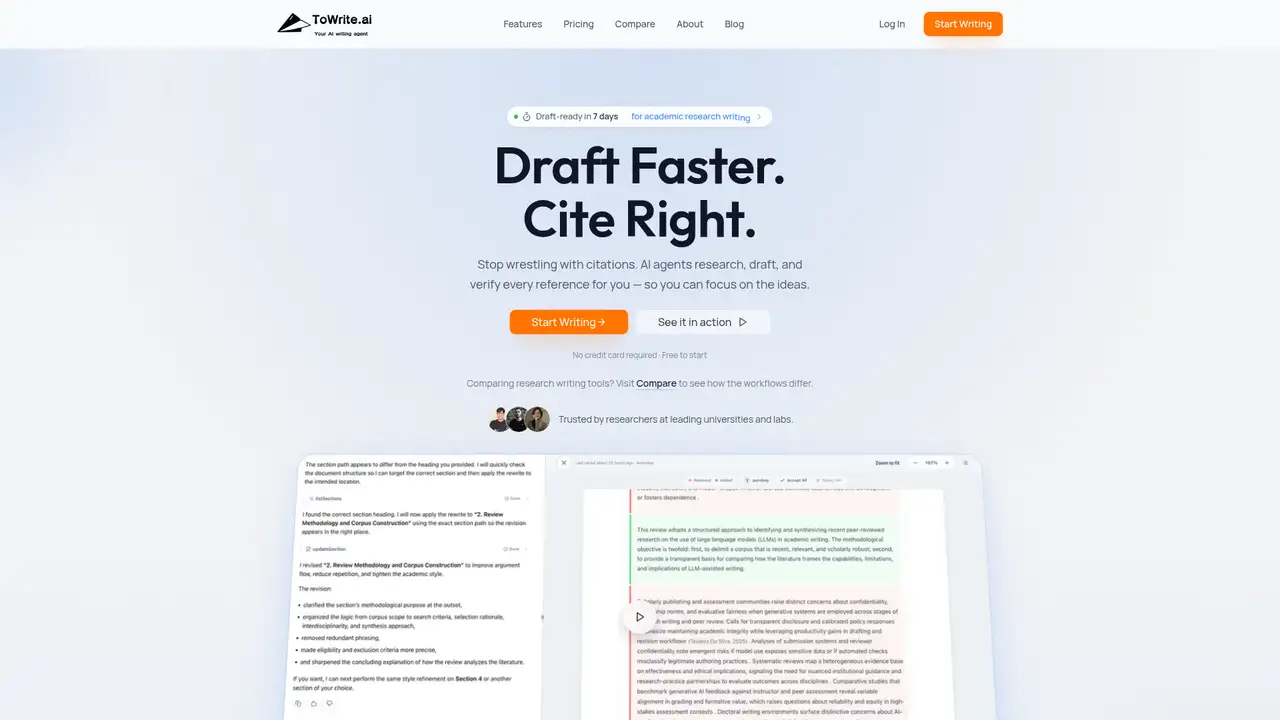
towrite.ai is a hosted academic research-writing workspace for students, researchers, labs, and authors. Its identity pages do not state a founding year or named corporate owner, and they provide no funding, employee, or customer count. The homepage says it is trusted by researchers at leading universities and labs, but the cited material offers limited organizational detail. The service is active and positioned as an academic-first product rather than an open-source or self-hosted package. It brings research context, drafting, revision, citations, and export into one browser workspace. That concentration can reduce switching among separate writing and reference tools. The tradeoff is that users still must inspect sources, verify claims, and judge whether generated language meets academic, institutional, and publication standards.
Users can start with an outline, research question, notes, uploaded documents, or a BibTeX file. The site says agents read that context, search academic databases, draft sections, and attach claims to sources. Four named agents support editing, citation management, strategy, and chat. Users can review changes inline before exporting finished work. The homepage also describes seven or more academic databases, deduplication, citation verification, audit logs, and multiple document formats. This workflow is useful when a writer wants each important sentence connected to supporting material and wants revisions visible inside the same project. It does not replace source criticism. Users should inspect publication quality, confirm quotations, check interpretations, resolve duplicate or conflicting references, and compare generated citations with original works before submitting or publishing.
The public pages do not identify foundation models, model versions, context windows, or inference providers. The pricing page distinguishes baseline from premium long-context models without defining them, so the technical product is best understood as agent orchestration around research-writing tasks. Its blog advertises ship logs, while current pages describe provenance panels, token reporting, and conflict checks. However, the cited material does not identify a dated major model release or rewrite. This limited disclosure may matter to institutions seeking a precise account of model behavior, retention, processing locations, or vendor relationships. The visible description instead emphasizes task roles, source connections, review controls, and document outputs. That approach simplifies use, but makes independent evaluation of reliability and operational risk more difficult.
Free costs $0 and provides 100 daily credits on core models, five sources per literature query, and Blocks editing, but no export or history. Pro costs $19.90 monthly and includes 20,000 premium credits, 20 sources per query, history, and DOCX, LaTeX, and Markdown export. Max costs $99.90 monthly and adds unlimited credits, advanced models, governance, unlimited multi-keyword search, and CSL/JSON export. No annual price appears in the readable plan text. The tiers progress from limited trial use to sustained academic work, though the free plan may constrain long papers and repeated searches. Paid value depends on frequency of use and the need for history, higher limits, governance, advanced models, or specialized exports. Users should weigh those benefits against recurring cost and their expected research volume.
The strongest case for towrite.ai is a citation-centered workflow combining research, drafting, visible revisions, and exports. Its weaknesses include undisclosed model provenance, a restrictive free tier, and privacy wording requiring careful interpretation. The About page says manuscripts are never used to train models, while the Privacy Policy says anonymized information trains and enhances models. Jenni AI is the closest writing comparison; Elicit and Connected Papers serve different discovery jobs, while Paperpal, Writefull, and SciSpace are other alternatives. Pick towrite.ai when source-linked academic drafting matters more than detailed model transparency. Avoid it when cloud processing is unacceptable or published security information is required. Institutions should clarify handling before uploading unpublished manuscripts, grant proposals, participant data, or other sensitive material.
Who is towrite.ai best for?
- It is best for academic writers who need citation-linked drafts and visible source relationships.
- It suits researchers assembling literature reviews with structured notes and source-aware revisions.
- It works for labs that need reviewable edits, audit information, and multiple export formats.
- It fits users who want research, drafting, citation management, and export in one web workspace.
towrite.ai Pricing (2026)
Pricing model: Freemium. All prices in USD.
| Plan | Price | What you get |
|---|---|---|
| Free | $0 | 100 daily credits, five sources per query, Blocks editing; no export or history. |
| Pro | $19.90/month | 20,000 monthly premium credits, 20 sources per query, history, and DOCX, LaTeX, Markdown export. |
| Max | $99.90/month | Unlimited credits, advanced models, governance, unlimited multi-keyword search, and CSL/JSON export. |
Pros and Cons
Pros
- Four agents address editing, research, strategy, and chat within one workspace.
- Inline provenance connects claims with supporting sources for review.
- Pro exports include DOCX, LaTeX, and Markdown while preserving citations.
- The free plan starts without a credit card and provides daily credits.
Cons
- The free plan cannot export documents or retain history.
- Underlying model providers, versions, and context limits are not disclosed.
- Privacy wording differs between the About page and Privacy Policy.
Who should look elsewhere?
- It is not suited to general-purpose chatbot use without academic source requirements.
- It may not suit teams that require published security certifications or detailed model disclosures.
- It is not suited to researchers who cannot place manuscripts in cloud software.
Technical Details
Frequently Asked Questions
How much does towrite.ai cost?
Free is $0, Pro is $19.90 monthly, and Max is $99.90 monthly. The public plan text shows monthly prices and no separate annual USD price. Pro and Max increase credits, source limits, history, governance, and export options. Users should check the current plan page before subscribing because pricing and included limits can change.
Does it have a free plan?
Yes. Free includes 100 daily credits, five literature sources per query, and inline editing, but no document export or version history. It uses core models rather than the premium model allocation described for paid plans. The free tier can test the workflow, although repeated searches and longer writing projects may reach its limits quickly.
How does it compare with Jenni AI?
towrite.ai emphasizes coordinated research agents, provenance, audit logs, and scholarly exports, while Jenni AI is a closer fit for general AI-assisted editing. The better choice depends on the task. Writers who prioritize source-linked research workflows may prefer towrite.ai, while users seeking a broader editing experience may find Jenni AI more appropriate.
Does it train on manuscripts?
The About page says user work is never used for training, while the Privacy Policy says anonymized information trains models. The wording warrants institutional clarification before uploading confidential or unpublished material. Users should ask the service which data is retained, what anonymization means, which providers process content, and whether workspace controls change the applicable policy.
Can output be used commercially?
Terms say users retain content ownership, but users remain responsible for policy compliance and the terms do not separately detail commercial licensing. Ownership does not guarantee that generated text is accurate, original, or free from third-party obligations. Commercial users should review the current Terms, verify sources, and obtain any required institutional or publisher approval before distribution.
Best towrite.ai Alternatives in 2026
These tools do the same job as towrite.ai, with different pricing, limits and trade-offs.