
Synthflow Review, Pricing & Alternatives (2026)
Visual voice agents for enterprise phone operations
Last updated: October 26, 2026
What is Synthflow?
Synthflow is a visual platform for building and deploying AI phone agents for support, sales, scheduling, and business operations. Berlin-based AgentFlow AI GmbH targets mid-market and enterprise teams with telephony, integrations, compliance controls, and implementation support. Enterprise contracts start at $30,000 per year, while no current public self-serve or free plan is listed.
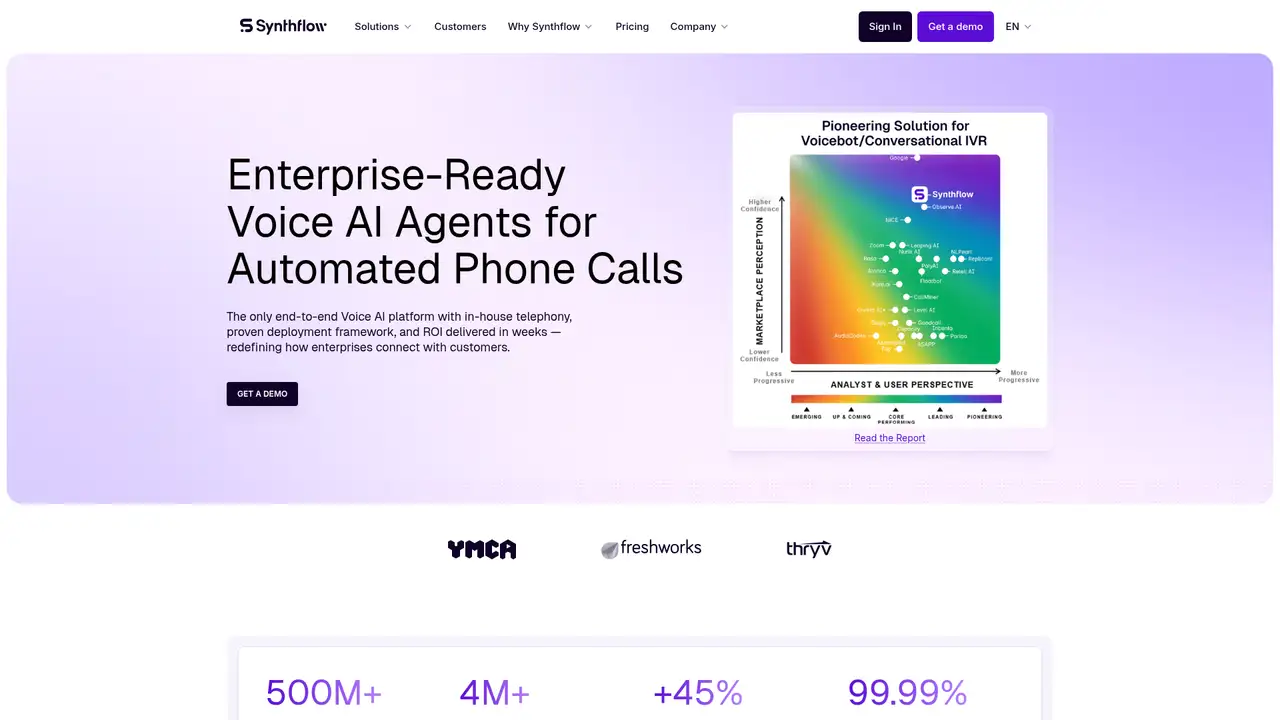
Synthflow is an enterprise voice-agent platform from Berlin-based AgentFlow AI GmbH, founded in 2023 by siblings Albert and Hakob Astabatsyan. It serves customer support, sales, appointment booking, claims, collections, and BPO operations. The company says its agents handle more than 65 million voice calls monthly across over 30 countries. Its 2025 Series A raised $20 million, led by Accel, with Atlantic Labs and Singular also listed as investors. Synthflow is a managed business platform rather than a speech API like LMNT. It combines conversation logic, telephony, knowledge sources, integrations, analytics, and human handoffs. Enterprise contracts start at $30,000 annually, with pricing shaped by call volume, concurrency, telephony, integrations, security, implementation, and launch support. The current public offer does not include a self-serve free plan or published pay-as-you-go rate.
A typical Synthflow workflow starts in the Visual Flow Designer, where a team sets the agent’s goal, prompt, knowledge source, conversation branches, actions, and escalation rules. The team then connects Synthflow telephony, SIP trunking, or an approved provider. Agents can schedule appointments, query business systems, trigger webhooks, route calls, and transfer conversations to staff. Built-in tools cover testing, simulations, call logs, analytics, campaigns, workflows, and contact management. Administrators can also configure retention and PII controls, including disabled recordings or transcripts, 30-day retention limits, and redaction for names, emails, phone numbers, addresses, and payment identifiers. Enterprise planning can include concurrency, routing, fallback logic, integrations, testing, training, and launch support. The platform supports commercial phone operations, but its sales-led contracts make deployment planning part of procurement.
Synthflow’s technology combines proprietary orchestration, OpenAI models, ElevenLabs, Deepgram, telephony, tools, business data, and custom in-house logic. Its Visual Flow Designer lets teams define prompts, branches, knowledge sources, actions, fallback rules, and human escalation before connecting a number or provider. The company says agents support more than 50 languages and include sentiment detection, while workflows can schedule appointments, query systems, send webhooks, route calls, and log interactions. Documented controls include ISO 27001:2022, SOC 2, GDPR, HIPAA, and PCI DSS V4.0.1 compliance. Recent 2026 billing changes moved new customers to sales-led enterprise pricing, and reseller billing inside the product ended on September 15, 2026. Synthflow does not publish component-level model controls comparable to developer-first platforms, limiting customization for engineering teams.
Synthflow’s current public pricing lists one tier, Enterprise, starting at $30,000 per year. The contract amount is scoped to expected call volume, concurrency, telephony, integrations, security requirements, implementation, and launch support. Its visual workflow builder, native telephony, SIP options, contact management, analytics, testing, and human handoffs are part of the managed business platform, but individual usage allowances depend on the agreement. Synthflow does not publish a current self-serve free tier, monthly starter plan, or public pay-as-you-go rate. Existing workspaces may retain account-specific minute allocations, overage charges, carryover rules, or add-ons, especially after the 2026 move to sales-led enterprise billing. Before budgeting, customers should check billing cadence, included minutes, concurrency, overage treatment, renewal terms, and contractual usage limits in their agreement or Plan & Billing page.
Synthflow’s main limitation is its enterprise commitment: contracts start at $30,000 annually, and the company does not publish a current self-serve plan or public pay-as-you-go rate. Operations teams receive visual flow design, native telephony or SIP options, integrations, compliance controls, testing, analytics, human handoffs, and implementation support, while engineers get less component-level control than on developer-first platforms. Retell offers modular, pay-as-you-go infrastructure with API and SDK access, and Vapi centers on developer-built voice agents. PolyAI targets managed conversational systems while exposing model-level API access, including Dialog-RSN-1 billed by connected second. Synthflow covers the broader phone-agent workflow than speech-only services, including routing, business actions, scheduling, and contact management. Choose Synthflow when an operations or contact-center team needs a supported enterprise rollout rather than a low-cost pilot or self-hosted stack.
Who is Synthflow best for?
- Enterprise support teams automating recurring phone calls.
- BPOs managing voice agents across client workflows.
- Operations teams preferring visual design over extensive coding.
- Regulated deployments needing retention and PII controls.
Synthflow Pricing (2026)
Pricing model: Paid. All prices in USD.
| Plan | Price | What you get |
|---|---|---|
| Enterprise | From $30,000/year | Terms cover call volume, concurrency, telephony, integrations, security, support, and launch requirements. |
Pros and Cons
Pros
- Visual tools support agent design without building every component.
- Enterprise contracts include implementation and launch support.
- Retention and PII controls address common compliance needs.
- Native telephony, SIP, and integrations support production calls.
Cons
- Public enterprise pricing starts at $30,000 annually.
- Current rates depend on a sales-scoped contract.
- The platform is less modular than developer-first alternatives.
Who should look elsewhere?
- Small pilots needing a low-cost self-serve plan.
- Developers wanting an API-only voice stack.
- Teams requiring fully self-hosted infrastructure.
Technical Details
Frequently Asked Questions
How much does Synthflow cost?
Synthflow’s current public pricing page lists Enterprise contracts starting at $30,000 per year. Final pricing covers call volume, concurrency, telephony, integrations, security, implementation, and support. Existing customers may have different rates, minute allowances, overage rules, or carryover terms under their agreements.
Does Synthflow have a free plan?
Synthflow does not currently publish a free plan or self-serve starter tier. Its public offer is sales-led Enterprise pricing from $30,000 annually. Existing workspaces may show older billing arrangements, but those account terms do not create a current public free allowance for new customers.
Synthflow or Retell AI: which is better?
Synthflow suits operations and enterprise teams wanting a visual builder, bundled telephony, integrations, compliance review, and implementation support. Retell is API-first and modular, which suits engineers assembling and tuning a voice stack. Synthflow favors managed deployment, while Retell offers more component-level control and pay-as-you-go billing.
How does Synthflow handle caller data?
Synthflow lets administrators disable recordings and transcripts, limit retention to 30 days, and redact names, emails, phone numbers, addresses, and payment identifiers from transcripts and logs. Redaction does not affect live audio and may miss some data. The company states that data is deleted within 90 days unless contract terms specify otherwise.
Can Synthflow agents be used commercially?
Yes. Synthflow sells the platform for business call automation and offers enterprise contracts covering production deployment, telephony, integrations, support, and security requirements. Commercial use is governed by the customer agreement. Teams should review model, voice, telephony, recording, and data-processing terms during procurement.
Best Synthflow Alternatives in 2026
These tools do the same job as Synthflow, with different pricing, limits and trade-offs.

Build, test, and run production voice agents with usage-based billing.

Developer platform for building phone and web voice agents on any model stack

Production voice agents for complex phone, SMS, and chat conversations.

Enterprise agents for complex customer conversations across voice and chat

Build and operate customer support agents across chat, phone, and SMS