
Stack AI Review, Pricing & Alternatives (2026)
Governed AI agents for regulated enterprise workflows
Last updated: October 26, 2026
What is Stack AI?
Stack AI is an enterprise platform for building and governing AI agents across business systems. It targets IT and enterprise architecture teams managing regulated workflows, with a free entry plan priced at $0 per month. Paid enterprise capacity, infrastructure, support, and security features use custom pricing.
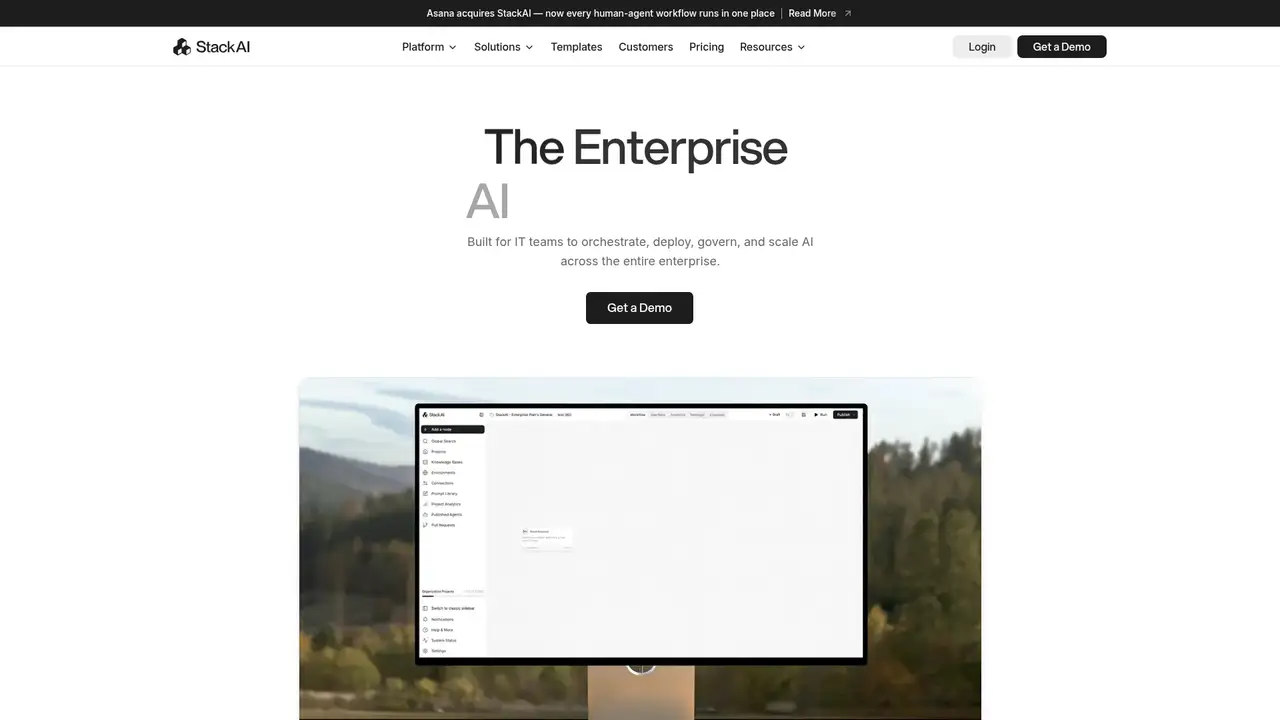
Stack AI is an enterprise AI agent platform made by StackAI for IT and enterprise architecture teams. The company says it helps organizations orchestrate, deploy, govern, and scale AI across regulated operations. Its deployment choices include multi-tenant cloud, VPC, and on-premise environments, while human review can sit at critical decision points. StackAI says agents can connect with more than 500 enterprise integrations and read, write, and execute tasks in existing systems. TechCrunch reported that the company joined Y Combinator’s Winter 2023 cohort and had raised under $20 million, including a $16 million Series A. Asana announced its acquisition of StackAI on May 27, 2026, and StackAI says it remains its own product and brand.
Stack AI combines no-code agent building with workflow automation, retrieval-augmented generation, document processing, integrations, and governance controls for regulated organizations. Its SOW Intake Agent extracts structured data from statements of work, enriches that information with live Salesforce context, and generates Salesforce and Asana payloads, while the workflow can send an email report. The platform offers more than 500 enterprise integrations and supports multi-tenant cloud, VPC, and on-premise deployment. Plans list agents, flows, Python and JavaScript code, document readers for PDF, Word, and PowerPoint, knowledge bases, browser and Chrome extensions, REST API access, Slack bots, analytics, custom domains, and access control. Users can handle text, image, audio, and video inputs and produce text, image, or audio outputs. Human review covers critical decision points, and certifications include HIPAA, GDPR, SOC 2 Type II, and ISO 27001. Enterprise teams should pick this tool.
StackAI positions itself as LLM agnostic, enabling teams to deploy the best-performing model for each task. Its platform supports agentic workflows, retrieval-augmented generation, data loaders, document readers, code logic, and connections to existing systems. The pricing comparison lists text, image, audio, and video inputs, with text, image, and audio outputs; supported loaders include web scraping, file upload, Google Drive, and Notion, while readers handle PDF, Word, and PowerPoint files. Enterprise plans add dedicated infrastructure, access control, SSO, VPC deployment, and on-premise deployment. Security controls include AES-256 encryption at rest and TLS 1.3 in transit, configurable retention, SAML identity-provider connections, and four deployment models, including air-gapped on-premise. On May 27, 2026, StackAI announced it was joining Asana, while saying its product, brand, workflows, integrations, and deployment arrangements would remain unchanged. It suits IT and enterprise architecture teams needing governed agents.
StackAI’s Free plan costs $0 per month and provides 500 runs, two projects, one seat, and community support on Discord. It supports text, image, audio, and video inputs; text, image, and audio outputs; code using Python or JavaScript; and data loaders including web scraping, file upload, Google Drive, and Notion. The comparison also lists browser and Chrome extensions, a REST API, Slack Bot, document-upload, web-scraping, and Google Drive knowledge bases, PDF, Word, and PowerPoint readers, custom domains, API access, and analytics. Enterprise uses Custom monthly pricing, with custom runs and seats, unlimited projects, all features and data loaders, dedicated infrastructure, dedicated solution engineers, access control, SSO, on-premise and VPC deployment, and SOC 2, HIPAA, and GDPR compliance. Security materials also describe AES-256 encryption at rest and TLS 1.3 in transit. Free users should pick it for limited experimentation, while regulated enterprises should pick Enterprise.
Stack AI’s clearest limitation is pricing opacity for production: its published pricing shows only a free plan at $0 per month and an Enterprise plan with custom pricing, rather than a standard paid monthly rate. The free tier includes 500 runs per month, two projects, and one seat, while Enterprise adds custom run limits, unlimited projects, custom seats, dedicated infrastructure, and on-premise or Virtual Private Cloud deployment. Stack AI also offers access control, SSO, SOC 2, HIPAA, and GDPR compliance. Its platform is aimed at IT and enterprise architecture teams, with human review, audit logs, four deployment models, and more than 500 integrations. Zapier remains the more familiar choice for mainstream app automation, while OpenAI and Anthropic supply models that Stack AI can orchestrate. Teams wanting consumer assistance or transparent self-serve pricing should look elsewhere; regulated enterprise teams needing governed agents should pick Stack AI.
Who is Stack AI best for?
- IT teams building governed agents across business systems.
- Regulated organizations requiring deployment and access controls.
- Enterprise architects connecting documents, data, and actions.
- Teams needing human review in automated workflows.
Stack AI Pricing (2026)
Pricing model: Freemium. All prices in USD.
| Plan | Price | What you get |
|---|---|---|
| Free | $0/month | 500 runs per month, 2 projects, and 1 seat. Community support is provided on Discord. |
| Enterprise | Custom | Custom runs and seats, unlimited projects, all features and data loaders, dedicated infrastructure, and on-premise or VPC deployment. |
Pros and Cons
Pros
- The Free plan includes 500 monthly runs for initial testing.
- More than 500 integrations connect agents to business systems.
- Enterprise supports VPC and on-premise deployment.
- Human review and audit controls suit regulated workflows.
Cons
- Enterprise pricing requires a custom quote.
- The Free plan is limited to two projects and one seat.
- The platform targets organizations more than individual users.
Who should look elsewhere?
- Individuals seeking a general-purpose personal assistant.
- Teams requiring transparent paid tiers beyond the free allowance.
- Organizations wanting a model provider rather than an orchestration platform.
Technical Details
Frequently Asked Questions
How much does Stack AI cost?
Stack AI has a Free plan priced at $0 per month. It includes 500 runs per month, two projects, and one seat. Enterprise is priced Custom rather than through a standard monthly rate. Enterprise capacity, seats, infrastructure, support, security controls, and deployment options can vary by agreement.
Does Stack AI have a free plan?
Yes. The Free plan includes 500 runs per month, two projects, one seat, and community support on Discord. The comparison also lists agents, flows, document uploads, web scraping, Google Drive, Notion, REST API access, and Slack Bot support. Enterprise capabilities require the Custom plan.
How does Stack AI compare with n8n?
Stack AI focuses on enterprise AI agents, retrieval-augmented generation, governance, human review, and deployment options including VPC and on-premise. n8n is a direct workflow automation alternative with broad integrations and self-hosting. Stack AI suits regulated agent programs, while n8n suits teams prioritizing general workflow flexibility.
Does Stack AI train models on customer data?
Stack AI says it does not use customer data to train artificial intelligence models. It says uploaded data may be sent to third-party model providers for inference when a user executes a project. Its data processing addendums state that those providers do not use customer data to improve their products or models.
Can businesses use Stack AI commercially?
Yes. Stack AI markets the platform for finance, healthcare, legal, risk and compliance, customer service, IT service management, and operations. Commercial licensing is part of its paid service offering. Enterprise agreements can include dedicated infrastructure, support, access controls, on-premise deployment, and VPC deployment.
Best Stack AI Alternatives in 2026
These tools do the same job as Stack AI, with different pricing, limits and trade-offs.