
Refact.ai Review, Pricing & Alternatives (2026)
Local-first coding assistance with agent workflows and provider choice
Last updated: October 26, 2026
What is Refact.ai?
Refact.ai is an open-source coding assistant for developers who want local models, BYOK providers, repository retrieval, and agent-led edits. Its historical Cloud service offered Free and Pro plans, with Pro from $10 per month, but hosted subscriptions ended April 30, 2026. The continuing product requires users to manage models, providers, or infrastructure themselves.
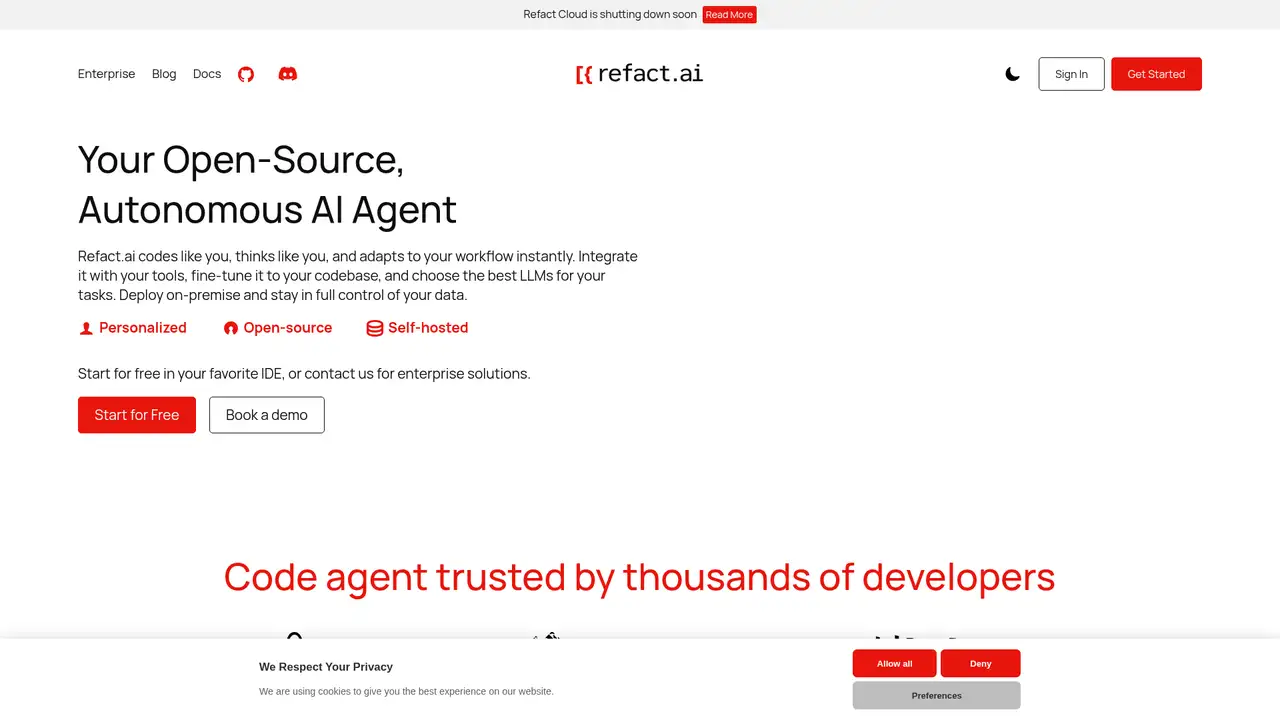
Refact.ai is an open-source coding assistant from SmallCloud AI, founded by Oleg Klimov, Vlad Guber, and Oleg Kiyashko. The team began work in 2021, and the IDE plugin launched on March 31, 2023 with completion, refactoring, and chat. TechCrunch reported in January 2024 that Refact had raised $2 million, run about 20 pilots, and operated with an eight-person London team. Its Agent became available to all users on January 31, 2025, adding autonomous planning, execution, and testing. A May 2025 company test recorded 59.7 percent on SWE-bench Lite for Refact Agent using Claude 3.7 Sonnet across 179 tasks. Refact Cloud shut down on April 30, 2026, removing managed accounts, hosted credits, and paid cloud subscriptions. The continuing project is local-first, with provider keys, local runtimes, and custom OpenAI-compatible endpoints.
Refact combines inline completion, repository-aware chat, retrieval augmented generation, and autonomous coding tasks in one IDE workflow. Its Agent can plan work, edit files, execute commands, run tests, and handle multi-file changes, including rollback and direct patching. The continuing project supports shell and browser access, GitHub and GitLab, database and Docker workflows, MCP, and a command-line interface, according to the 2026 shutdown announcement. A typical session starts by installing the IDE plugin, indexing a repository, selecting a provider or local runtime, and requesting an explanation, patch, test, or implementation. After Refact Cloud shut down on April 30, 2026, supported access became local-first or BYOK. Providers include OpenAI, Anthropic, Gemini, DeepSeek, Groq, xAI, OpenRouter, and custom OpenAI-compatible endpoints. Local runtimes include Ollama, LM Studio, and vLLM.
Refact’s model foundation is the Refact 1.6B Code LLM, trained for 20 programming languages with a 4,096-token context window. The company says it used permissively licensed code and open text, released the weights on Hugging Face, and offered the model for commercial use under the BigScience OpenRAIL-M license. The March 10, 2025 update added Claude 3.7 Sonnet, MCP, o3-mini planning, rollback, and direct patching; it also reported offline and local model support with related model updates. The Agent became available to all users on January 31, 2025, supporting autonomous planning, execution, testing, and repository work. A May 2025 company test reported 59.7 percent on SWE-bench Lite across 179 tasks using Refact Agent with Claude 3.7. The model weights alone do not make every platform component open source.
Refact Cloud historically offered Free at $0 and Pro from $10 per month. Free included limited daily Autonomous Agent use, 32,000-context IDE chat, unlimited Qwen2.5-Coder completions, and a code-aware vector database for repository retrieval. Pro provided 40 Agent requests daily, unlimited 64,000-context chat, and additional completion models. The May 2025 coin system listed 5,000 one-time Free coins, 10,000 monthly Pro coins with unused coins rolling over, and top-ups starting at $5, with $1 equal to 1,000 coins. BYOK and local models consumed no Refact coins. These prices are historical because Refact Cloud closed April 30, 2026. The continuing local-first project has no Refact-issued credits or hosted subscription prices. Users instead pay external model providers or infrastructure costs when those apply.
The main limitation is operational: Refact Cloud shut down on April 30, 2026, ending managed accounts, hosted credits, and paid cloud subscriptions. Users now configure provider keys, local runtimes such as Ollama, LM Studio, or vLLM, or custom OpenAI-compatible endpoints, then maintain installations and review applicable licenses. The legacy self-hosting repository is archived under a BSD-3-Clause license, although development moved to another repository. GitHub Copilot remains a managed service, Cursor focuses on an integrated editor, and Continue offers another local or BYOK route. Refact supports providers including OpenAI, Anthropic, Gemini, DeepSeek, Groq, xAI, and OpenRouter, giving users control over model selection and execution location. Refact’s terms restrict commercial use of its service, plugin, and model materials without express written consent, while its Refact 1.6B weights were released under BigScience OpenRAIL-M. Pick Refact if local control matters more than a maintained hosted subscription.
Who is Refact.ai best for?
- Developers who want local or BYOK coding models.
- Teams that can operate their own coding infrastructure.
- Engineers needing repository retrieval and agent workflows.
- Users comfortable maintaining open-source developer tools.
Refact.ai Pricing (2026)
Pricing model: Free. All prices in USD.
| Plan | Price | What you get |
|---|---|---|
| Local and open-source | $0 | No current Refact Cloud subscription or Refact-issued credits exist after the April 30, 2026 shutdown. Model access, compute, provider charges, and maintenance depend on the user’s chosen setup. |
Pros and Cons
Pros
- Supports Ollama, LM Studio, vLLM, and custom endpoints.
- Combines completion, chat, retrieval, and autonomous editing.
- Offers the Refact 1.6B Code LLM release.
- BYOK and local models avoid Refact usage credits.
Cons
- Refact Cloud shut down on April 30, 2026.
- The legacy self-hosting repository is archived.
- Commercial licensing terms require careful review.
Who should look elsewhere?
- Teams seeking a current managed subscription.
- Users wanting a supported hosted API with published pricing.
- Developers unwilling to configure providers or local runtimes.
Technical Details
Frequently Asked Questions
How much did Refact.ai cost?
Refact Cloud historically offered Free at $0 and Pro from $10 per month. Free included limited Agent use, 32,000-context chat, Qwen2.5-Coder completions, and repository retrieval. Pro offered 40 Agent requests daily and 64,000-context chat. Refact Cloud shut down April 30, 2026, so those prices no longer describe current subscriptions.
Does Refact.ai have a free plan now?
Refact no longer has a managed free Cloud plan. Cloud shut down April 30, 2026, while the coding project continued for local, self-hosted, and BYOK use. The software can be used without a Refact subscription, but model access, computer hardware, provider fees, and maintenance may still cost money.
How does Refact compare with GitHub Copilot?
GitHub Copilot remains a managed coding service, while Refact moved away from hosted subscriptions after Cloud closed. Refact gives developers more control over local models, custom endpoints, and self-managed workflows. Copilot requires less infrastructure work. Refact suits users prioritizing model control, while Copilot suits teams seeking a current commercial service.
Does Refact.ai train on user code?
Refact’s privacy policy and launch materials state that it does not collect data or datasets server-side. Its Terms grant a broader service and content license for Free accounts and permit training for Trial or Paid accounts only with further consent. BYOK providers have separate data handling and training terms, so users should review those providers’ policies.
Can Refact.ai be used commercially?
The Refact 1.6B Code LLM was released under BigScience OpenRAIL-M for commercial use. Refact’s terms separately restrict commercial use of service, plugin, and model materials without express written consent. Suggestions incorporated into user code are treated as the user’s code. Commercial teams should review each model, plugin, provider, and third-party license.
Best Refact.ai Alternatives in 2026
These tools do the same job as Refact.ai, with different pricing, limits and trade-offs.
AI coding assistance across editors, terminals, and GitHub
AI coding workspace with repository context and software agents

Open source coding agents for editors, terminals, and pull requests

Open coding agent for editors, terminals, desktops, and custom apps
Open-source AI pair programming in a Git-aware terminal