Pydantic AI Review, Pricing & Alternatives (2026)
Typed Python agents with structured outputs and provider choice
Last updated: October 26, 2026
What is Pydantic AI?
Pydantic AI is an open source, MIT licensed Python SDK for developers building typed AI agents in their own applications. It supports multiple model providers, typed tools, structured outputs, MCP, evaluations, graphs, realtime interfaces, and durable execution through external engines. The SDK is free, while optional Logfire observability starts with a free Personal plan, followed by Team at $49 per month.
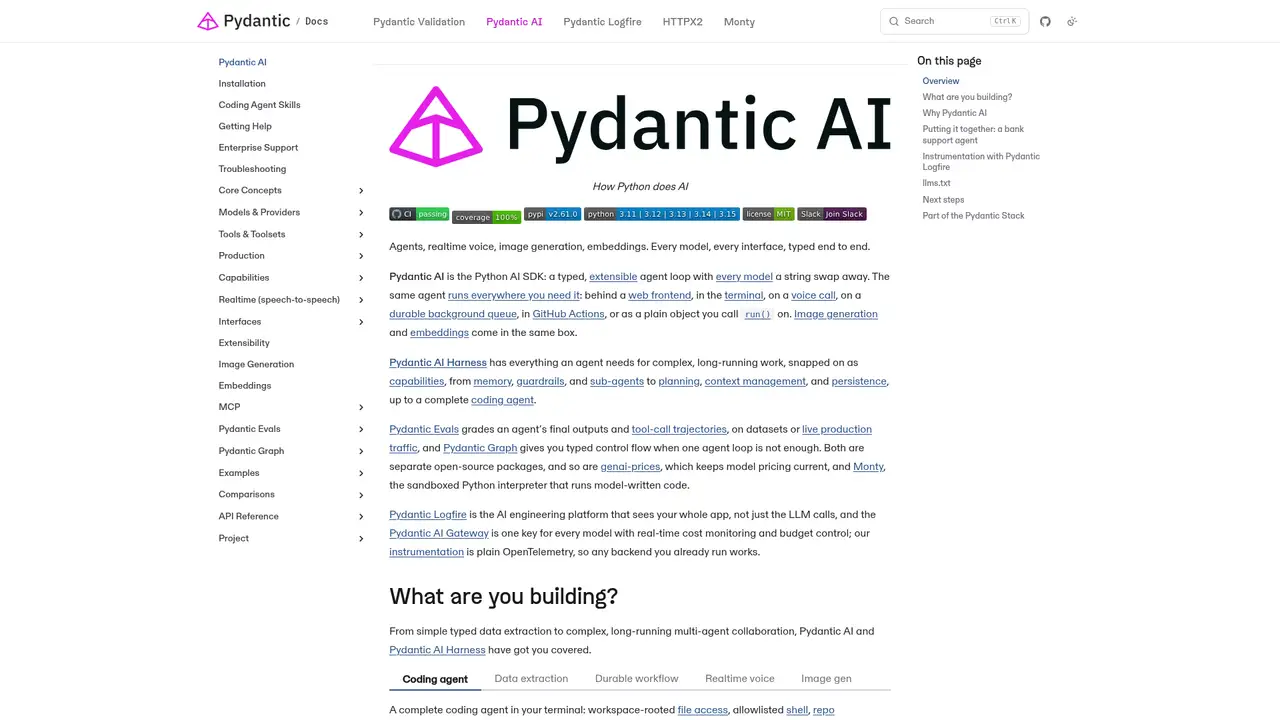
Pydantic AI is an open-source, MIT-licensed Python SDK for typed AI applications and agents, created and maintained by the Pydantic team. Its first public release arrived in December 2024, and it requires Python 3.11 or newer. The central Agent abstraction manages model calls, typed dependencies, tool inputs, structured outputs, retries, streaming, and message history. Pydantic models and type checking place schemas at the center of the programming model. The package runs inside the customer's process rather than through a Pydantic-hosted agent runtime. Durable execution therefore connects through external engines, including Temporal, DBOS, and Prefect. The company announced $12.5 million in Series A funding for Pydantic and Logfire in October 2024. Current documentation is hosted at pydantic.dev/docs/ai.
A normal application defines an Agent, chooses a model provider, declares dependencies, and registers tools with decorators, functions, or Tool objects. A prompt then starts the model loop. The agent validates tool arguments and structured output, retries failures when configured, and returns typed results or streamed data. Toolsets can combine local functions, MCP servers, and third party tools. Reusable capabilities can package tools, lifecycle hooks, instructions, model settings, or model selection. The same agent can serve a web interface, command line application, voice or realtime interface, frontend stream, or ordinary Python call. Documented integrations include AG-UI and Vercel AI, giving developers options for connecting the agent to different application surfaces.
Pydantic AI supports OpenAI, Anthropic, Google, Bedrock, Azure, Groq, Mistral, xAI, Ollama, and compatible APIs. The open-source package runs inside the customer’s application, while durable execution connects through external engines including Temporal, DBOS, and Prefect. Pydantic Evals tests agent behavior, Pydantic Graph supports typed graph workflows, and Pydantic AI Harness provides capabilities for complex coding and long-running work. Documented additions include realtime features, MCP support, Harness capabilities, and durability features. The release repository lists version 2.61.0, dated October 23, 2026. Model availability and compatibility depend on the installed version and provider configuration. These components require application-side setup and do not constitute a hosted Pydantic agent runtime. Teams therefore manage deployment and provider configuration themselves.
The Pydantic AI SDK is free and MIT licensed, while model providers, application infrastructure, and durable execution services cost separately. Optional Pydantic Logfire provides OpenTelemetry based tracing for agent runs, model requests, tools, and other application activity. Its Personal plan is free and includes 10 million telemetry records monthly, one seat, two read only guests, three projects, and 30 day retention. Team costs $49 monthly, includes 10 million records, and charges $2 for each additional million. Growth costs $249 monthly, includes the same record allowance, and supports retention up to 90 days. Enterprise pricing is custom. The AI Gateway has separate provider and usage terms, so its costs are not included in SDK or Logfire pricing.
The main limitation is operational responsibility. Pydantic AI does not provide a hosted agent runtime, so teams must manage the application process, provider configuration, and any durable execution service. Durable execution connects through engines including Temporal, DBOS, and Prefect, while the SDK runs in the customer’s process. LangGraph uses a graph oriented framework, whereas CrewAI and AutoGen focus on multi agent orchestration. Pydantic AI also includes Pydantic Graph, but its Agent abstraction prioritizes typed inputs, validated outputs, and ordinary Python composition. That makes it practical for Python teams seeking provider flexibility and explicit data contracts. Choose Pydantic AI when your application needs typed agent code and your team is prepared to operate the surrounding infrastructure and separately selected services.
Who is Pydantic AI best for?
- Python teams that need typed agent inputs and outputs.
- Applications that must switch among several model providers.
- Developers building custom tools, MCP connections, and structured workflows.
- Teams that want optional tracing without adopting a hosted agent runtime.
Pydantic AI Pricing (2026)
Pricing model: Free. All prices in USD.
| Plan | Price | What you get |
|---|---|---|
| Pydantic AI SDK | Free | Open source and MIT licensed. Model provider charges, application infrastructure, and optional services are separate. |
| Logfire Personal | Free | 10 million telemetry records per month, one seat, two read only guests, three projects, and 30 day retention. |
| Logfire Team | $49/month | 10 million records included, then $2 per additional million. Five seats and 10 read only guests are included. |
| Logfire Growth | $249/month | 10 million records included, then $2 per additional million. Unlimited seats, guests, and projects, with retention up to 90 days. |
| Logfire Enterprise Cloud | Custom | Custom retention, SLA backed support, SSO, SCIM, custom roles, and cloud, dedicated, or self hosted deployment options. |
| Logfire Enterprise Dedicated | Custom | Custom retention, SLA backed support, SSO, SCIM, custom roles, and cloud, dedicated, or self hosted deployment options. |
| Logfire Enterprise Self-hosted | Custom | Custom retention, SLA backed support, SSO, SCIM, custom roles, and cloud, dedicated, or self hosted deployment options. |
Pros and Cons
Pros
- Typed dependencies, tools, and outputs make agent contracts explicit.
- Provider support includes OpenAI, Anthropic, Google, Bedrock, and Ollama.
- MCP, evaluations, graphs, realtime interfaces, and durability are documented.
- The SDK sends nothing to Logfire unless instrumentation is configured.
Cons
- The SDK does not include hosted runtime infrastructure.
- Model and infrastructure bills remain separate from the SDK.
- Durable execution requires an external engine such as Temporal or Prefect.
Who should look elsewhere?
- Teams seeking a fully managed agent platform with no runtime work.
- Developers restricted to Python versions older than 3.11.
- Projects requiring provider costs and durable infrastructure in one subscription.
Technical Details
Frequently Asked Questions
How much does Pydantic AI cost?
The Pydantic AI SDK is free and MIT licensed. Model providers, application infrastructure, and durable execution services are billed separately. Optional Logfire has a free Personal plan, a $49 per month Team plan, a $249 per month Growth plan, and custom Enterprise pricing. The AI Gateway is optional and has separate provider and usage terms.
Does Pydantic AI have a free plan?
Yes. The SDK is open source and free to use. Logfire also has a free Personal plan with 10 million telemetry records per month, one seat, two read only guests, three projects, and 30 day retention. Personal ingestion pauses after the monthly record limit instead of charging for additional records.
How does Pydantic AI compare with LangGraph?
Pydantic AI centers development on Python types, validated tool inputs, structured outputs, and provider selection. LangGraph is a competing framework with a graph oriented design. Pydantic AI also offers Pydantic Graph, but its main Agent abstraction is designed for typed application code, while LangGraph places graph construction closer to the center of workflow design.
Does Pydantic AI train on user data?
Installing the SDK does not send prompts or tool data anywhere. Data is sent when an application configures a model provider, telemetry backend, or hosted service. Logfire instrumentation is optional. Data processing and retention therefore depend on the providers and services selected by the application, along with their applicable terms and controls.
Can I use Pydantic AI commercially?
Yes. The SDK is MIT licensed, which permits commercial use under that license. An application remains responsible for model provider terms, output restrictions, data handling, and licenses for included dependencies or tools. Logfire is a separate commercial service with Personal, Team, Growth, and Enterprise plans.
Best Pydantic AI Alternatives in 2026
These tools do the same job as Pydantic AI, with different pricing, limits and trade-offs.