
Producer.ai Review, Pricing & Alternatives (2026)
Conversational music creation with songs, videos, remixes and instruments
acquired: Google announced on February 24, 2026 that ProducerAI joined Google Labs. The service continued as a standalone product, with current branding and links using Google Flow Music.
Last updated: October 26, 2026
What is Producer.ai?
Producer.ai is a conversational music creation service from Google Labs for musicians, creators and beginners who want songs, vocals, remixes and related media from natural language. It includes a free plan with daily credits, while paid access starts at $6 per month with annual billing. Current product pages use the Google Flow Music branding.
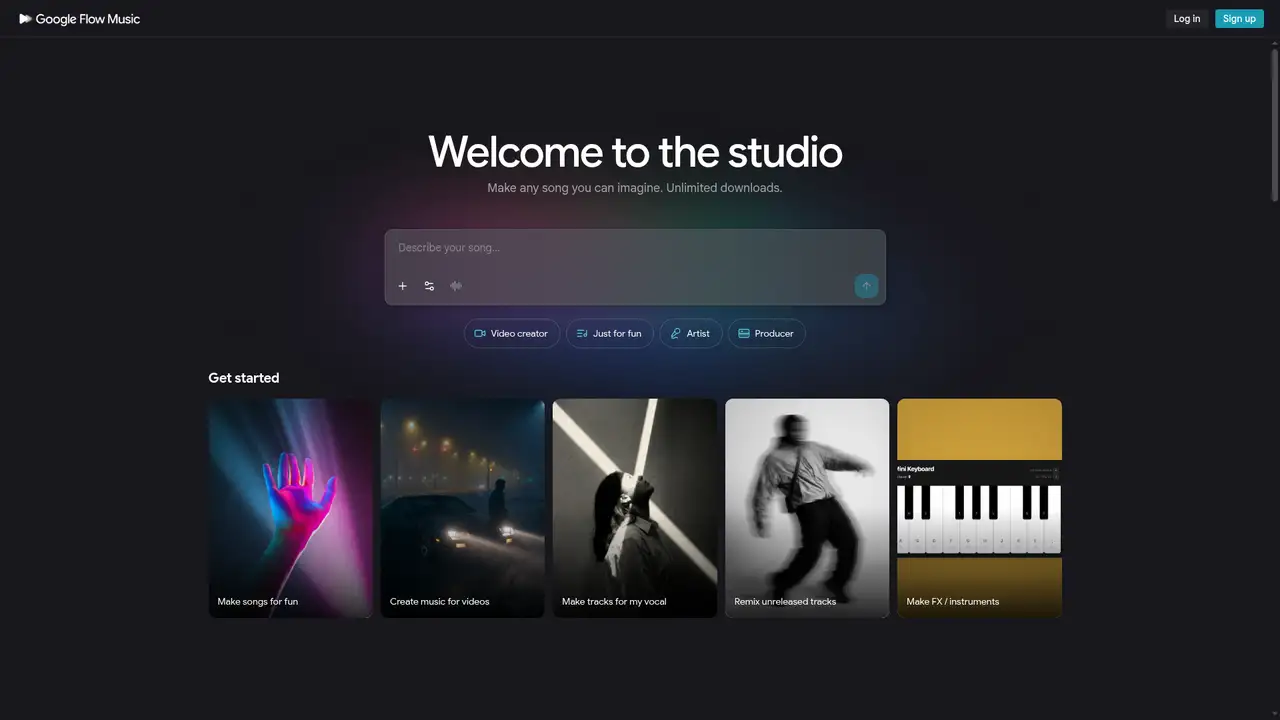
Producer.ai is a conversational music creation service that became part of Google Labs after Google announced the move on February 24, 2026. It began as Riffusion, an open source project launched in December 2022, then launched as ProducerAI in July 2025. The current product pages use Google Flow Music branding while the requested product identity remains Producer.ai. Google presents the service as a place to create, publish and share studio quality songs, with music videos, instruments and personalization included in the same product. Its audience includes musicians, creators and beginners who want finished tracks without beginning in a traditional digital audio workstation. The service is available through web and mobile experiences, with free and paid access.
The workflow starts with a natural language request describing a song, genre, mood or production direction. Users can then continue the conversation to refine the result, while Google advertises full length songs, dynamic vocals, granular tempo control and time aligned lyrics. Current features include remixing, audio effects, stem splitting, publishing, playlists and downloads in MP3, WAV and M4A. Spaces add natural language tools for creating instruments, plugins, music games and digital audio workstations. Users can also direct music videos with Veo and create album artwork with Nano Banana. In practical terms, a session moves from prompt to song, revision, effects or stems, then export, sharing or publication. That makes Producer.ai broader than a single text to music generator.
Google says Gemini coordinates the conversational producer and Lyria 3 generates the music, with detailed tempo and lyric control. Veo creates music videos, Nano Banana creates album art and SynthID watermarks generated outputs. The Google Flow Music homepage now promotes Lyria 3.5, while the App Store listing reports a May 2026 update that improved musicality, lyrics and vocal quality. The service also promotes personalization, saying continued creation helps it understand a user's sound. These capabilities belong to the Flow Music product experience and do not represent access to a separate Gemini API. Producer.ai therefore combines conversational control with Google's current music, video, image and watermarking systems, while retaining a product lineage that began with Riffusion.
The free plan costs $0 and includes daily top up credits, two concurrent generations and core features. Starter costs $6 per month with annual billing and includes 3,000 monthly credits, about 600 songs, daily top ups and eight concurrent generations. Plus costs $18 per month with annual billing, while Member costs $48 per month with annual billing. Third party October pricing documentation reports 10,000 monthly credits and 12 concurrent generations for Plus, plus 30,000 credits and 16 concurrent generations for Member. At five credits per song, those figures represent about 2,000 and 6,000 songs. The official pricing page lists MP3, WAV and M4A downloads, while the monthly pricing view lists equivalent prices of $8, $24 and $64.
Producer.ai depends on Google's online service, credits and current Flow Music interface, and it does not offer a current open source model or self hosted Flow Music service. Google's terms say it will not claim ownership of generated content, but that statement does not guarantee copyright protection or resolve every commercial licensing question. The Flow Music privacy notice says Google collects uploads, generated output, feature usage and feedback, stores generated outputs until deletion by default, and retains conversation data for up to 18 months. Suno offers a close song creation workflow, Udio emphasizes song generation and editing, and ElevenLabs Music targets creator focused generation. Producer.ai adds Google's video, image and SynthID tools, making it the strongest fit for conversational full song creation with connected media features.
Who is Producer.ai best for?
- It suits creators who want full songs from conversational prompts.
- It suits musicians exploring vocals, remixes, stems and audio effects.
- It suits users who want music videos and album art in one service.
- It suits beginners who do not want to start in a digital audio workstation.
Producer.ai Pricing (2026)
Pricing model: Freemium. All prices in USD.
| Plan | Price | What you get |
|---|---|---|
| Free | $0 | Daily top up credits, two concurrent generations and all core features. |
| Starter | $6/month | Annual billing. 3,000 monthly credits, about 600 songs, daily top ups and eight concurrent generations. |
| Plus | $18/month | Annual billing. Third party October pricing documentation reports 10,000 monthly credits, about 2,000 songs and 12 concurrent generations. |
| Member | $48/month | Annual billing. Third party October pricing documentation reports 30,000 monthly credits, about 6,000 songs and 16 concurrent generations. |
Pros and Cons
Pros
- Google combines Gemini, Lyria, Veo and Nano Banana in one workflow.
- The free plan includes daily credits and core creation features.
- It users can download MP3, WAV and M4A files.
- It synthID watermarks generated outputs.
Cons
- It current branding and service terms changed after Google's acquisition.
- It higher plan credit and concurrency details are partly third party reported.
- Google terms do not guarantee copyright protection for generated music.
Who should look elsewhere?
- It is a poor fit for teams requiring a self hosted music generation system.
- It is a poor fit for developers seeking a published standalone music API.
- It is a poor fit for users needing a guaranteed copyright position for commercial releases.
Technical Details
Frequently Asked Questions
How much does Producer.ai cost?
Producer.ai has a free plan with daily top up credits. Starter costs $6 per month with annual billing and includes 3,000 monthly credits. Plus costs $18 per month with annual billing, while Member costs $48 per month with annual billing. The monthly pricing view lists equivalent prices of $8, $24 and $64. Higher plan credit and concurrency figures are reported in October third party pricing documentation.
Does Producer.ai have a free plan?
Yes. The Free plan costs $0 and includes daily top up credits, two concurrent generations and core features. The product also advertises full song creation, remixing, audio effects, stem splitting and downloads. The pricing page does not state the exact daily credit quantity, so free usage depends on the allocation applied to the account.
Is Producer.ai better than Suno?
Producer.ai and Suno both create songs from prompts. Producer.ai adds Google's Gemini, Lyria, Veo, Nano Banana and SynthID features, along with Spaces for instruments, plugins, games and digital audio workstations. Suno remains a direct song generation competitor. Producer.ai suits users who want connected Google tools for music, video and artwork in one workflow.
Does Producer.ai use user data to improve its services?
The Flow Music privacy notice says Google collects uploads, generated output, feature usage and feedback. It says Google may use this data to provide, improve and develop products and machine learning technologies. Users can turn off Help improve Google Flow Music in settings, although reviewed or annotated data can remain separately for up to 18 months. Google also stores generated outputs until users delete them.
Can I use Producer.ai music commercially?
Google's current terms say Google will not claim ownership of generated content. That statement does not guarantee copyright protection or establish every commercial condition for a particular track. Service specific terms can govern additional rights and restrictions. Users planning monetized releases should review the current Flow Music terms, keep records of the subscription used and check any rules affecting uploaded material or generated output.
Sources
- Google announcement about ProducerAI joining Google Labs
- Current Producer.ai and Flow Music product page
- Official Flow Music annual pricing
- Official Flow Music privacy notice
- Google Terms of Service used by Flow Music
- Google Flow Music App Store release information
- The Verge acquisition and pricing report
- Third party operational pricing documentation
Best Producer.ai Alternatives in 2026
These tools do the same job as Producer.ai, with different pricing, limits and trade-offs.
Prompt-driven song creation with editing, stems, and voice tools
Generate, extend, remix, and edit songs from text prompts

Prompt complete songs with vocals, structure, and commercial rights.

Instrumental music and sound effects with open weights and commercial rights

AI music creation, production, mastering, and distribution for creators