
Paperpal Review, Pricing & Alternatives (2026)
Academic editing, research discovery, and submission checks in one workspace
Last updated: October 26, 2026
What is Paperpal?
Paperpal is an academic writing assistant from Editage and Cactus Communications for researchers, students, and scholarly teams. It combines language editing, paraphrasing, translation, citation tools, PDF chat, plagiarism checks, and submission-readiness features across web and document integrations. A free tier is available; Prime starts at $25 per month or $144 annually.
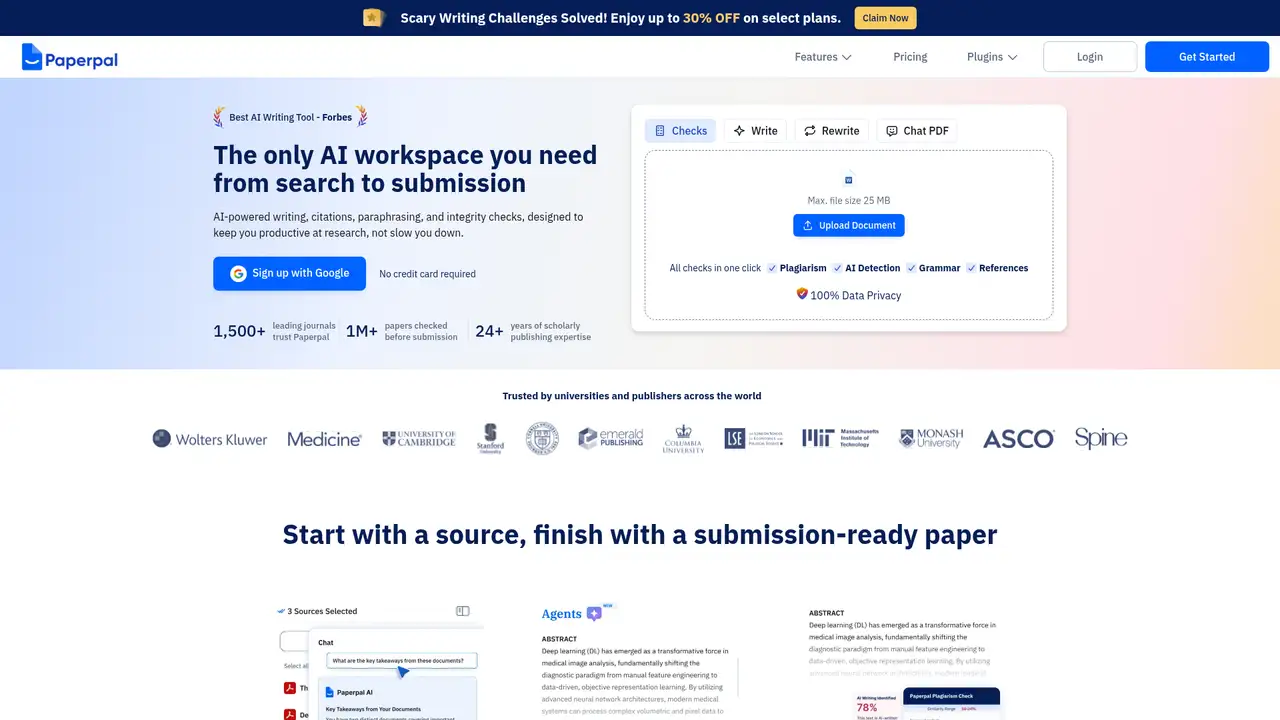
Paperpal is an academic writing environment from Editage and Cactus Communications, not a general grammar checker. Its documented tools cover grammar and vocabulary suggestions, academic translation, rewriting, generative assistance, consistency checks, plagiarism checking, AI detection, citation generation, Research and Cite, Chat PDF, and submission readiness. Users can access these functions through a web editor and integrations for Microsoft Word, Chrome, Google Docs, and Overleaf. Paperpal’s maker, Cactus Communications, does not publish a launch year or funding history for the product. For researchers, Paperpal’s defining identity is breadth. It places language editing, research questions, document analysis, citations, and manuscript preparation in one account, which may reduce the need to combine several specialized services.
Paperpal’s workflow usually begins with an uploaded or pasted manuscript, a connected document, or a question about a research PDF. Users can review language suggestions, rewrite passages, translate text, generate citations, ask Research Q&A questions, and check work for plagiarism, AI generated text, consistency, or submission readiness. Chat PDF and Research and Cite extend the product beyond sentence level correction by helping users interrogate sources and prepare references. Word, Chrome, Google Docs, Overleaf, mobile, and web support provide several entry points, although features differ across surfaces and plans. Prime is presented for regular research and writing, while Pro is aimed at theses, journal articles, clinical documents, and other higher stakes material. Buyers should confirm their preferred integration before subscribing.
Paperpal’s official materials describe proprietary and fine tuned AI systems, but they do not identify a complete commercial model family. The company says its models are trained on independent scholarly datasets. Its changelog records updates across the web editor, Word, mobile, Chrome, Overleaf, and Google Docs through September 30, 2026. A February 2026 company article highlights Research and Cite, Chat PDF, writing support, and submission checks. These releases indicate that Paperpal is extending from language correction toward a broader research workflow. They do not provide a versioned model inventory or enough technical information to compare architecture, context windows, routing, or latency with general purpose AI services. Technical buyers should therefore evaluate results directly rather than infer capabilities from release descriptions.
Paperpal offers a free tier, Prime at $25 per month or $144 per year, and Pro at $59 per month or $348 per year. A February 2026 company article says free users receive unlimited citation generation and Chat PDF, five Research Q&A uses per day, and limited writing features. The same article describes unlimited Research Q&A, citation generation, and Chat PDF for Prime. Pricing material does not fully expose allowances for every feature, so frequent users should verify quotas in the account before paying. Enterprise and institutional access is custom priced, with shared libraries and access management advertised. Regional pricing, taxes, promotions, currency conversion, and renewal terms can affect the final amount. Pro may suit higher stakes work, but its extra limits should be confirmed.
Paperpal’s breadth also creates a substantial review burden. A 2025 study reported gains in grammar, clarity, and editing efficiency, while finding general suggestions, contextual inaccuracies, and limited creativity support. Another 2025 account described altered spelling conventions, edited quotations, and errors that changed meaning. Writefull is a closer fit for focused scholarly language feedback and Overleaf work, Grammarly is broader for general business writing, and Trinka targets technical and academic English. These differences matter when choosing: a user seeking one workspace for editing, research discovery, PDF questions, citations, and submission checks may accept Paperpal’s need for careful verification. Paperpal is best for researchers and academic teams wanting those combined functions, provided every substantive change, quotation, citation, and technical term is reviewed.
Who is Paperpal best for?
- Researchers editing journal manuscripts and theses.
- Authors preparing submissions across multiple journal formats.
- Teams needing shared scholarly writing resources.
- Users wanting research questions and language editing together.
Paperpal Pricing (2026)
Pricing model: Freemium. All prices in USD.
| Plan | Price | What you get |
|---|---|---|
| Free | $0 | Five Research Q&A uses per day, unlimited citation generation and Chat PDF, plus limited writing features according to a February 2026 company article. |
| Prime | $25/month or $144/year | Unlimited Research Q&A, citation generation, and Chat PDF according to the company article; complete feature limits are not published in the pricing material. |
| Pro | $59/month or $348/year | Designed for high-stakes research writing, theses, journal articles, and clinical documents; complete feature limits are not published in the pricing material. |
| Enterprise/Institution | Custom | Shared libraries and access management are advertised; seat counts and quotas depend on the contract. |
Pros and Cons
Pros
- Combines academic editing with citations, PDF chat, and submission checks.
- Works across Word, Google Docs, Overleaf, Chrome, mobile, and web.
- Free users receive useful citation and PDF features.
- The company publishes detailed security and privacy controls.
Cons
- Feature quotas are not consistently exposed in public pricing text.
- Independent reports document contextual and meaning-changing edits.
- The company does not publish a complete model inventory.
Who should look elsewhere?
- Writers seeking unrestricted general-purpose AI generation.
- Authors who want autonomous manuscript editing.
- Teams requiring published model versions and technical benchmarks.
Technical Details
Frequently Asked Questions
Does Paperpal replace a human editor?
No. Its suggestions can improve grammar, clarity, consistency, and submission preparation, but independent reports document contextual mistakes, changes to quotations, spelling mismatches, and meaning-changing edits. Authors should inspect every suggestion, preserve citations and technical terminology, and follow the target journal’s style guide. Paperpal works best as an editing aid rather than a final editorial authority.
Is Paperpal free?
Yes, Paperpal offers a free tier, but it is usage-limited. The February 2026 company article says free users receive unlimited citation generation and Chat PDF, five Research Q&A uses per day, and other limited writing features. The exact current allowance for every tool is not fully visible in the pricing material, so users should confirm quotas in the live account.
What does Paperpal Prime cost?
The official Help Center lists Prime at $25 per month when billed monthly, or $144 per year, equivalent to $12 per month billed annually. Prices can be localized. Taxes, promotions, currency conversion, renewal terms, and any checkout-specific offer should be checked before purchase. The official Help Center does not confirm multi-year pricing.
Does Paperpal train on uploaded manuscripts?
Paperpal says no. Its security page and Help Center state that documents, uploads, personal information, and processed content are not used to train its AI, including for free users. The company says its models are trained on independent scholarly datasets. For confidential research, authors should still review retention, deletion, subprocessors, and any institutional data-processing agreement.
Which AI model does Paperpal use?
The official material does not identify a branded model such as GPT or Claude. Paperpal describes advanced proprietary and fine-tuned systems tailored for scholarly writing. Its security page says models are trained on independent scholarly datasets. Because the vendor does not publish a complete model inventory, model identity, routing, and third-party provider use remain unverified.
Best Paperpal Alternatives in 2026
These tools do the same job as Paperpal, with different pricing, limits and trade-offs.