
OpenCode Review, Pricing & Alternatives (2026)
Provider-flexible coding agent for terminal, desktop, and IDE work
Last updated: October 22, 2026
What is OpenCode?
OpenCode is an MIT licensed coding agent for developers who want repository editing through terminal, desktop, or IDE clients. The client is free, while provider usage, Zen, and Go add costs. OpenCode Go starts at $10 per month, with Go Plus at $40 per month and model-specific usage limits.
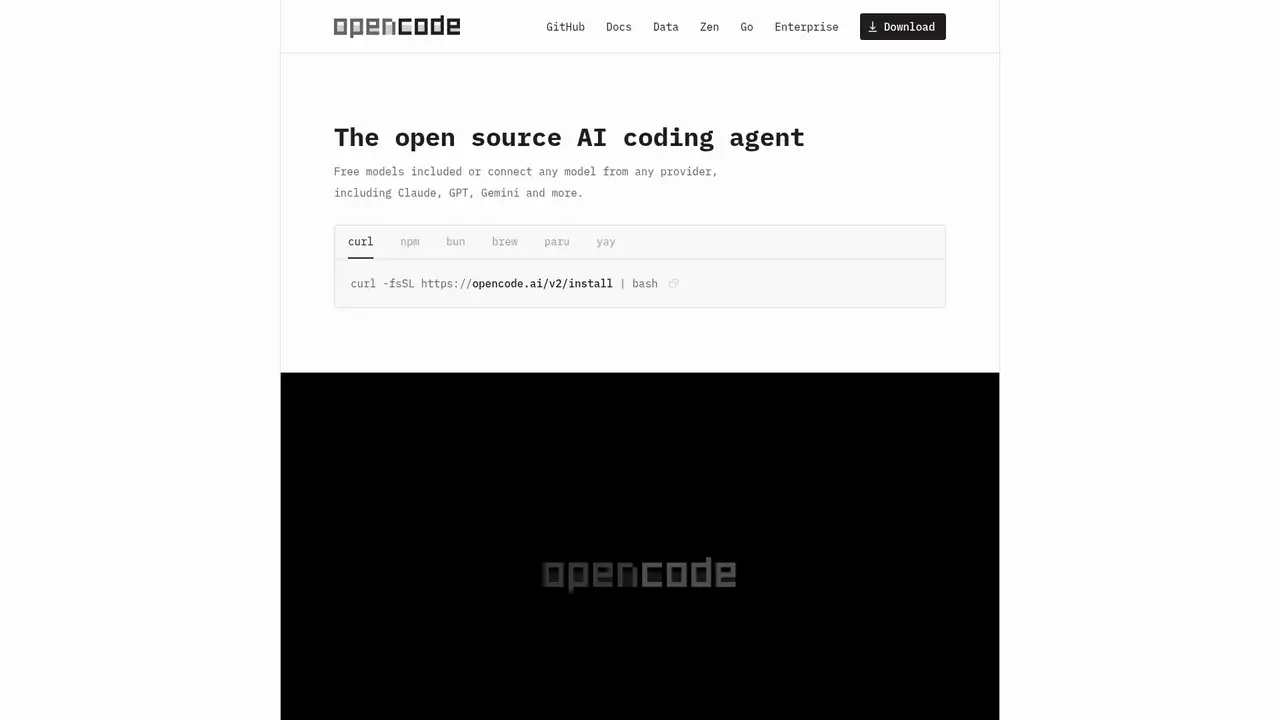
OpenCode is an open source coding agent for terminal, desktop, and IDE workflows. The public site reports more than 215,000 GitHub stars, 950 contributors, 20,000 commits, and more than 16 million developers monthly, figures the company can change. The repository identifies the software as MIT licensed. Current documentation distinguishes OpenCode 1 and OpenCode 2, which share the same command name and cannot coexist under default installation paths. Version 2.1.2 is dated October 21, 2026. OpenCode is best understood as a client and agent layer rather than one hosted assistant. It can inspect repositories, explain code, edit files, run commands, and keep multiple sessions. The MIT license permits commercial modification and distribution subject to its conditions.
A typical workflow starts in a project directory with the opencode command. The documentation describes an /init command that creates an AGENTS.md file for project structure and coding conventions. OpenCode separates a build agent from a plan agent: the build agent can edit files and run commands, while the plan agent is read-only by default and asks before bash commands. Sessions can use LSP integration, provider selection, and a general subagent. Developers can connect OpenAI, Anthropic, Google, xAI, GitHub Copilot, ChatGPT Plus or Pro, local models, OpenCode Zen, or OpenCode Go. The terminal, desktop, and IDE clients support the same provider choice. This workflow is adaptable, although the account, model, quota, and data terms depend on the selected route.
OpenCode does not supply one underlying model. Its catalog uses Models.dev and covers more than 75 providers, including local models. Version 2.1, dated October 20, 2026, added persistent Windows PTYs, an experimental todo tool, and support for long-running TUI commands beyond Bun's five-minute fetch deadline. Version 2.1.2 added clearer free-limit recovery, an option to hide free models, and installer fixes for fresh shells. OpenCode Go also documents curated models, API endpoints, model identifiers, and usage tables. Go requests use rolling limits of 20 percent of a model allowance per five hours, 50 percent weekly, and 100 percent monthly. The client remains separate from inference, which can come from a direct provider, local runtime, Zen, or Go.
The client costs $0, and free models include Big Pickle plus promotional models with a stated quota of 200 requests per day. Direct providers remain usage based because each provider controls its prices, quotas, and terms. Zen is optional pay as you go. OpenCode Go costs $10 per month, while Go Plus costs $40 per month, with higher limits. Go model allowances are model specific. For example, the Go documentation lists a $15 monthly limit for GPT 5.6 Luna, $80 for DeepSeek V4.1 Flash, and $60 for GLM-5.3-Flash. Go and Go Plus share token prices but differ in included monthly limits. Console access costs $0, while connected model inference and Go usage are charged separately.
OpenCode's main tradeoff is choice. Provider selection can reduce lock-in, but it also makes billing, privacy, and troubleshooting less predictable than a single-vendor product. The Go privacy table says most listed models do not use prompts for training, while Muse Spark models permit training and Gemini 4 Argon Contributor may use prompts and completions for future Google models. Compared with Claude Code, OpenCode offers local models and a broader provider route. Compared with Cursor, it is more terminal centered and MIT licensed. Compared with Aider, it adds desktop and IDE clients. Pick OpenCode for repository work when provider flexibility matters more than one unified account and bill.
Who is OpenCode best for?
- Developers editing repositories from a terminal.
- Teams needing local models or multiple providers.
- Users wanting read-only planning before edits.
- Engineers using terminal, desktop, and IDE clients.
OpenCode Pricing (2026)
Pricing model: Freemium. All prices in USD.
| Plan | Price | What you get |
|---|---|---|
| Client and free models | $0 | The client is free. Big Pickle and promotional models have a stated quota of 200 requests per day, and availability can change. |
| Direct providers | Usage-based | The connected provider controls model prices, quotas, account requirements, and data terms. |
| OpenCode Zen | Usage-based | Optional pay as you go model service. |
| OpenCode Go | $10/month | Lower-cost access to the Go model lineup. Limits are model specific, with 20 percent of monthly allowance per five hours, 50 percent weekly, and 100 percent monthly. |
| OpenCode Go Plus | $40/month | The same Go lineup with higher usage limits. Token prices match Go, while included allowances are model specific. |
| OpenCode Console | $0 | Console access is free; connected model inference and Go usage are charged separately. |
Pros and Cons
Pros
- MIT licensing permits commercial modification.
- Supports direct, local, and catalog providers.
- Plan and build agents separate exploration and changes.
- Go exposes documented model APIs and SDK routes.
Cons
- Provider choice complicates pricing and privacy.
- Free and subscription limits can interrupt sessions.
- Different client and provider routes require setup care.
Who should look elsewhere?
- Teams requiring one predictable all-inclusive model bill.
- Users wanting a minimal prompt-only command line.
- Organizations unable to route inference through vendors.
Technical Details
Frequently Asked Questions
How much does OpenCode cost?
The client is free, and free models are available, but usage is not universally unlimited. Direct providers charge their own accounts, Zen uses pay as you go pricing, Go costs $10 per month, and Go Plus costs $40 per month. Model allowances differ by model, and the product documentation says limits may change.
Can I use OpenCode without paying?
Yes. The client costs nothing and the free route includes Big Pickle plus promotional models, with a stated quota of 200 requests per day. You can also connect a local model or an existing provider account. Paid providers, Zen, or Go may be needed for higher capacity or particular models.
OpenCode or Claude Code?
OpenCode is the better fit for local models, multiple providers, desktop access, or an MIT licensed client. Claude Code centers on Anthropic's model and account experience. OpenCode can connect to Anthropic, but billing, capabilities, and privacy then follow the selected provider or OpenCode service.
Does OpenCode train on user code?
Training and retention depend on the selected model route. The Go privacy table marks most listed models as not using prompts for training, but Muse Spark models permit training and Gemini 4 Argon Contributor may use prompts and completions for future Google models. Review the provider terms before sending sensitive repositories.
Can businesses use OpenCode commercially?
The repository uses the MIT License, which permits commercial use, modification, and distribution subject to its conditions. That license applies to the software, not third-party models, provider subscriptions, generated-code warranties, or paid-service terms. Businesses should review each model license and data agreement before deployment.
Best OpenCode Alternatives in 2026
These tools do the same job as OpenCode, with different pricing, limits and trade-offs.
An agentic coding assistant for terminal, IDE, desktop, and web
AI coding workspace with repository context and software agents
Open-source AI pair programming in a Git-aware terminal

Open coding agent for editors, terminals, desktops, and custom apps
An agent-native code editor unified with Cognition's Devin platform