
Open Interpreter Review, Pricing & Alternatives (2026)
A provider-neutral coding agent for terminal, desktop, and computer control
Last updated: October 26, 2026
What is Open Interpreter?
Open Interpreter is an Apache 2.0 coding agent for terminal workflows, local models, hosted providers, and computer control. It targets developers and technical users who want commands, code edits, browser testing, and application automation from one interface. The terminal software costs $0; separate Interpreter Desktop plans start at $0, with Pro at $20 monthly.
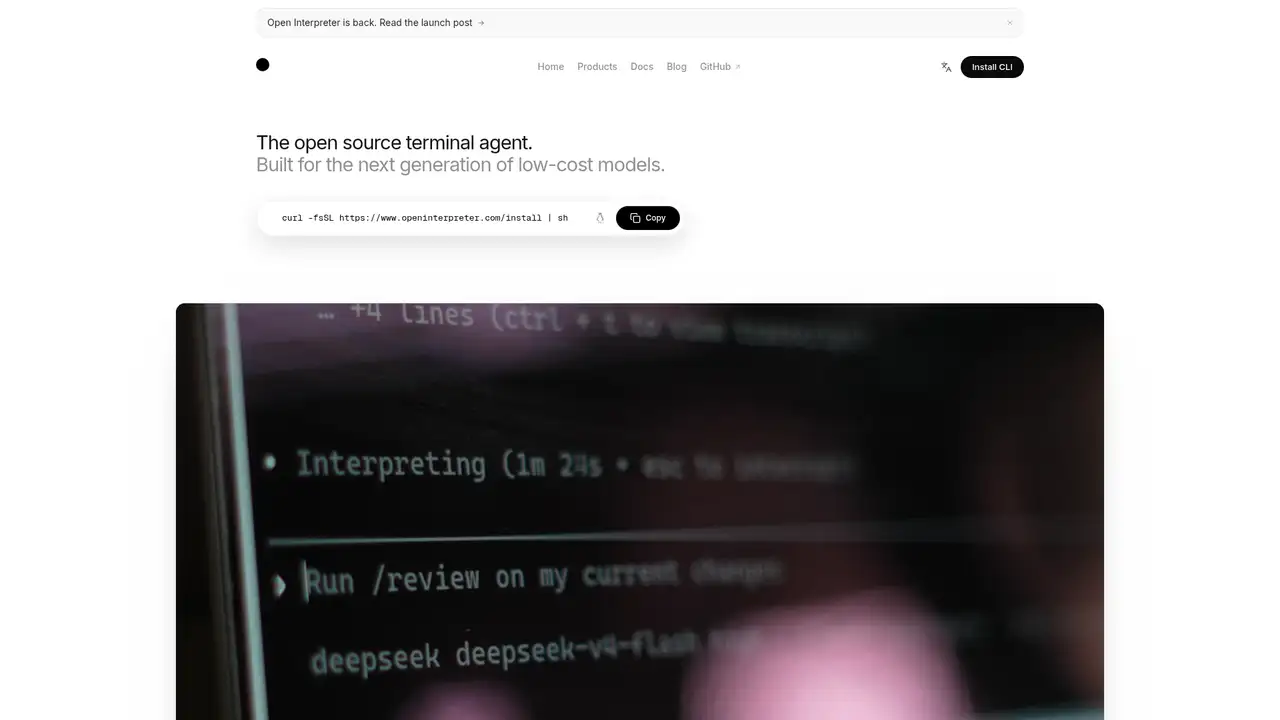
Open Interpreter is an open-source coding agent maintained by the Open Interpreter project, whose current repository is a Rust implementation built on the Codex agent runtime. The original Python implementation remains available through the community-maintained endolith fork, so users encounter two related projects with different maintenance paths. The current Rust project is licensed under Apache 2.0 and publishes native packages for macOS, Windows, and Linux. Its remit extends beyond code editing: it can run terminal commands, select model providers, test browsers, operate native applications, and connect with editors. The project publishes no funding figure or employee count. Development remains active, with release 0.0.56 dated October 7, 2026, updating model metadata and correcting shell-environment handling when eligible idle threads resume.
Open Interpreter’s Rust terminal client supports a provider-neutral workflow across macOS, Windows, and Linux. After installation, users open a project directory, choose a model or provider, and ask the agent to inspect files, edit code, run commands, or test an interface. Native sandboxing, permissions, hooks, skills, MCP, and AGENTS.md files determine what the session can access and execute. The terminal interface switches models with /model and harnesses with /runtime, while ACP-compatible editors and Codex-compatible clients extend the same workflow beyond the terminal. OpenAI-compatible Chat Completions endpoints and local streaming web chat support custom deployments. For broader automation, agent-browser can operate real browsers and trycua can control native applications, giving the client a path from repository changes to interface testing without requiring one model vendor.
The current project is a Rust implementation built on the Codex runtime, not a proprietary language model. It supports OpenAI-compatible endpoints and lists integrations for Anthropic, Alibaba, Kimi, DeepSeek, Google, Groq, Ollama, and other configured providers. Release 0.0.56, published October 7, 2026, added GPT-6.1 Sol metadata, refreshed the maintained provider catalog, added Anthropic Claude Sonnet 5.5, and fixed shell-environment rebinding when resuming eligible idle threads. Earlier 2026 releases added model entries for Claude, Kimi, Alibaba, DeepSeek, Google, and Groq. The bundled catalog does not guarantee account access, since availability can vary by provider and region. Users can run the `/model` command to see practical choices for their configured accounts. This architecture keeps provider selection separate from the terminal client and supports both hosted and local inference.
The terminal software costs $0 under Apache 2.0, but model calls can incur provider charges. Local providers such as Ollama can keep inference on the user's machine, while hosted providers require separate credentials and billing. Interpreter Desktop is a separate product. Its Free tier costs $0 monthly and includes bring-your-own API keys, experimental browser control, and ChatGPT sign-in. Pro costs $20 monthly, adding hosted models, four times the Free usage, and experimental macOS control. Business costs $60 monthly and provides three times Pro usage. These plans do not make every external provider free, and terminal users should not treat Desktop allowances as terminal entitlements. Hosted Desktop requests pass through company servers and are logged for up to 30 days, while local and bring-your-own-key routing follows different handling. The practical cost depends on the chosen provider, model, and request volume.
Open Interpreter's breadth creates a security tradeoff: terminal commands, browser sessions, and native application control can affect files, credentials, and external services. Its native sandbox runs on macOS, Linux, and Windows, while permissions, hooks, skills, MCP, and AGENTS.md files shape sessions. Provider billing remains separate from the free Apache 2.0 terminal software, although Ollama can keep inference on the user's machine. Interpreter Desktop is separate, with a $0 Free plan, $20 monthly Pro plan, and $60 monthly Business plan; hosted desktop requests can be logged for up to 30 days. Aider offers a narrower repository-editing workflow, Claude Code centers on Anthropic's model service, and GitHub Copilot CLI provides a more integrated GitHub path. Open Interpreter suits developers who want terminal coding, local or hosted model choice, and computer-use capabilities in an Apache-licensed project.
Who is Open Interpreter best for?
- Developers who want one agent for terminal coding and interface testing.
- Users who need local, hosted, and OpenAI-compatible model options.
- Teams that require sandboxing, permissions, and approval controls.
- Technical users automating browsers and native applications.
Open Interpreter Pricing (2026)
Pricing model: Freemium. All prices in USD.
| Plan | Price | What you get |
|---|---|---|
| Terminal | $0 | Apache 2.0 software with provider selection; hosted model providers may charge separately. |
| Desktop Free | $0/month | Bring your own API keys, experimental browser control, or ChatGPT sign-in. |
| Desktop Pro | $20/month | Hosted models, four times Free usage, and experimental macOS control. |
| Desktop Business | $60/month | Everything in Pro and three times Pro usage. |
Pros and Cons
Pros
- Apache 2.0 permits commercial use, modification, and redistribution.
- The Rust client supports hosted, local, and compatible providers.
- Native sandboxing covers macOS, Linux, and Windows.
- Computer-use features test browsers and native applications.
Cons
- Provider charges remain separate from the free terminal software.
- Computer control can expose files, credentials, and external services.
- Model availability depends on provider accounts and regional access.
Who should look elsewhere?
- People who want included model usage without configuring a provider.
- Users unwilling to review commands or grant computer permissions.
- Teams requiring a single vendor for software and model billing.
Technical Details
Frequently Asked Questions
Is Open Interpreter free?
The current terminal project costs $0 and uses Apache 2.0. Model inference is separate: hosted providers can charge for requests, while local providers such as Ollama can run models on the user's hardware. Interpreter Desktop also has a $0 Free tier, but its included features and routing differ from the terminal software.
How much does Interpreter Desktop cost?
Interpreter Desktop Free costs $0 monthly and includes bring-your-own API keys, experimental browser control, and ChatGPT sign-in. Pro costs $20 monthly, adding hosted models, four times Free usage, and experimental macOS control. Business costs $60 monthly and provides three times Pro usage. These plans do not make every external provider free.
How does Open Interpreter compare with Aider?
Aider concentrates on editing software repositories through a focused coding loop. Open Interpreter covers repository work but also runs commands, supports multiple harnesses, tests browsers, and operates native applications. Aider is the more specialized choice for code changes, while Open Interpreter suits users who want coding plus broader computer control.
Does Open Interpreter send files to its servers?
The terminal can use local providers or configured hosted providers, so data handling depends on that routing choice. Interpreter Desktop says hosted requests pass through company servers and are logged for up to 30 days. Local and bring-your-own-key configurations follow different paths. The model provider's own training and retention policy also applies.
Can Open Interpreter be used commercially?
Yes. The current project uses Apache 2.0, which permits commercial use, modification, and redistribution with the license's required notices. Commercial users still need to follow model-provider terms, third-party software licenses, application permissions, privacy obligations, and any restrictions attached to the data or services they process.
Best Open Interpreter Alternatives in 2026
These tools do the same job as Open Interpreter, with different pricing, limits and trade-offs.
Open-source AI pair programming in a Git-aware terminal
An agentic coding assistant for terminal, IDE, desktop, and web

An agentic coding assistant for GitHub-centered terminal work

AI-assisted shell commands, code snippets, and terminal explanations

Agentic coding in a terminal with specs, hooks, MCP, and model choice.