
Obviously AI Review, Pricing & Alternatives (2026)
No-code predictive analytics, now continued under the Zams brand
rebranded: Obviously AI became Zams on February 11, 2025, shifting from no-code predictive analytics to enterprise AI agents and sales automation.
Last updated: October 26, 2026
What is Obviously AI?
Obviously AI was a no-code predictive analytics service for business analysts, focused on forecasts and classifications from tabular data. The company became Zams in February 2025 and now sells AI workers and workflow automation, including Evan at $50/month and platform plans displayed from $125/month. Buyers seeking the legacy modeling product should confirm availability before purchasing.
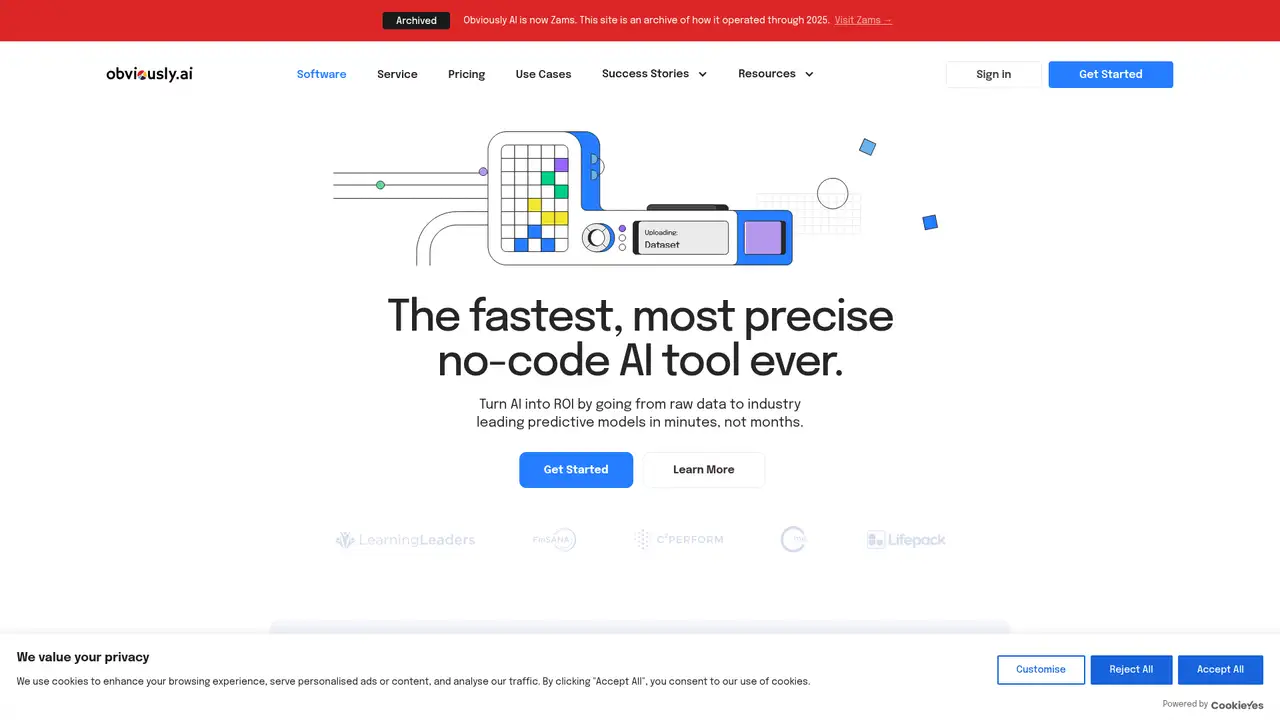
Obviously AI was a no-code machine-learning company founded by Nirman Dave and Tapojit Debnath. Its original service targeted mid-market businesses and analysts without dedicated data scientists, allowing them to create supervised-learning models from business data. TechCrunch reported a $4.7 million seed round in July 2021, increased from $3.6 million two months earlier, along with more than 3,000 clients and over 82,000 hosted predictive models. The product supported forecasts, classifications, model sharing, APIs, embedded predictions, and integrations with databases and business applications. On February 11, 2025, the company announced that Obviously AI had become Zams. Zams now presents an enterprise platform for AI agents focused on sales and business operations, including research, meeting preparation, CRM updates, and workflow automation. The former modeling service and current Zams brand therefore represent different product directions.
The legacy workflow let analysts upload tabular business data, select a prediction target, and produce a model without writing code. It supported classification, forecasts, time-series analysis, data validation, model sharing, APIs, embeddable predictions, and connections to MySQL, BigQuery, Salesforce, and Zapier. Its Edge-Sharp AutoML system shortlisted five candidate models, tuned their hyperparameters, and returned prediction results. Users could also request data-scientist assistance for model creation, data cleaning, source merging, audits, and related advice. This made the service suitable for teams without dedicated data scientists that needed a working forecast or classification model. The workflow was narrower than Dataiku or DataRobot, which provide broader enterprise modeling and governance features, while Akkio offered a closer no-code analytics comparison. Availability changed after Obviously AI became Zams in February 2025.
The legacy technology was automated machine learning rather than a named foundation model. TechCrunch described Edge-Sharp AutoML as a proprietary system that shortlisted five candidate models, tuned their hyperparameters, and returned predictions for each dataset. The company also highlighted automatic model improvements, manual model selection, shareable models, data validation, and time-series forecasting. Its workflow supported classifications and forecasts from tabular data, with API access and integrations including MySQL, BigQuery, Salesforce, and Zapier. The company does not document a clearly dated 2025 or 2026 release for that predictive-analytics service. Zams, the successor announced on February 11, 2025, describes a different Z1 Engine combining multi-tool orchestration, persistent memory, and contextual reasoning. Recent Zams updates added multi-agent meeting preparation and support for Claude Sonnet 4.6, GPT-5.1, and GPT-5.2.
Zams pricing has replaced the historical Obviously AI schedule. Evan, a meeting-intelligence worker, is listed at $50/month. Automation Platform Basic costs $125/month for one user, 1,000 agent tasks, 10 enrichment tasks, and three PDF pages. Pro costs $1,208/month for one user, 50,000 agent tasks, 1,000 enrichment tasks, and 100 PDF pages. Team costs $1,417/month for 25 users, with the same listed task and page allowances as Pro. The displayed Pro and Team prices correspond to a 200,000-task selector state. Zams offers monthly and annual billing choices, so check the selected cadence and task volume before purchase. Enterprise pricing is custom, including agent tasks, enrichment tasks, PDF pages, support, and governance options. Zams advertises a guided trial rather than a permanent free tier.
The key limitation is the product transition: Obviously AI became Zams on February 11, 2025. The former service offered a short, no-code route from tabular data to forecasts and classifications, with APIs, integrations, and optional data-scientist assistance. Dataiku provides broader data-science workflows and governance, while Akkio is a closer comparison for no-code business analytics. DataRobot targets automated machine learning with deeper enterprise modeling capabilities, and H2O Driverless AI offers another automated modeling alternative. Zams now focuses on AI workers that research information, prepare meeting briefs, update records, and execute workflows across connected applications. Its current plans start at $50 per month for Evan and $125 per month for the Basic platform plan, rather than a dedicated legacy modeling subscription. Buyers needing a maintained model catalog or current standalone predictive-analytics pricing should look elsewhere. Choose Obviously AI only if you need its former workflow and confirm continued access first.
Who is Obviously AI best for?
- Teams comparing the former product with its Zams successor.
- Business analysts seeking no-code predictive workflows.
- Sales teams automating research and CRM work with Zams.
- Companies evaluating AI workers across connected business applications.
Obviously AI Pricing (2026)
Pricing model: Paid. All prices in USD.
| Plan | Price | What you get |
|---|---|---|
| Evan | $50/month | Meeting-intelligence worker that researches meeting participants and prepares briefs. |
| Basic | $125/month | One user, 1,000 agent tasks, 10 enrichment tasks, and three PDF pages. |
| Pro | $1,208/month | One user, 50,000 agent tasks, 1,000 enrichment tasks, and 100 PDF pages. Displayed for the 200K-task selector state. |
| Team | $1,417/month | Twenty-five users, 50,000 agent tasks, 1,000 enrichment tasks, and 100 PDF pages. Displayed for the 200K-task selector state. |
| Enterprise | Custom | Agent tasks, enrichment tasks, and PDF pages are custom, with enterprise support and governance options. |
Pros and Cons
Pros
- The historical product supported no-code forecasts and classifications.
- Zams connects agents with CRMs, databases, email, and other applications.
- The former service offered API access and optional data-scientist support.
- Zams lists governance features including audit logs and access controls.
Cons
- The company no longer markets the legacy product under its former name.
- Zams pricing varies by task volume and displayed billing selection.
- The current offering is broader automation rather than dedicated predictive analytics.
Who should look elsewhere?
- Buyers seeking a current standalone Obviously AI modeling plan.
- Researchers needing transparent training code and model internals.
- Teams requiring an unchanging product category and price structure.
Technical Details
Frequently Asked Questions
How much does Obviously AI cost now?
Obviously AI became Zams in February 2025. Current Zams pricing displays Evan at $50/month, Basic at $125/month, Pro at $1,208/month, and Team at $1,417/month. Enterprise is custom. Pro and Team prices appear with a 200K-task selector state, and the page offers monthly and annual choices, so verify cadence and task volume before purchase.
Does Obviously AI have a free plan?
The former Obviously AI product is not presented with a current free plan. Zams advertises a guided trial rather than a permanent free tier. Its pricing page lists paid AI workers and automation-platform plans, including Evan at $50/month and Basic at $125/month. Trial access and setup terms may depend on the selected Zams workflow and should be confirmed before starting.
How does Obviously AI compare with Akkio?
Akkio is a closer comparison for no-code business analytics, while the former Obviously AI product focused on building predictions from tabular data with integrations and APIs. Zams now targets AI workers that research, prepare meetings, update CRMs, and automate business workflows. Buyers choosing between them should first decide whether they need predictive modeling or cross-application task execution.
Does Obviously AI train on customer data?
The former Obviously AI privacy policy describes collection and use of account, payment, device, usage, and information from other sources. It also describes business purposes for processing personal information. The policy does not provide a clear blanket statement that customer data is used to train models. Organizations should review the applicable Zams agreement and data-processing terms for current handling.
Can I use Obviously AI commercially?
The former product was marketed for business applications, including predictive outputs embedded in customer-facing software. Zams is marketed as enterprise software for automating workflows across business systems. Commercial deployment is therefore part of the intended use cases, but the company does not publish a standalone commercial-use license or output-ownership rule. Review the subscription agreement before embedding outputs in a paid product.
Best Obviously AI Alternatives in 2026
These tools do the same job as Obviously AI, with different pricing, limits and trade-offs.

Agency-focused analytics, forecasting, and embedded predictive models

Governed collaborative data science from preparation through deployment

Governed enterprise AI for models, agents, and hybrid deployments

Visual data preparation and analytics for governed enterprise workflows