DataRobot Review, Pricing & Alternatives (2026)
Governed enterprise AI for models, agents, and hybrid deployments
Last updated: October 26, 2026
What is DataRobot?
DataRobot is a proprietary enterprise platform for developing, deploying, monitoring, and governing predictive AI, generative AI, and agents. It targets organizations with regulated, hybrid, on-premises, or air-gapped requirements. DataRobot does not publish a standard list price; enterprise access is sold through custom terms and private offers, while a trial has usage quotas.
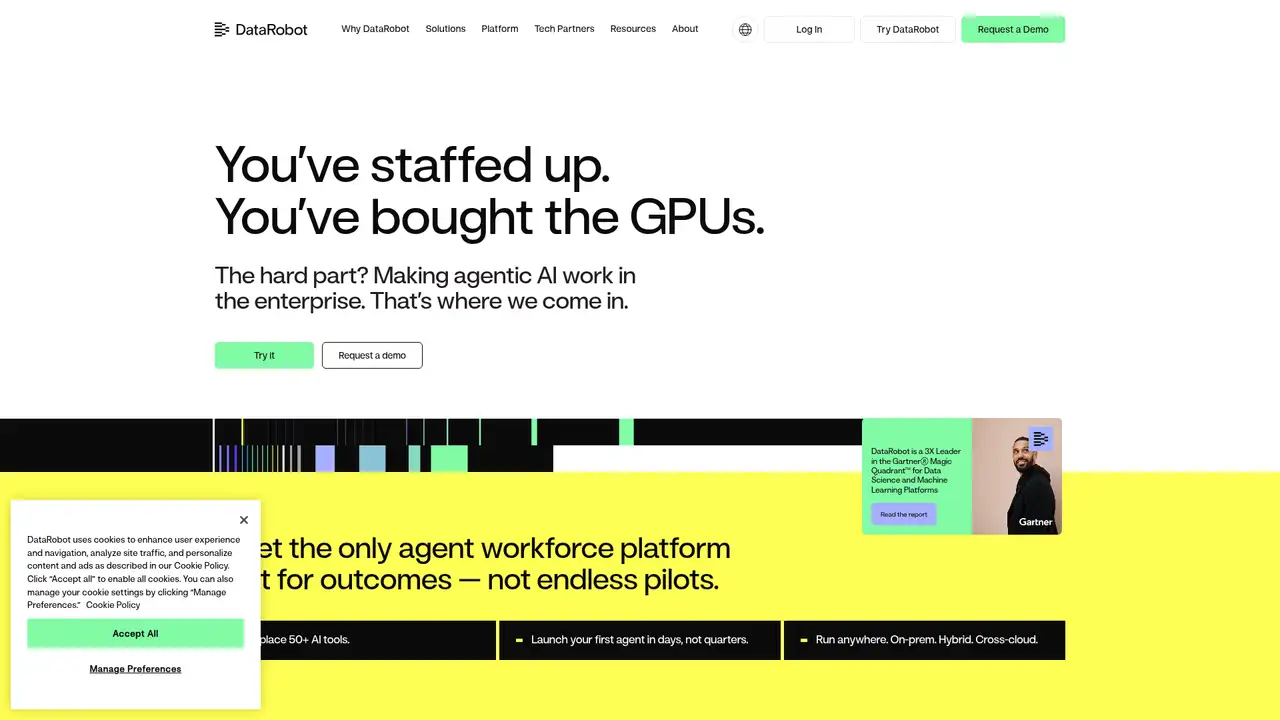
Founded in 2012, DataRobot provides proprietary enterprise AI software for developing, deploying, monitoring and governing predictive models, generative AI applications and agents. Its Enterprise AI Suite and newer Agent Workforce Platform support customizable blueprints, integrations, selectable large language models and embeddings, lifecycle tracking, testing, approvals, authentication, audit documentation and agent-quality monitoring. Deployment options include SaaS, single-tenant SaaS on major clouds, multi-tenant AWS SaaS, and self-managed installations in AWS, Azure, Google Cloud or on-premises, including hybrid and air-gapped environments. DataRobot offers APIs, integrations and bring-your-own model connections, while its syftr framework is open source but separate from the core platform. Pricing is sales-led and custom, with no published standard subscription tier or public free tier.
A typical DataRobot workflow begins by connecting enterprise data sources, selecting a modeling approach or agent blueprint, and configuring algorithms, LLMs, embeddings, integrations, and execution environments. Teams can build predictive models, generative applications, or agents, then test them with validation data, approval controls, documentation, and evaluation tools. Agent workflows may include quality checks, adversarial swarm evaluation, batch evaluation, authentication, and audit records. Once approved, assets can be deployed through SaaS, single tenant or multitenant cloud, self managed infrastructure, on premises environments, or edge targets. Production operations include API or batch scoring, lifecycle tracking, monitoring for model performance, agent quality, usage, and drift, plus governance and retraining processes. Administrators can manage access, deployment environments, external models, and ongoing operational controls.
DataRobot is proprietary enterprise software for developing, deploying, monitoring and governing predictive AI, generative AI and agents. Its current positioning emphasizes an Agent Workforce Platform, while Enterprise AI Suite remains the named enterprise package. The platform supports customizable blueprints, multiple LLM providers, integrations, testing, approvals, audit documentation, lifecycle tracking and monitoring, with SaaS, single or multitenant cloud, self-managed, on-premises, hybrid and air-gapped deployment options. Documented 2025 and 2026 developments include the syftr open-source framework, an Agent Workforce Platform announcement with NVIDIA, A2A agent-card discovery, bring-your-own LLM registration, MCP OAuth validation, MCP server deployment, adversarial and batch agent evaluation, Salesforce connectivity, Redshift support and expanded governance. Pricing is sales-led and custom, with no published standard subscription tier.
DataRobot uses custom, sales-led pricing rather than published Enterprise AI Suite tiers. Its AWS Marketplace listing supports private offers with custom terms and committed pricing, while the displayed $0.01 dimensions are accounting placeholders, not a subscription price. Prospective customers should request a quote and confirm deployment, capacity, support, enabled features, and contract terms. A trial exists but is limited: trial users receive 1,000 LLM API calls and access to up to 15 hosted or third-party vector databases, with no NVIDIA NIM or GPUs. Self-managed non-trial users generally have a 5,000-prompt daily limit, subject to plan and administrator controls. Cloud infrastructure, model-provider usage, storage, vector databases, data transfer, and other compute may create additional charges, especially for customer-managed deployments or external LLMs.
DataRobot’s main limitations are cost opacity, sales-led procurement, and implementation overhead: Enterprise AI Suite pricing is custom, with no published standard monthly tier, and its breadth can require substantial administration. Compared with Dataiku, DataRobot emphasizes governed deployment, monitoring, agent operations, and portability across cloud, on-premises, hybrid, and air-gapped environments, while Dataiku is a close visual data-science and governance alternative. Compared with H2O.ai, DataRobot offers a more integrated proprietary enterprise platform, whereas H2O.ai is stronger for buyers prioritizing open-source components and broad model choice. Cloud-native teams may find Vertex AI or SageMaker more economical or familiar, although those options can require more cloud-specific assembly. Choose DataRobot if your organization needs one governed platform spanning predictive AI, generative AI, and agents, particularly under strict deployment and compliance requirements.
Who is DataRobot best for?
- Enterprises requiring governed AI development and production operations.
- Teams deploying across cloud, on-premises, hybrid, or air-gapped environments.
- Regulated organizations needing monitoring, approvals, audit documentation, and lifecycle controls.
- Organizations building predictive, generative, and agent-based applications in one platform.
DataRobot Pricing (2026)
Pricing model: Paid. All prices in USD.
| Plan | Price | What you get |
|---|---|---|
| Enterprise AI Suite | Custom | DataRobot does not publish a standard list price. AWS Marketplace uses private offers with custom terms and committed pricing; marketplace $0.01 dimensions are accounting placeholders, not subscription costs. |
| Trial | Custom | A trial exists with quotas. Trial users receive 1,000 LLM API calls and up to 15 hosted or third-party vector databases, with no NVIDIA NIM or GPUs. |
Pros and Cons
Pros
- DataRobot supports SaaS, self-managed, on-premises, hybrid, and air-gapped deployments.
- The platform combines development, deployment, monitoring, governance, and agent controls.
- External model connections include Azure OpenAI, Amazon Bedrock, Google Gemini, Anthropic, Cerebras, and TogetherAI.
- The company publishes trial quotas and documented self-managed deployment options.
Cons
- DataRobot does not publish a standard Enterprise AI Suite list price.
- The platform requires sales engagement and can bring substantial administration overhead.
- LLM gateway availability depends on plan and administrator settings.
Who should look elsewhere?
- Individuals seeking a low-cost self-serve machine learning tool.
- Teams that require transparent monthly list pricing before contacting sales.
- Small projects that do not need governance, deployment portability, or production monitoring.
Technical Details
Frequently Asked Questions
How much does DataRobot cost?
DataRobot does not publish a standard monthly or annual Enterprise AI Suite price. The company directs buyers toward custom commercial terms, and its AWS Marketplace listing uses private offers with committed pricing. The $0.01 dimensions shown in that listing are marketplace accounting placeholders, not the customer-facing subscription cost. Buyers should request a quote that reflects deployment type, package, users, and required capabilities.
Does DataRobot have a free plan?
DataRobot does not publish a continuing standard free tier for Enterprise AI Suite. A trial exists, but it has quotas rather than unlimited access. Trial documentation describes 1,000 LLM API calls and up to 15 hosted or third-party vector databases, and says trial users do not receive NVIDIA NIM or GPUs. Enterprise access is sold through custom terms.
What is DataRobot's closest competitor?
Dataiku is one of DataRobot's closest direct competitors because both target enterprise data science, AI development, and governance teams. H2O.ai is another close alternative, especially for buyers focused on open-source components and model choice. Google Vertex AI and AWS SageMaker can fit organizations already committed to those clouds, though their services may require more cloud-specific assembly.
Does DataRobot train on customer data?
DataRobot's 2026 Data Processing Policy says it processes personal data on documented customer instructions, does not sell it under CCPA, and applies stated security controls. Older AI Platform Agreement language grants DataRobot a license to use customer data to improve services. Enterprise buyers should therefore review the current order form, Data Processing Policy, and applicable agreement before deployment.
Can companies use DataRobot commercially?
DataRobot is proprietary commercial platform software intended for enterprise use, including commercial production deployments. Licensing, pricing, and permitted services depend on the customer's contract and package. The syftr framework released by DataRobot is open source, but it is a component and does not make Enterprise AI Suite open source. Buyers should confirm commercial rights and deployment terms in their order documents.
Best DataRobot Alternatives in 2026
These tools do the same job as DataRobot, with different pricing, limits and trade-offs.