
Mutiny Review, Pricing & Alternatives (2026)
An agent-first workspace for sales and marketing assets
pivoted: Mutiny terminated its customer contracts in November 2025, reduced its team and rebuilt around an agent-first, product-led AI business. The current product focuses on sales and marketing assets, workflows and rep support rather than the former website-personalization SaaS.
Last updated: October 26, 2026
What is Mutiny?
Mutiny is a hosted AI agent for B2B revenue teams creating sales and marketing assets such as pitch decks, deal rooms, landing pages and follow-up content. It fits teams that want natural-language asset production and sales workflows. A free plan is available, Business costs $50 per month, and Enterprise starts at $40,000 per year.
Mutiny is an active private B2B software company founded in 2018 by Jaleh Rezaei and Nikhil Mathew. The founders entered Y Combinator that year, launched an MVP in two weeks and reached almost $100,000 in annual recurring revenue two months later. Its original product provided no-code B2B website personalization by persona, industry, company size, account and segment. After its Series B, Mutiny moved toward LLM-powered, agentic go-to-market work, soft-launching the new direction for marketing leaders in May 2025. TechCrunch reported $68.5 million raised as of January 2025, while Mutiny later listed $72 million. The company announced a $50 million Series B in April 2022 at a $600 million valuation, led by Tiger Global and Insight Partners, with Sequoia, Cowboy Ventures and Uncork Capital participating.
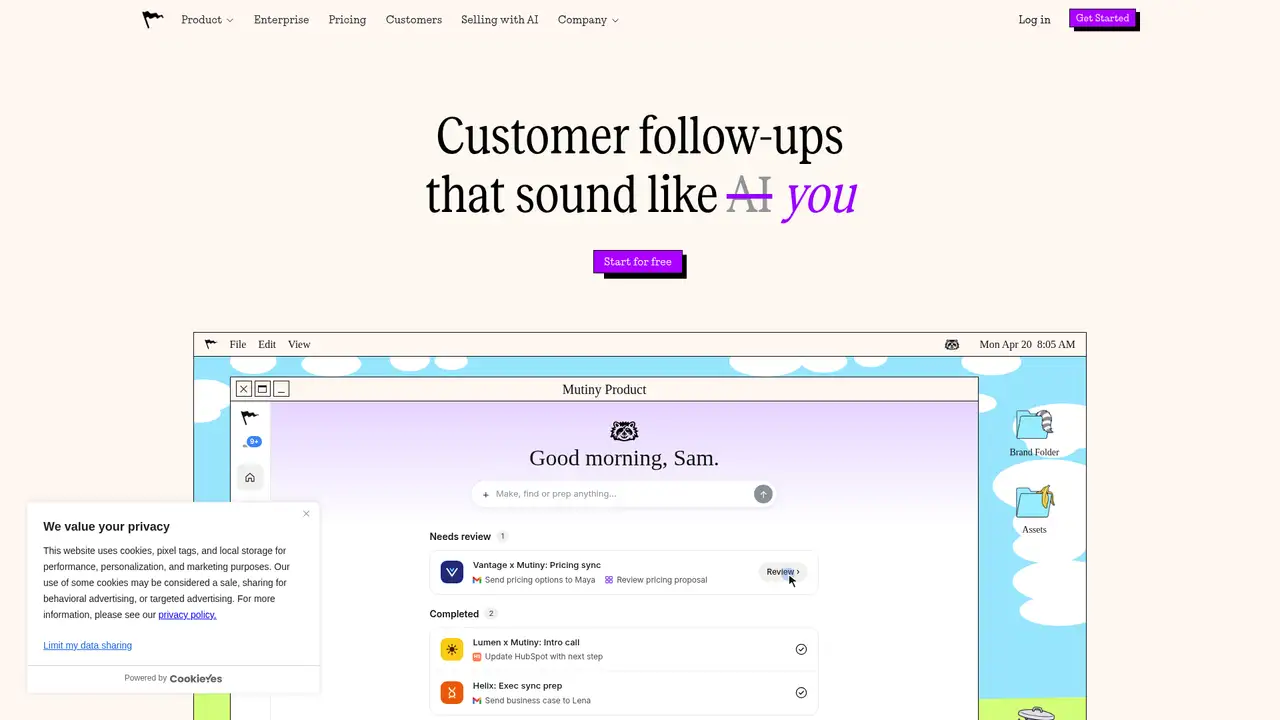
Mutiny’s current workflow starts with a website, existing content and natural-language instructions. Its agent learns brand identity, then drafts customer-facing materials such as pitch decks, deal rooms, case studies, executive business cases, pricing proposals, landing pages and one-pagers. Meeting and message triggers can generate personalized follow-up, share assets and create qualified-opportunity deal rooms. Other workflows prepare representatives using calendar details, deal stage and previous calls, then flag risks including single-threading or stalled stages. The workspace includes templates, routines, projects, integrations, asset analytics and password protection. Users can drive Mutiny through another AI assistant with MCP support. Administrators can set per-user credit caps, while generated copy and designs still require human review for accuracy, brand consistency and compliance.
Mutiny now positions itself as AI infrastructure and an agentic go-to-market platform spanning account-based marketing, sales enablement, deal content, workflow automation and representative coaching. Smart Assets covers pitch decks, deal rooms, case studies, executive business cases, pricing proposals, landing pages and one-pagers. The agent creates drafts from natural-language instructions after learning from a website and existing content. Credits separate low-cost planning from credit-consuming building actions, with Fast, Balanced and Max modes. Balanced costs approximately 50 percent less than Max, while Max is recommended for net-new assets. MCP support allows control from another AI assistant. Mutiny’s 2025 to 2026 direction followed its shift away from website personalization toward agent-created revenue content. The company does not identify a specific underlying foundation model. In November 2025, it ended the former customer-contract model and rebuilt around an agent-first product.
Mutiny’s current public pricing has three levels. Free costs $0 per month and includes up to five team members, five daily credits, up to 30 monthly credits per seat, five templates, five routines and five projects per user. Business is published at $50 per month with 50 monthly credits, unlimited members, templates, skills and integrations, plus 20 routines and projects per user. Enterprise starts at $40,000 per year and adds custom credit limits, volume discounts, SSO, Salesforce, onboarding and a dedicated Growth Strategist. Credits pool across workspaces, roll over unused balances and can be capped by administrators. Max-mode examples range from approximately 0.35 credits for a line edit to eight credits for a combined research and pitch workflow.
Mutiny’s main limitation is its changing scope: it is no longer a narrow website-personalization product. Costs depend on context and output size, Enterprise pricing is high, and value depends on clean account data and sufficient B2B traffic. Intellimize remains closer to website personalization, Demandbase and 6sense provide broader account intelligence and ABM, and Folloze focuses on persistent ABM content destinations. Mutiny’s privacy terms say it may use de-identified or aggregated customer-derived prompts, inputs and outputs to improve services, while stating that identifiable personal data is not used to train models. Customers retain content ownership, and paid contracts may add restrictions. The product suits teams that need sales assets, deal preparation and representative automation rather than fixed-cost personalization. B2B revenue teams seeking agent-created customer-facing content should pick Mutiny.
Who is Mutiny best for?
- B2B revenue teams producing customer-facing sales assets.
- Marketing teams managing branded landing pages and deal content.
- Sales teams needing meeting preparation and follow-up workflows.
- Teams comfortable with usage-based AI credits.
Mutiny Pricing (2026)
Pricing model: Freemium. All prices in USD.
| Plan | Price | What you get |
|---|---|---|
| Free | $0/month | Up to 5 team members, 5 daily credits and up to 30 credits per seat monthly. Includes 5 templates, 5 routines and 5 projects per user. |
| Business | $50/month | Includes 50 monthly credits, unlimited members, templates, skills and integrations, plus 20 routines and 20 projects per user. |
| Enterprise | Starting at $40,000/year | Adds volume credit discounts, custom user limits, unlimited workspace features, SSO, Salesforce, onboarding and a dedicated Growth Strategist. |
Pros and Cons
Pros
- The agent creates several sales and marketing asset types.
- Free accounts include team access and recurring credits.
- Credits roll over and can be pooled across a workspace.
- Enterprise plans include SSO, Salesforce and DPA terms.
Cons
- Credit usage varies with context and output size.
- Enterprise pricing starts at $40,000 annually.
- Generated assets require human accuracy and compliance review.
Who should look elsewhere?
- Teams seeking the former narrow website-personalization product.
- Small businesses without recurring B2B sales workflows.
- Buyers requiring a low, predictable enterprise price.
Technical Details
Frequently Asked Questions
How much does Mutiny cost?
Mutiny lists Free at $0 per month, Business at $50 per month and Enterprise starting at $40,000 per year. Business includes 50 monthly credits, while Enterprise adds volume discounts and custom credit limits. Because agent actions consume credits, total usage depends on the amount and complexity of work rather than subscription price alone.
Does Mutiny have a free plan?
Yes. Free supports up to five team members, provides five daily credits and allows up to 30 credits per seat each month. It includes five templates, five routines and five projects per user, along with a mutiny.app domain, asset analytics, training videos and limited-time unlimited integrations.
How does Mutiny compare with Intellimize?
Mutiny now centers on AI-generated sales and marketing assets, representative workflows and coaching. Intellimize is closer to Mutiny’s former website-personalization category, helping teams personalize and optimize web experiences. Mutiny fits revenue teams seeking an agent-first asset workspace, while Intellimize is more appropriate for buyers prioritizing automated website experimentation and personalization.
Does Mutiny train AI models on customer data?
Mutiny’s privacy policy allows use of de-identified or aggregated customer-derived prompts, inputs and outputs to improve services and AI. The company says it does not use identifiable personal data to train models, and customers can opt out by contacting privacy@mutinyhq.com. Paid and Enterprise contracts may impose additional restrictions. Mutiny does not provide a broad no-training guarantee.
Can businesses use Mutiny outputs commercially?
Mutiny is designed for commercial sales and marketing assets such as proposals, landing pages, pitch decks and deal rooms. Enterprise purchasing includes MSA and DPA terms. Customers remain responsible for reviewing generated copy and designs for accuracy, brand fit and compliance. Mutiny does not publish a separate public output-license clause, so contractual terms matter for regulated or sensitive work.
Best Mutiny Alternatives in 2026
These tools do the same job as Mutiny, with different pricing, limits and trade-offs.