Moonvalley Review, Pricing & Alternatives (2026)
Licensed-data video generation with filmmaker-focused controls
Last updated: October 22, 2026
What is Moonvalley?
Moonvalley develops Marey, a video-generation product for filmmakers, production teams, and enterprises seeking controllable clips trained on licensed footage. Subscriptions start at $14.99 per month, and Moonvalley says it has no free plan because video generation is costly. The cited pricing material does not publish current plan names, credit allocations, or complete generation limits.
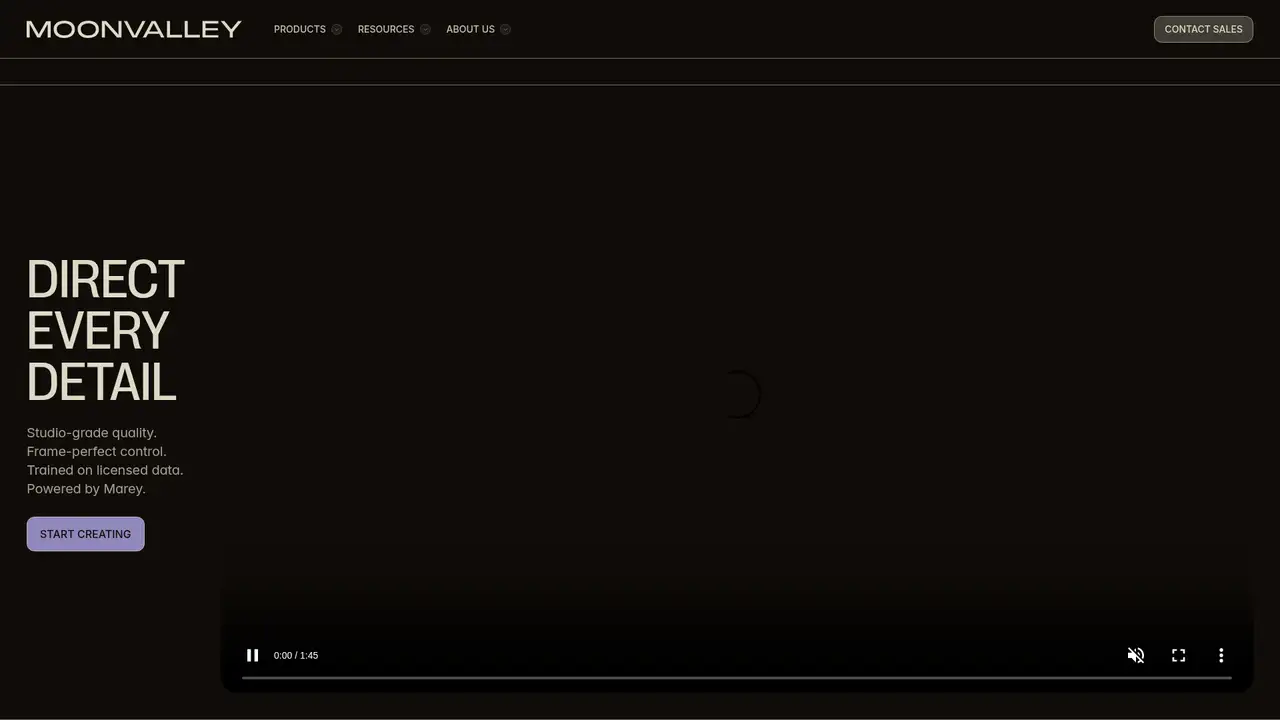
Moonvalley is an AI video company whose main public product is Marey, designed for professional production rather than casual social media experiments. Marey launched on March 12, 2025, for Hollywood, selected filmmakers, and enterprise customers. Moonvalley says it trained the model on owned or fully licensed footage. The company announced a $70 million seed round led by Bessemer Venture Partners, Khosla Ventures, and General Catalyst at launch. Reuters later reported an $84 million financing round led by General Catalyst in July 2025. Its stated audience includes film teams, commercial creators, and technical production groups. Marey remains active, with web access, an API, ComfyUI workflows, and enterprise custom model services available by request.
Marey combines text-to-video generation with controls intended for production work. Users can adjust trajectory, camera movement, motion transfer, pose transfer, and inpainting. The general-availability production model was trained on native 1080p footage and generates high-definition clips at 24 frames per second. Public reporting in July 2025 described outputs of up to five seconds, despite an earlier beta claim of clips reaching 30 seconds. Moonvalley also provides ComfyUI API nodes and workflows for technical pipelines. Enterprise customers can request custom models. The company says Marey does not use user-generated content for model training. Its terms allow customers to use outputs for their own commercial purposes, while inputs remain subject to applicable rights and service terms.
Moonvalley released Marey in March 2025 and moved it to general availability in July 2025. The launch model offered native high-definition generation, multiple aspect ratios, camera and motion controls, and training based on owned or fully licensed footage. The July production release added or documented Trajectory, Camera, Motion Transfer, Pose Transfer, and Inpainting controls, plus ComfyUI nodes and workflows. Moonvalley also introduced beta Voyager during the general-availability announcement. The company says Marey was not trained on user-generated content, while its terms exclude customer content from machine-learning or AI training without explicit opt-in consent. The product supports web use and API access. OpenAI Sora is not a current alternative: its web and app service ended April 26, 2026, and its API ended September 24, 2026.
Marey subscriptions start at $14.99 per month, according to Moonvalley’s help documentation. The company says it has no free plan because video generation carries high costs. Current official material does not publish complete plan names, monthly credit allocations, resolution limits, or API unit prices. Historical July 2025 reporting listed packages at $14.99 for 100 credits, $34.99 for 250 credits, and $149.99 for 1,000 credits, but those figures may no longer describe current checkout. Enterprise customers can request custom models and services, with no standard public price or fixed allowance. This pricing structure may suit production teams with defined budgets, but it gives casual users fewer low-cost testing options and leaves current usage costs harder to estimate.
Marey’s main limits are short generation length, paid-only access, and incomplete public pricing details. Five-second production clips may require multiple generations and editing for longer sequences. Moonvalley also applies safeguards around named people, celebrities, NSFW prompts, and other sensitive requests. Runway, Google Veo, and Luma Ray2 provide competing video-generation options, while Adobe Firefly targets broader creative software workflows. Marey differs through its stated licensed-data policy, filmmaker controls, and ComfyUI support, but users needing a free tier, long continuous shots, or a fully published credit and API table may prefer another service. With Sora discontinued, Marey is best suited to film teams, commercial projects, and technical creators seeking controlled short clips with a documented training-data position.
Who is Moonvalley best for?
- Film teams that need camera, pose, motion, and inpainting controls.
- Commercial projects that prefer a stated licensed-data training policy.
- Creators producing short, high-definition clips at 24 frames per second.
- Technical users who want ComfyUI workflows and API nodes.
Moonvalley Pricing (2026)
Pricing model: Paid. All prices in USD.
| Plan | Price | What you get |
|---|---|---|
| Marey subscription | $14.99/month | Moonvalley says subscriptions start at this price and that there is no free plan. Current credits and the complete plan table are not published in the cited pricing material. |
| Enterprise | Custom | Custom models and enterprise services are offered by request. Moonvalley does not publish a standard enterprise price or fixed usage allowance. |
Pros and Cons
Pros
- Moonvalley says Marey uses owned or fully licensed training footage.
- Marey includes trajectory, camera, motion, pose, and inpainting controls.
- The production model outputs native high-definition clips at 24 frames per second.
- ComfyUI nodes and workflows support technical production pipelines.
Cons
- The public production release limits reported clips to five seconds.
- Moonvalley offers no free plan, according to its help documentation.
- Current plan names, credits, and API unit prices are not publicly detailed.
Who should look elsewhere?
- Users seeking a free plan for casual video experiments.
- Projects requiring long continuous clips from one generation.
- Teams needing published API prices and a complete current credit table.
Technical Details
Frequently Asked Questions
How much does Moonvalley Marey cost?
Moonvalley’s help documentation says Marey subscriptions start at $14.99 per month. It also says there is no free plan. The cited page does not publish current plan names, credit allotments, or a complete usage table. July 2025 coverage listed historical packages at $14.99, $34.99, and $149.99, but those prices may no longer describe checkout.
Does Moonvalley Marey have a free plan?
No. Moonvalley’s help documentation says Marey does not have a free plan because video generation has high costs. Access begins with a paid subscription reported as starting at $14.99 per month. The cited material does not publish a current free allowance, so users should not assume that trial credits or unrestricted previews are included.
How does Moonvalley Marey compare with OpenAI Sora?
Marey remains an active Moonvalley product with controls for trajectory, camera, motion, pose transfer, and inpainting. OpenAI discontinued Sora’s web and app service on April 26, 2026, and its API on September 24, 2026. Sora is therefore a historical comparison rather than a current service. Marey emphasizes licensed training footage and production workflows.
Does Moonvalley train Marey on user videos?
Moonvalley says Marey was trained on owned or fully licensed footage and not on user-generated content. Its terms say customer content may be processed to provide and improve services, but content is excluded from machine-learning or AI training without explicit opt-in consent. That distinction applies to the published terms and should be reviewed with enterprise agreements.
Can I use Moonvalley outputs commercially?
Moonvalley’s terms say users may use outputs for their own commercial purposes and retain ownership and copyright rights in those outputs. Commercial use remains subject to the terms, applicable law, and rights in user-provided inputs or third-party material. Enterprise customers requesting custom models should review their specific agreement before production release.
Best Moonvalley Alternatives in 2026
These tools do the same job as Moonvalley, with different pricing, limits and trade-offs.