
Google Veo Review, Pricing & Alternatives (2026)
Cinematic text-to-video with synchronized audio and frame controls
Last updated: October 22, 2026
What is Google Veo?
Google Veo is a Google DeepMind video-generation model for filmmakers, creators, developers, and production teams. It creates short clips from text and images, with native audio, reference-image controls, frame transitions, scene extension, vertical output, and documented 4K support. Gemini API access starts at $0.05 per generated second for Veo 3.1 Lite, while consumer access is bundled with Google AI plans.
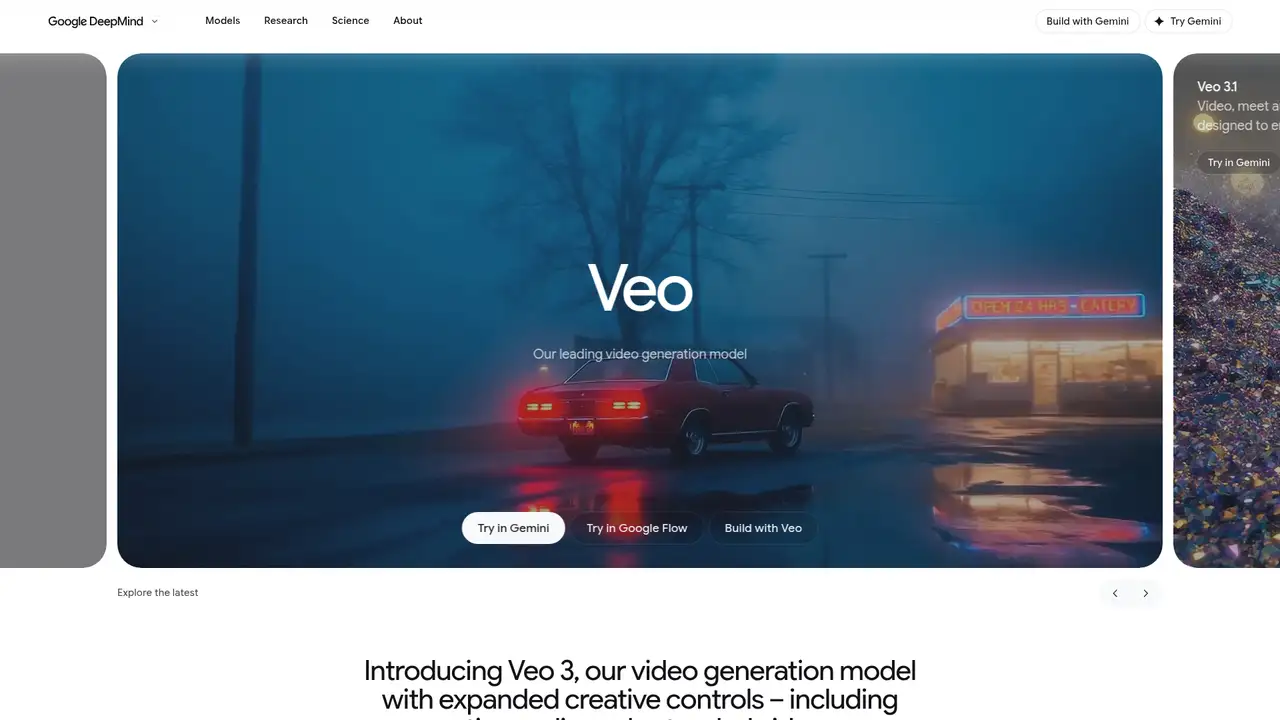
Google Veo is a generative video model made by Google DeepMind for creators, developers, filmmakers, and production teams. Google introduced Veo at I/O in 2024, describing a model that could produce cinematic 1080p clips lasting beyond one minute. The first access route was a private VideoFX preview. Veo is a Google product rather than a separately financed startup, and Google does not publish a standalone Veo funding figure. Google DeepMind began as DeepMind in 2010 and formed its current organization after merging with Google Brain in April 2023. Veo access now spans Gemini, Google Cloud, and Flow, with capabilities and prices varying by route. The model family remains active, although its Gemini API preview endpoints retire on October 22, 2026.
Veo turns a written description or reference image into a short video. A typical workflow is to write a shot prompt, generate several candidates, inspect motion and sound, then revise the prompt or assemble selected clips in an editor. Veo 3.1 supports image-to-video generation, up to three reference images in the Gemini API announcement, first and last frames, scene extension, native audio, vertical 9:16 output, and 1080p output. Google DeepMind also describes 4K availability. Cloud documentation for Veo 3.0 lists 4, 6, or 8-second clips, up to four outputs per prompt, 24 frames per second, English prompts, 720p or 1080p, and 10 requests per minute in the documented region. Longer films still require editing and continuity work outside the model.
Veo 3 launched in May 2025 with synchronized dialogue, environmental sound, and effects. Google added stable Gemini API access, vertical video, 1080p output, and lower pricing in September 2025. Veo 3.1 and Veo 3.1 Fast followed on October 15, 2025, adding improved image-to-video behavior, reference images, first and last frames, scene extension, and richer audio. The family includes Standard, Fast, and Lite variants in Gemini API pricing. Google warns that spoken audio, especially in short clips, can remain incoherent or poorly synchronized. The latest dated Veo release in the documented product history is Veo 3.1. The API page identifies those preview endpoints as deprecated on October 22, 2026.
Gemini API pricing is paid only for Veo 3.1. Standard costs $0.40 per generated second at 720p or 1080p and $0.60 at 4K. Fast costs $0.10 at 720p, $0.12 at 1080p, and $0.30 at 4K. Lite costs $0.05 at 720p and $0.08 at 1080p, with no 4K output. Google AI Studio usage is free in available regions, but the Veo pricing table lists no free Veo tier. Consumer Google AI plans bundle Flow credits and identify video access as Omni Flash, so their credits are not a documented Veo generation allowance. Google Cloud publishes separate Veo prices and uses a different output-unit presentation, making API and Cloud estimates unsuitable for direct comparison.
Veo is strongest for short, directed shots where synchronized audio, reference images, frame transitions, vertical framing, or Google Cloud deployment matter. Spoken audio can fail in short clips, continuity requires external editing, and Google publishes different terms for consumer, API, and Cloud routes. OpenAI Sora is the closest high-profile alternative, while Hailuo AI and Runway target similar text-to-video workflows. Google’s documented features distinguish Veo through native audio, frame controls, scene extension, and Cloud integration, but they do not prove universal image-quality leadership. Choose Veo if Google services fit your production stack and you need a paid API priced by generated second. Choose Sora, Hailuo, or Runway when their editing tools, plans, or licensing terms better fit the project.
Who is Google Veo best for?
- Filmmakers creating short shots with generated dialogue, effects, and environmental sound.
- Developers integrating video generation into Gemini API workflows.
- Creators using reference images, frame transitions, vertical framing, or scene extension.
- Teams already using Google services and Cloud infrastructure.
Google Veo Pricing (2026)
Pricing model: Usage-based. All prices in USD.
| Plan | Price | What you get |
|---|---|---|
| Google AI Plus | $4.99/month | Includes 200 Flow credits monthly, 400 GB storage, and video access identified as Omni Flash. Google does not publish a Veo-per-credit conversion. |
| Google AI Pro | $19.99/month | Includes 1,000 Flow credits monthly, 5 TB storage, and $10 monthly Google Cloud credits. Video access is identified as Omni Flash. |
| Google AI Ultra 5x | $99.99/month | Includes 10,000 Flow credits monthly, 20 TB storage, and $40 monthly Google Cloud credits. The plan lists Omni Flash video access. |
| Google AI Ultra 20x | $199.99/month | Includes 25,000 Flow credits monthly, 30 TB storage, and $100 monthly Google Cloud credits. The plan lists Omni Flash video access. |
| Veo 3.1 Standard API | $0.40/second at 720p or 1080p, $0.60/second at 4K | Paid Gemini API access only. The price covers generated video with audio and no free Veo tier is listed. |
| Veo 3.1 Fast API | $0.10/second at 720p, $0.12/second at 1080p, $0.30/second at 4K | Paid Gemini API access only. Fast is priced below Standard and supports generated audio. |
| Veo 3.1 Lite API | $0.05/second at 720p, $0.08/second at 1080p | Paid Gemini API access only. Lite does not support 4K output, and no free Veo tier is listed. |
Pros and Cons
Pros
- Veo 3.1 combines native audio with reference images and frame controls.
- The Gemini API publishes clear per-second prices for three Veo variants.
- Google Cloud offers enterprise deployment controls and documented quotas.
- The model family supports vertical video and documented 4K output.
Cons
- Consumer Google AI plans identify Omni Flash video access rather than Veo.
- Google presents Gemini API and Cloud video prices using different units.
- Google warns that short spoken audio can be incoherent or poorly synchronized.
Who should look elsewhere?
- Users seeking an open model or self-hosted video generator.
- Projects requiring dependable long-form continuity from one generation.
- Buyers needing one identical license across consumer, API, and Cloud access.
Technical Details
Frequently Asked Questions
How much does Google Veo cost?
Gemini API pricing starts at $0.05 per generated second for Veo 3.1 Lite at 720p. Standard costs $0.40 per second at 720p or 1080p and $0.60 at 4K. Fast costs $0.10, $0.12, or $0.30 per second by resolution. Consumer Google AI plans begin at $4.99 monthly, but their video access is listed as Omni Flash.
Does Google Veo have a free plan?
The Gemini API pricing table lists no free Veo tier. Google AI Studio usage is free in available regions, but that does not make Veo generation free. Consumer Google AI plans are paid subscriptions beginning at $4.99 monthly. Flow credits are shown on those plans, but Google does not publish a Veo generation conversion for them.
How does Google Veo compare with OpenAI Sora?
Both products generate video from text and images. Veo’s documented features include native audio, reference images, first and last frames, scene extension, vertical output, and Google Cloud access. Sora is a direct alternative with its own access rules and product workflow. The published information does not support a universal quality ranking between them.
Does Google train on Veo user data?
The Gemini API pricing page says Veo data is used to improve Google products on the free tier and not on the paid tier. That statement applies to the API pricing table. Google’s consumer, Flow, and Cloud routes can have different terms, so organizations should review the policy attached to the specific service and billing route they use.
Can I use Google Veo videos commercially?
Commercial rights depend on the access route, including Google AI plans, Flow, Gemini API, and Google Cloud. Google publishes service-specific terms rather than one universal Veo license covering every route. Before commercial publication, review the applicable customer agreement, content policy, copyright rules, and any restrictions attached to the account or product.
Best Google Veo Alternatives in 2026
These tools do the same job as Google Veo, with different pricing, limits and trade-offs.