
Mindgrasp Review, Pricing & Alternatives (2026)
Turn lectures, documents, and videos into structured study aids
Last updated: October 26, 2026
What is Mindgrasp?
Mindgrasp is an AI learning assistant for students, educators, professionals, and lifelong learners. It turns documents, audio, video, images, and links into notes, summaries, flashcards, quizzes, and answers. Basic starts at $9.99 per month, or $5.99 per month billed annually at $71.88 per year, with a three-day trial.
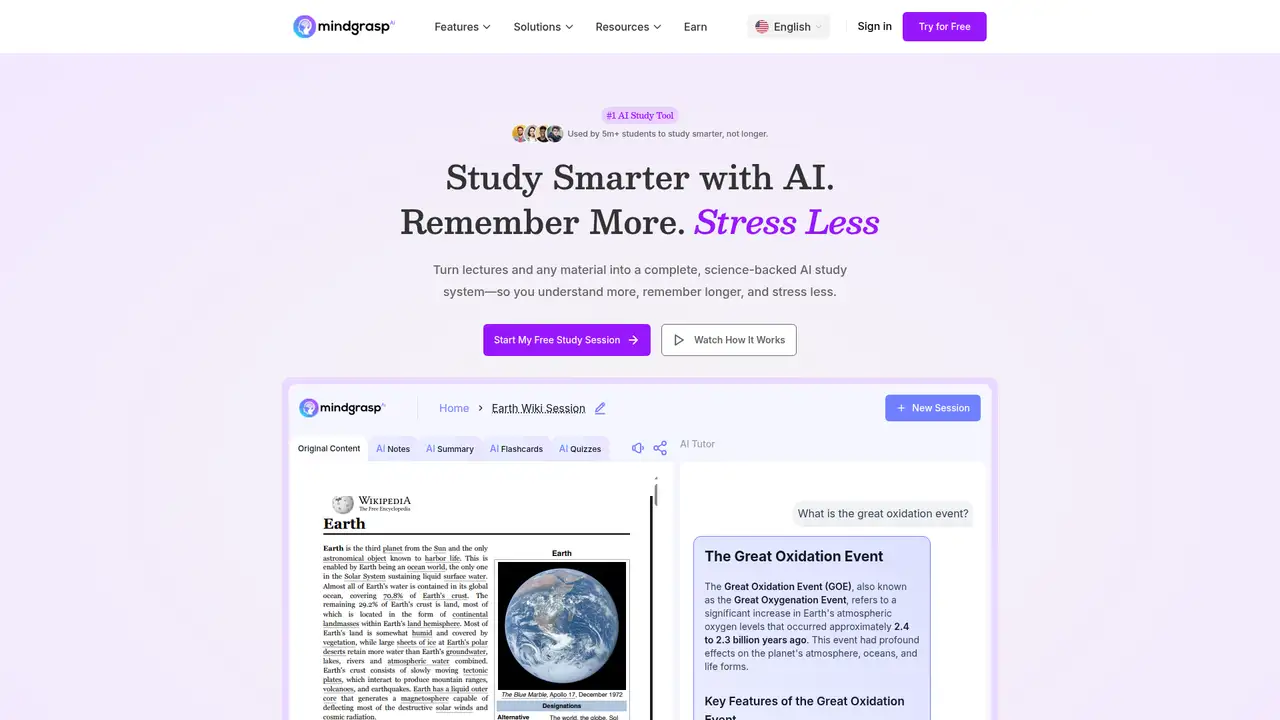
Mindgrasp is an AI learning assistant made by Mindgrasp, Inc., launched in 2021 from the Maryland Innovation Center. The company says its redesigned 2025 website serves more than 1.5 million registered users, while its homepage claims use by more than 5 million students. Those figures use different measures, so they should not be treated as interchangeable. Mindgrasp is aimed at students, educators, professionals, and people working through dense material. Its central promise is practical: submit learning content, then receive study materials without creating every note or question by hand. The company describes support for documents, PDFs, images, audio, video, web material, and links. That broad input range makes Mindgrasp closer to a study workspace than a single-purpose summarizer.
A typical Mindgrasp session starts with an upload, pasted link, or supported recording. The service analyzes the material and creates structured notes, a summary, flashcards, quizzes, and an AI Tutor for questions about the content. The homepage also presents an AI study system that keeps generated material with the original source in a library. The pricing page lists focused reading, unlimited library storage, AI assistant questions, and study tools in Basic. Higher plans add live recording, an AI Math Expert, a Chrome extension beta, iOS access, multiple files or links in one session, and image analysis. This workflow suits a student preparing from a lecture or chapter: ingest the source, review the generated explanation, test recall with questions or flashcards, then return to the source when an answer needs checking.
Mindgrasp describes its technology as artificial intelligence that analyzes uploaded files and links, rather than naming a particular model, context window, or inference provider. The company says the system can process text, audio, video, images, and web material, then produce notes, summaries, flashcards, quizzes, and answers. Its 2025 website announcement highlighted a redesigned site and named a video summarizer, annotation generator, AI note taker, study buddy, and document analysis tools. The pricing page also identifies AI Math Expert and a Chrome extension beta as plan features. Mindgrasp supports 35 languages according to its US App Store listing. There is no published model name, API specification, open source repository, or self-hosting option in the cited product materials, so those details remain unknown.
Mindgrasp's website pricing lists Basic at $9.99 per month, or $5.99 per month when billed annually at $71.88 per year. Basic includes unlimited AI assistant questions, study tools, file uploads, focused reading, and library storage. Premium is listed at $14.99 monthly, or $10.99 monthly when billed annually at $131.88 per year, and adds multiple files or links in one session plus image analysis. Scholar has no visible website price in the cited pricing page, although it adds math help, the extension beta, iOS access, and live recording. The website offers three-day trials for Basic and Premium. It says subscriptions include unlimited uploads and generated study materials, while live recording, image uploads, and simultaneous multiple-file uploads are tier restricted. The US App Store displays different Scholar annual pricing.
Mindgrasp’s main limitation is plan separation: live recording, image analysis, and multi-source sessions require higher tiers, and the website does not publish a Scholar price. Its terms grant personal, noncommercial access to Mindgrasp content but do not provide a clear commercial-use license for generated work, making business publishing unsuitable without separate permission. Compared with Quizlet, Mindgrasp focuses on converting source material into multiple study formats. Compared with Otter.ai, it emphasizes study aids rather than general meeting transcription. Compared with NotebookLM, it places recording, image analysis, and multi-file sessions behind paid tiers. Privacy-conscious users should read the policy because uploaded content may be scanned for potentially illegal material. Students seeking source-to-study conversion should choose Mindgrasp, especially if they value notes, flashcards, quizzes, and tutoring in one platform.
Who is Mindgrasp best for?
- Students converting lectures, chapters, and videos into revision materials.
- Learners who want notes, flashcards, quizzes, and questions from one source.
- Educators creating quizzes from video or document material.
- Users seeking study assistance across 35 supported languages.
Mindgrasp Pricing (2026)
Pricing model: Freemium. All prices in USD.
| Plan | Price | What you get |
|---|---|---|
| Basic | $9.99/month, or $5.99/month billed annually | Unlimited AI Assistant questions, study tools, file uploads, focused reading, and library storage. Three-day free trial listed. |
| Scholar | Custom | Adds AI Math Expert, Chrome extension beta, iOS access, and live recording. The website does not display a price. |
| Premium | $14.99/month, or $10.99/month billed annually | Includes Basic and Scholar features, plus multiple files or links in one session and image analysis. Three-day free trial listed. |
| Enterprise | Custom | Enterprise inquiries go through Mindgrasp support. The pricing page does not publish enterprise limits. |
Pros and Cons
Pros
- It accepts documents, images, audio, video, and links for study processing.
- Basic includes unlimited uploads, questions, study tools, and library storage.
- Higher tiers add live recording, math help, image analysis, and multi-source sessions.
- The service supports 35 languages according to its US App Store listing.
Cons
- The website does not display a Scholar subscription price.
- Live recording, image analysis, and multi-file sessions are tier restricted.
- The terms do not clearly grant commercial rights to generated material.
Who should look elsewhere?
- Teams requiring a documented API or self-hosted deployment.
- Businesses seeking an explicit commercial-use license for generated content.
- Users needing live recording or image analysis on the lowest plan.
Technical Details
Frequently Asked Questions
How much does Mindgrasp cost?
The website lists Basic at $9.99 monthly, or $5.99 monthly billed annually at $71.88 per year. Premium costs $14.99 monthly, or $10.99 monthly billed annually at $131.88 per year. Scholar has no website price. The US App Store lists separate Scholar pricing, while Enterprise pricing is custom through support.
Does Mindgrasp have a free plan?
Mindgrasp's pricing pages do not list a permanent free plan. They list a three-day free trial for Basic and Premium. After the trial, the website displays paid subscription prices. Subscriptions include unlimited uploads and generated study materials, while live recording, image analysis, and simultaneous multiple-file uploads are limited to particular tiers.
How does Mindgrasp compare with NotebookLM?
Both products help users work from uploaded learning material. Mindgrasp's published feature set centers on notes, summaries, flashcards, quizzes, AI Tutor questions, live recording, image analysis, and multi-file sessions. NotebookLM is a separate source-grounded notebook product. Their pricing, limits, supported inputs, and feature availability are not identical.
Does Mindgrasp train models on user uploads?
Mindgrasp's privacy policy describes limited collection, service providers operating under instructions, and scanning uploaded content for potentially illegal material. It does not say that user uploads are used to train models. Anyone submitting sensitive educational or personal material should read the current policy and consider the information required for the chosen feature.
Can I use Mindgrasp output commercially?
Mindgrasp's terms grant a limited, personal, non-exclusive, non-commercial license to view Mindgrasp content and limit service use to personal use. They do not provide a clear standalone commercial-use license for generated material. Commercial publishing, client work, or resale should therefore be treated as unconfirmed unless Mindgrasp gives separate written permission.
Best Mindgrasp Alternatives in 2026
These tools do the same job as Mindgrasp, with different pricing, limits and trade-offs.

Flashcards, adaptive practice, and AI study tools for students

Source-grounded research, study aids, and multimedia summaries
Automatic meeting transcription, summaries, and searchable conversation memory

AI study tools, flashcards, practice tests, and classroom assignments

Turn class materials into guided study sessions