
Magnific Review, Pricing & Alternatives (2026)
Prompt-guided upscaling inside a broad AI creative suite
rebranded: Freepik became Magnific on April 28, 2026. Magnific.ai remains the original standalone upscaler for existing subscribers and plans, while magnific.com is the successor platform containing the upscaler and the wider creative suite.
Last updated: October 26, 2026
What is Magnific?
Magnific is a web-based AI creative platform from the company formerly known as Freepik, built for creators, designers, agencies and teams. It combines generative upscaling with image, video, audio, 3D, stock and editing tools. The free plan costs $0, while paid access starts at $20 per month or $14.50 per month billed annually.
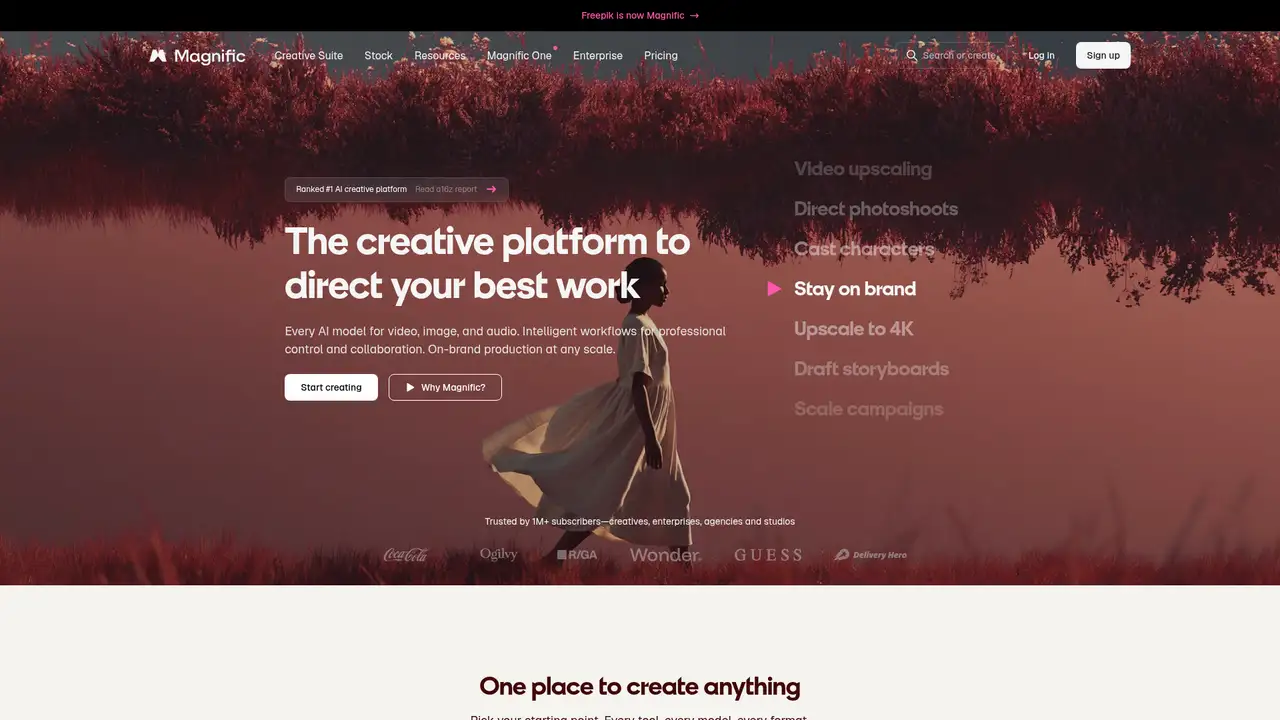
Magnific is a web-based creative platform from the company formerly known as Freepik, which acquired the original Magnific upscaler in May 2024. The wider Freepik-to-Magnific rebrand took effect on April 28, 2026, bringing stock assets, image generation, video, audio, 3D and editing under the magnific.com name. The original service launched in Murcia, Spain about five months before the acquisition, and Freepik said it had more than 725,000 registered Magnific users at that point. The current platform reports more than 1 million paid subscribers and more than 250 million stock assets. Magnific.ai remains the older standalone upscaler for existing subscribers and plans, rather than the full current platform.
Magnific combines generative upscaling with image generation, prompt-based photo editing, background removal, relighting, reframing, video generation, video upscaling, voice, music, sound effects, 3D tools and stock content. A typical image workflow starts with an upload or prompt, then uses a selected model or tool to generate, edit or enlarge the asset. Users can also connect steps in Spaces, use desktop batch processing, work through Photoshop, Premiere or Figma plugins, or call the service from ChatGPT, Claude or Cursor through MCP. The API exposes the platform through credit-based usage. This breadth reduces tool switching, although each model and output setting can consume credits at a different rate.
Magnific’s platform combines its own tools with third-party models from providers including Google, Black Forest Labs, ByteDance, OpenAI, Ideogram, Kuaishou, MiniMax, Alibaba and ElevenLabs. The service lists Magnific One, Magnific Precision, Nano Banana, Flux, Seedream, GPT Image, Ideogram, Kling, Seedance, Hailuo, Veo, Wan and other model families. Recent 2026 additions include Kling 4, Sound Effects and Magnific MCP, while the broader platform introduced Spaces, agents, plugins and native desktop and mobile workflows. The underlying product is credit-based rather than a single fixed model. Magnific can add plausible detail during enlargement, which helps creative reconstruction but can change faces, lettering, objects or factual textures.
Magnific’s Free plan costs $0 and provides up to 20 daily image generations with the in-house model plus 10 stock downloads per day. Premium costs $20 monthly or $14.50 monthly billed annually, with 20,000 monthly credits and commercial use. Premium+ costs $45 monthly or $33.75 annually, with 45,000 credits and unlimited image generation on most models. Pro Starter costs $110 monthly or $82.50 annually, while Pro costs $280 monthly or $210 annually. Those tiers provide 112,500 or 300,000 monthly credits and a Merchandise License. Business starts at $55 per seat monthly, and Enterprise is custom. Annual prices are charged for the annual billing period.
Magnific is a stronger fit than Topaz Photo for prompt-guided reconstruction, while Topaz Photo is the current subscription successor to discontinued Topaz Photo AI and focuses more directly on desktop photo enhancement. Adobe Firefly is the closer option for users who prioritize Adobe workflow integration. Magnific’s main limitation is that generative enhancement may invent details, and credit costs vary by model and output settings. Its AI Products Terms say inputs and outputs are not used to train its own models, while also permitting hosting and service improvement. Free outputs are personal and require attribution; paid plans include commercial use, and Pro adds merchandise rights. Pick Magnific if creative reconstruction and a broad AI workspace matter more than strictly faithful enlargement.
Who is Magnific best for?
- Creators who want prompt-guided image enhancement.
- Designers combining AI generation with stock assets.
- Agencies needing paid-plan commercial licensing.
- Developers using the API, MCP or plugins.
Magnific Pricing (2026)
Pricing model: Freemium. All prices in USD.
| Plan | Price | What you get |
|---|---|---|
| Free | $0 | Up to 20 in-house image generations per day and 10 stock downloads daily. Personal use requires attribution. |
| Premium | $20/month or $14.50/month billed annually | 20,000 credits monthly, 100 stock downloads daily and commercial use. |
| Premium+ | $45/month or $33.75/month billed annually | 45,000 credits monthly, 100 stock downloads daily and unlimited image generation with most models. |
| Pro Starter | $110/month or $82.50/month billed annually | 112,500 monthly credits, commercial use, early access and a Merchandise License. |
| Pro | $280/month or $210/month billed annually | 300,000 monthly credits, commercial use, early access and a Merchandise License. |
| Business | From $55/seat/month | Teams of 2 to 100 share credits, projects, billing and administrative controls. |
| Enterprise | Custom | Unlimited seats, custom credits, SSO, dedicated support and enterprise terms. |
Pros and Cons
Pros
- Prompt controls can direct added visual detail.
- Paid plans combine upscaling, generation and stock.
- Magnific says inputs and outputs do not train its models.
- API, MCP and plugins extend the same account.
Cons
- Generative enhancement can invent incorrect details.
- Credit costs vary by model and output settings.
- Free outputs are personal use and require attribution.
Who should look elsewhere?
- Photographers requiring strictly faithful enlargement.
- Buyers seeking a current perpetual desktop license.
- Free users producing commercial work without attribution.
Technical Details
Frequently Asked Questions
How much does Magnific cost?
Magnific has a $0 Free plan. Premium costs $20 per month, or $14.50 per month billed annually. Premium+ costs $45 monthly, or $33.75 annually. Pro Starter costs $110 monthly, or $82.50 annually. Pro costs $280 monthly, or $210 annually. Business starts at $55 per seat monthly, and Enterprise uses custom pricing.
Is Magnific free?
Yes. The Free plan provides limited daily access, including up to 20 image generations per day with Magnific’s in-house model and 10 stock downloads daily. Free use is personal and requires attribution. Paid plans add larger credit allocations, premium stock access, commercial licensing and, on higher tiers, unlimited image generation with most models.
Magnific or Topaz Photo?
Magnific is a web-based creative platform that uses prompts to generate or alter detail, alongside image, video, audio, stock and API tools. Topaz Photo is the subscription successor to discontinued Topaz Photo AI and focuses more directly on desktop photo enhancement. Choose Magnific for creative reconstruction, or Topaz for a narrower photo workflow that prioritizes enhancement.
Does Magnific train on user data?
Magnific’s AI Products Terms say it will not use inputs or outputs to train its own AI models. The terms also grant Magnific permission to host content and use it for security and service improvement. Inputs and outputs remain confidential unless users publish them, disclosure is needed to provide the service, or law requires disclosure.
Can Magnific outputs be used commercially?
Paid Premium, Premium+, Pro Starter, Pro and Business plans include commercial use without attribution. Pro plans also include a Merchandise License for eligible physical products. Free users receive a personal, non-commercial license and must provide attribution. Users remain responsible for rights and permissions covering uploads, people, voices, trademarks and other third-party material.
Best Magnific Alternatives in 2026
These tools do the same job as Magnific, with different pricing, limits and trade-offs.
A multi-model studio for generating and editing creative assets

Create images, video, and design assets with hosted generative models
Fast AI image creation and editing for visual production

Product visuals, background removal, and generative editing for commerce