
LocalAI Review, Pricing & Alternatives (2026)
Self-hosted APIs for text, voice, vision, images, video, and agents
Last updated: October 22, 2026
What is LocalAI?
LocalAI is free, MIT-licensed software that runs AI models on your hardware and exposes OpenAI-compatible APIs. It is built for developers and teams needing local text, audio, vision, image, video, embedding, or agent workloads. The software costs $0, while hardware, storage, electricity, model licenses, and administration remain your responsibility.
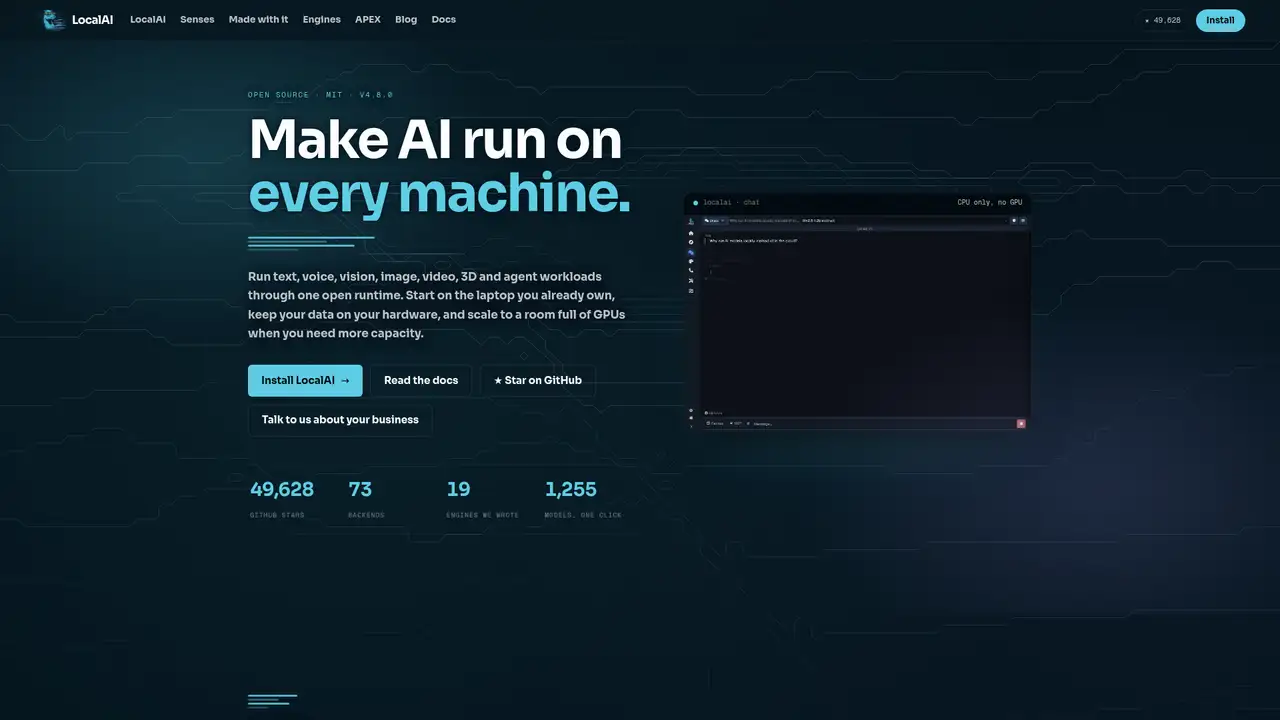
LocalAI is an open-source project created by Ettore Di Giacinto and maintained by the LocalAI team, with the repository created on March 18, 2023. It began as an OpenAI-compatible API in front of llama.cpp and has grown into a composable server with separate backend services. The project README reports roughly 49,000 GitHub stars and describes support for text, vision, voice, image, and video workloads without requiring a GPU. LocalAI's core is a small binary or container, while engines such as llama.cpp, vLLM, MLX, whisper.cpp, and Stable Diffusion are installed as needed. Its broader scope also includes embeddings, agents, and retrieval, but support varies by model, backend, and hardware. Choose LocalAI if you need one self-hosted endpoint for varied workloads and can manage the added configuration surface.
A normal workflow starts LocalAI with Docker, a binary, or another installation method, then adds a model through the web interface, CLI, API, gallery, models directory, or a model file. Users can point an existing OpenAI client or compatible application at the local endpoint. The interface supports chat, model management, agent creation, image generation, and system monitoring. LocalAI also documents Anthropic, Open Responses, Ollama, and ElevenLabs-compatible interfaces. Other capabilities include embeddings, reranking, retrieval, function calling, speech recognition, speech synthesis, vision, image generation, and video generation. Agents can use tools, knowledge bases, skills, and MCP. Separate backend services keep the core smaller, but operators must manage images, permissions, updates, compatibility, and security settings. LocalAI suits users needing a self-hosted endpoint across several modalities, API styles, agents, or hardware types.
LocalAI’s release history accelerated in 2026. Version 3.10 added Anthropic and Open Responses APIs, image and video generation, tool streaming, Moonshine, and Pocket-TTS. Version 4.0 introduced agent orchestration, a React interface, MCP Apps, and realtime audio. Later releases brought distributed inference, multi-user authentication, fine-tuning, voice and face recognition, diarization, video generation, Apple Silicon support, and new native backends. Released on October 2, 2026, version 4.11.0 added audio scenes combining transcription, diarization, sound detection, and remembered speakers, plus model failover chains, signed OCI galleries, a Decisions API, Kimodo text-to-animation, PDF extraction, and improved hardware detection. Model availability varies by gallery and backend, so operators should verify compatibility instead of assuming every model supports every modality. LocalAI is best for operators needing broad self-hosted capabilities across mixed hardware.
LocalAI has a $0 software entry price and no published paid hosted, seat, token, or usage tier. Its MIT license permits commercial use and redistribution of the software, subject to its terms. Costs instead come from the host machine, storage, electricity, containers, optional GPU hardware, cluster capacity, networking, and administration. LocalAI supports CPU-only operation, including consumer hardware, while selected backends can use CUDA, ROCm, Intel SYCL, Vulkan, Metal, or Jetson acceleration. Larger models and longer context windows require more memory. The model gallery supports installation and verification workflows, but model licenses vary and can be non-permissive or absent. Buyers must review each model and backend license separately, making LocalAI best suited to operators who want self-hosted, multi-modal inference and accept the related setup and maintenance work.
LocalAI keeps local inference on the operator's infrastructure by default, but privacy depends on authentication, agents, model sources, logs, network exposure, and any cloud proxy configuration. A security review of version 4.10 reported that authentication is disabled by default in the reviewed v4.10.0 setup and recommended enabling an API key or user authentication before remote exposure. Ollama is the easier choice for local text chat, vLLM is the more direct choice for high-throughput GPU text serving, and llama.cpp is the leaner underlying inference engine. LocalAI can run across CPU-first or selected accelerated hardware and supports multiple modalities and compatible API styles, but backend and model support can vary. Choose LocalAI when one self-hosted endpoint must cover several modalities, API dialects, agents, or mixed hardware, and accept the added configuration work. It is best for operators needing broad self-hosted coverage.
Who is LocalAI best for?
- Teams consolidating local text, audio, vision, image, and agent APIs.
- Developers replacing several cloud endpoints with one local server.
- Operators needing MCP, retrieval, agents, or multi-user controls.
- CPU-first deployments across laptops, servers, or selected edge hardware.
LocalAI Pricing (2026)
Pricing model: Free. All prices in USD.
| Plan | Price | What you get |
|---|---|---|
| Community self-hosted | $0 | No paid tier or hosted quota is published. Capacity depends on local CPU, memory, storage, accelerator hardware, and the selected backend. |
Pros and Cons
Pros
- MIT-licensed software has no per-token or seat fee.
- One endpoint supports multiple API dialects and modalities.
- CPU-only operation is available with optional accelerator support.
- The interface includes model management, agents, and monitoring.
Cons
- Many backends create a substantial configuration surface.
- Authentication requires deliberate operator setup before exposure.
- Model licenses and hardware requirements vary by workload.
Who should look elsewhere?
- Users wanting the shortest setup for laptop text chat.
- High-throughput GPU text serving where direct vLLM is sufficient.
- Teams unwilling to configure authentication before remote access.
Technical Details
Frequently Asked Questions
How much does LocalAI cost?
LocalAI is free, open-source software under the MIT license, and no paid hosted, seat, or token plan is published. Your costs are the computer or server, storage, electricity, and optional accelerators. A multi-node deployment adds infrastructure and administration costs. Models and external services can have separate license or provider charges.
Does LocalAI have a free plan?
LocalAI has free self-hosted software rather than a conventional hosted plan. You can run the server at no software charge on CPU-only hardware or with supported accelerators. There is no published hosted quota, seat allowance, or usage ceiling. Capacity depends on your machine, model, context length, storage, and concurrent workload.
LocalAI or Ollama, which should I choose?
Choose Ollama for a simpler personal-computer workflow focused on downloading and serving text models. Choose LocalAI when one endpoint must cover text, vision, audio, images, video, embeddings, agents, or multiple API dialects. LocalAI offers more deployment features and backend choices, while Ollama generally requires less configuration for straightforward local chat.
Does LocalAI train on my prompts?
LocalAI is self-hosted, and its documentation says local data stays on your infrastructure. The project does not operate a central prompt-training service for local requests. Privacy still depends on configuration. Agents, cloud proxy models, web tools, model downloads, logs, network exposure, and third-party backends can send or retain data outside the core local inference process.
Can I use LocalAI commercially?
The LocalAI software is MIT licensed, allowing commercial use, modification, and redistribution subject to the license notice and conditions. That permission applies to the project code, not automatically to every model or backend in its gallery. LocalAI warns that model licenses vary, so verify each model before commercial deployment or redistribution.
Best LocalAI Alternatives in 2026
These tools do the same job as LocalAI, with different pricing, limits and trade-offs.
Run open models locally or call larger ones through Ollama Cloud

Portable C and C++ inference for quantized language models

Open-source, high-throughput inference serving for language models

Portable local AI for writing, chat, and multimodal experiments
Private, local chat and model inference for ordinary computers