
vLLM Review, Pricing & Alternatives (2026)
Open-source, high-throughput inference serving for language models
Last updated: October 22, 2026
What is vLLM?
vLLM is an Apache 2.0 inference engine and API server for teams serving open models on GPUs and other supported hardware. The UC Berkeley project suits developers building self-hosted, concurrent inference services. The software costs $0, while compute, storage, networking, and model licenses create the operating bill.
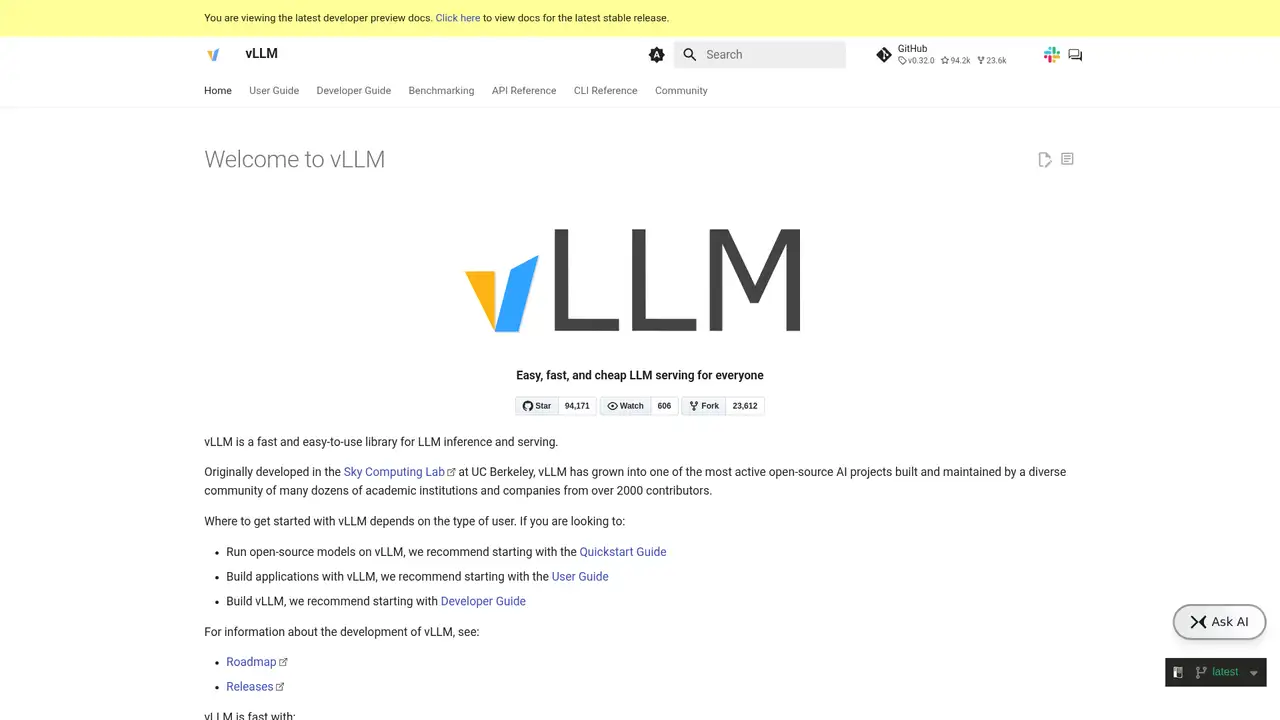
vLLM is an open-source inference and serving engine originally developed in UC Berkeley's Sky Computing Lab. Its GitHub repository was created in 2023, and the project says its community includes more than 2,000 contributors. Its 2024 retrospective recorded growth from 14,000 to 32,600 GitHub stars, 190 to 740 contributors, and 6,000 to 27,000 monthly downloads in 2024. These figures indicate project activity, not revenue or customer count. The repository uses Apache License 2.0, granting broad rights to use, modify, and redistribute the software, subject to license, notice, attribution, patent, and modification requirements. vLLM is community software rather than a hosted inference company, so operators remain responsible for deployment, infrastructure, maintenance, and support. Pick vLLM if you can manage those responsibilities and need self-hosted inference serving.
A typical deployment installs the Python package, selects a compatible Hugging Face model, and starts the vllm serve command. The OpenAI-compatible server accepts chat and completion requests, including streaming responses. PagedAttention manages key and value memory, while continuous batching combines concurrent requests. Tensor, pipeline, data, expert, and context parallelism support multi-device inference. Documented quantization options include FP8, MXFP8/MXFP4, NVFP4, INT8, INT4, GPTQ/AWQ, GGUF, and others. Developers can also use offline Python inference, the Anthropic Messages API, or gRPC interfaces. Structured outputs, tool calling, reasoning parsers, multimodal inputs, and LoRA are documented capabilities. Support for particular combinations depends on the model, hardware, and engine version, so compatibility should be checked before deployment. Pick vLLM when self-hosted throughput and distributed execution matter more than a turnkey endpoint.
V1 was the significant 2025 architectural release, redesigning the scheduler, KV-cache manager, worker, sampler, and API server while retaining many model implementations and GPU kernels from V0. Its core changes include persistent batches, lower CPU overhead, prefix caching, cleaner tensor parallelism, and separation of CPU work from execution. The January 2025 announcement reported up to 1.7 times V0 throughput in its tests, although the initial alpha lacked features such as pipeline parallelism, structured decoding, speculative decoding, metrics, and LoRA; current V1 documentation marks these capabilities as supported or optimized. Current documentation says V1 is enabled by default for supported use cases and that V0 is being deprecated. Current V1 documentation lists NVIDIA, AMD, and Intel GPUs, TPUs, and CPUs as supported, with additional hardware available through plugins. Compatibility depends on the model architecture and backend, so pick V1 for self-hosted teams prioritizing throughput and distributed execution.
The software costs $0, with no official vLLM subscription, hosted inference quota, managed endpoint, or paid support tier listed in project documentation. Practical costs include GPUs or other accelerators, cloud instances, storage, networking, monitoring, and electricity. Model weights may carry separate license terms. By default, vLLM collects anonymous usage statistics about technical deployment data, such as hardware, model configuration, version, and platform. Operators can opt out by setting VLLM_NO_USAGE_STATS=1 or DO_NOT_TRACK=1, or by creating a do-not-track file. Self-hosting keeps request processing on infrastructure selected by the operator and avoids sending prompts to vLLM, but operators must audit their own logs, monitoring systems, integrations, connected tools, and provider telemetry. Pick vLLM if self-hosted throughput and distributed execution matter more than a turnkey endpoint.
vLLM suits production teams needing concurrent serving, batching, distributed GPU execution, and an OpenAI-compatible interface. It is heavier to operate than desktop runtimes and requires teams to manage deployment, infrastructure, monitoring, and support themselves. llama.cpp generally offers a smaller deployment path for laptops, CPUs, and consumer GPUs, while SGLang is a close high-performance serving competitor. TensorRT-LLM is attractive for teams focused on NVIDIA-specific optimization. Hardware support and model compatibility vary across releases, so supported combinations require checking. vLLM has no managed control plane, project-level uptime guarantee, or commercial SLA. Its software is free, but operators still pay for infrastructure and related operations. Pick vLLM when self-hosted throughput, batching, parallelism, distributed execution, and an open API matter more than a turnkey hosted service.
Who is vLLM best for?
- Teams serving open models behind an OpenAI-compatible API.
- Multi-GPU deployments requiring batching and parallelism.
- Developers optimizing throughput on supported accelerators.
- Research groups running self-hosted inference.
vLLM Pricing (2026)
Pricing model: Free. All prices in USD.
| Plan | Price | What you get |
|---|---|---|
| Open-source software | $0 | No hosted quota or inference allowance. You provide compute, storage, networking, and model access. |
Pros and Cons
Pros
- PagedAttention and continuous batching target concurrent throughput.
- The OpenAI-compatible server can ease migration from hosted APIs.
- Apache 2.0 licensing permits commercial use under its conditions.
- V1 adds prefix caching and a redesigned serving architecture.
Cons
- GPU drivers, memory, and model compatibility require operational work.
- The project provides no bundled hosted service or support SLA.
- Feature and hardware coverage varies by model and release.
Who should look elsewhere?
- Users seeking a managed endpoint with a guaranteed SLA.
- Small desktop setups requiring minimal operational complexity.
- Teams unwilling to manage GPU drivers and model licenses.
Technical Details
Frequently Asked Questions
How much does vLLM cost?
The software costs $0 under Apache License 2.0. The project lists no hosted plan or usage price. Teams must budget separately for GPUs or other accelerators, storage, networking, monitoring, and model licenses. A cloud provider or inference company offering vLLM may set its own prices, which are separate from the project.
Does vLLM have a free plan?
vLLM has free open-source software rather than a hosted free plan. You can install the package and run its APIs on infrastructure you control. There is no vLLM-provided request quota or included compute allowance. Hardware, cloud instances, storage, networking, and operations still create costs.
How does vLLM compare with llama.cpp?
vLLM targets concurrent, high-throughput serving with continuous batching, an OpenAI-compatible server, and distributed parallelism. llama.cpp generally offers a smaller deployment path for laptops, CPUs, and consumer GPUs, with strong GGUF support. Choose vLLM for server workloads and llama.cpp for portable local deployments with lower operational overhead.
Does vLLM train on user prompts?
The project documentation describes anonymous usage statistics containing technical deployment information, such as hardware, model configuration, version, and platform. It provides opt-out settings including VLLM_NO_USAGE_STATS=1 and DO_NOT_TRACK=1. Self-hosted request handling occurs on your infrastructure, but your logs, monitoring, integrations, and cloud telemetry remain your responsibility.
Can businesses use vLLM commercially?
Apache License 2.0 permits commercial use, modification, and redistribution when its conditions are followed. Commercial users must preserve required notices and review the license for distributed modifications. The vLLM license does not grant rights to model weights, datasets, trademarks, or third-party dependencies, each of which may impose separate terms.
Best vLLM Alternatives in 2026
These tools do the same job as vLLM, with different pricing, limits and trade-offs.