
Liner Review, Pricing & Alternatives (2026)
Cited web and academic research with an AI workspace
Last updated: October 26, 2026
What is Liner?
Liner is an AI research workspace for students, academic researchers, professionals, and developers who need cited answers, document analysis, and research reports. Its consumer service starts at $17.99 per month, or $14.99 per month billed annually. A free offer includes up to 10 Deep Research reports daily under promotional terms, while API access is billed separately by request or token.
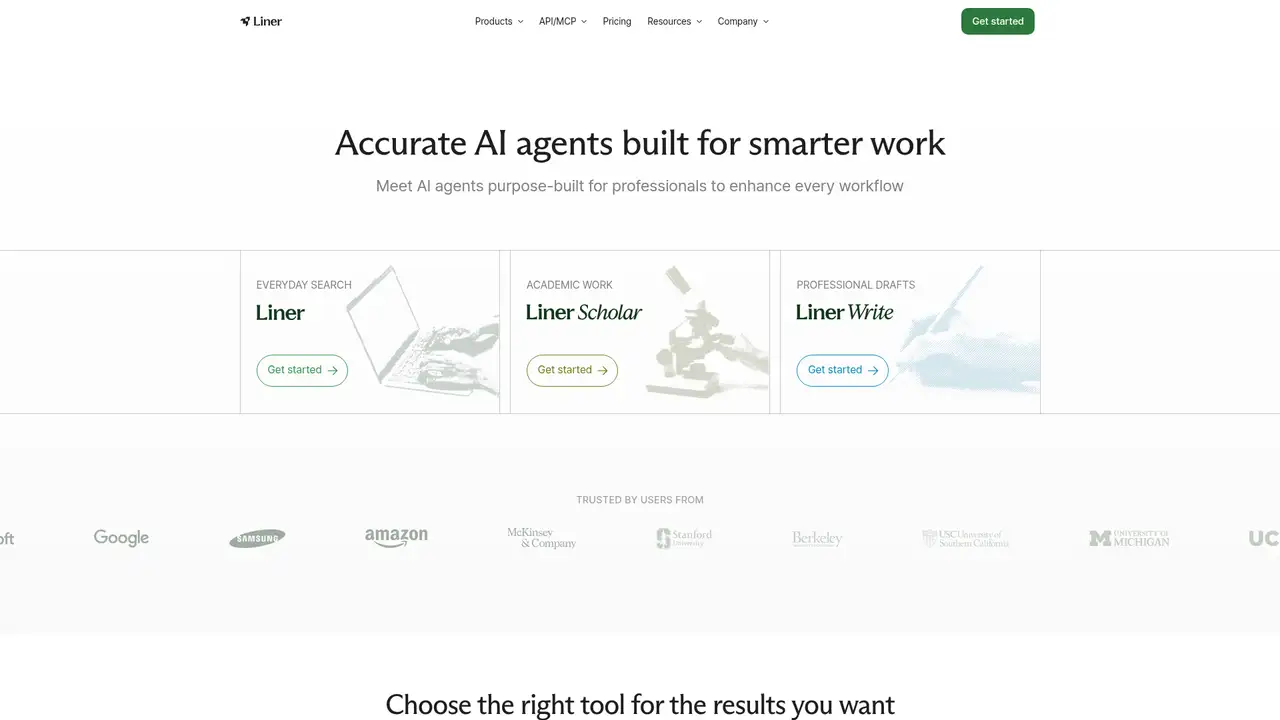
Liner is an AI research workspace operated by a company whose principal place of business is in Seoul, South Korea. It serves students, academic researchers, professionals, and developers with web search, Scholar search, writing tools, document analysis, and research agents. The company introduced Deep Research on March 20, 2025, with source discovery, citation checking, and long-form reports. Liner also offers developer access through search, visualization, agent, and Router APIs. Its terms say users retain ownership of submitted content while granting Liner a limited license to operate, promote, improve, and develop its services. Liner does not publish a founding year, user count, employee count, or funding total on the cited pages.
A typical Liner session starts with a question, uploaded file, or academic search request. Deep Research breaks the request into related subtasks, searches multiple sources, and returns a report with references, tables, graphs, and additional findings. Related research calls can run concurrently, which the company says reduces repeated prompting. Users can export findings to PDF, Microsoft Word, OneNote, or text. Scholar emphasizes papers, source reliability, and citation volume, drawing from more than 50 academic sources, while file uploads support questions about personal documents. Developers can call Web Search, Scholar Search, Visualization, Quick Answer Agent, Search Agent, Deep Research Agent, and Visual Answer Agent endpoints. API charges vary by feature and complexity, with requests or tokens deducted from prepaid credits. Pick Liner for cited research workflows involving papers, documents, reports, or developer integrations.
Liner combines search infrastructure, source ranking, intent-aware language models, and third-party generative models. Its Deep Research announcement says Scholar draws from more than 50 trusted academic sources, including arXiv, PubMed, Nature, and IEEE, while citation volume helps users assess credibility. Liner also describes an advanced ranker for high-quality references, a fine-tuned language model that understands user intent, and another fine-tuned model that uses selected references. Its pricing page lists 309 generation models, spanning GPT-6.1 and GPT-6 variants, Gemini image models, Claude-related offerings, and other providers. In 2025, Liner announced agents for hypothesis generation, citation recommendation, peer review, and survey simulation. Its API documentation lists Router models including liner-mark-1.3 and liner-gemini-router-1.0.
The free offer includes up to 10 Deep Research reports daily, but Liner says this allowance may change under promotional offers, terms, and subscription policy. Pro costs $17.99 per month or $14.99 per month when billed annually, and includes 20 daily uploads of up to 100 MB each. Max costs $35.99 per month or $29.99 per month annually, with unlimited daily uploads and files up to 200 MB. Team costs $26.99 per user monthly for teams of 2 to 20 seats. API pricing is usage based: Web Search costs $1 per 1,000 requests, Scholar Search costs $0.30, Quick Answer Agent costs $3, Search Agent costs $20, Deep Research Agent costs $200, and Visual Answer Agent costs $150 per 1,000 requests. Router access costs $0.60 to $1 per million input tokens, plus output charges.
Citations do not eliminate the need to verify important claims. Liner warns that generated material can be inaccurate or biased, and its Deep Research announcement says results vary with query complexity, context length, and data recency. Its privacy update also says submitted content may be shared with third-party service providers to process requests and provide AI-powered features, so users should review the current policy before uploading confidential documents. Perplexity is a closer general web research alternative, while Elicit and Consensus focus more tightly on academic literature. ChatGPT and Claude provide broader document and writing tools. Liner’s API also has published endpoint rates, from Web and Scholar Search to long-form Deep Research Agent requests. Pick Liner for cited web and paper research with file handling, exports, and metered developer endpoints.
Who is Liner best for?
- Students needing cited answers and exportable reports.
- Researchers comparing academic papers and references.
- Professionals analyzing uploaded documents with sources.
- Developers building metered research and search agents.
Liner Pricing (2026)
Pricing model: Freemium. All prices in USD.
| Plan | Price | What you get |
|---|---|---|
| Free | $0 | Up to 10 Deep Research reports daily. The allowance is subject to promotional offers, terms, and subscription policy. |
| Pro | $17.99/month or $14.99/month billed annually | Includes Liner, Scholar, and Write, plus 20 daily uploads of up to 100 MB each. |
| Max | $35.99/month or $29.99/month billed annually | Includes Liner, Scholar, and Write, plus unlimited daily uploads of up to 200 MB each. |
| Team | $26.99/user/month | The pricing page lists teams of 2 to 20 seats. |
| Liner API Web Search | $1/1,000 requests | Successful Web Search API calls are metered per request and paid from a prepaid credit balance. |
| Liner API Scholar Search | $0.30/1,000 requests | Successful Scholar Search API calls are metered per request and paid from a prepaid credit balance. |
| Liner API Visualization | $10/1,000 requests | Visualization requires the developer to provide a search engine. |
| Liner API Web Search + Visualization | $20/1,000 requests | Combines web search with visualization in one metered request. |
| Liner API Quick Answer Agent | $3/1,000 requests | Provides streaming answers with a small number of references. |
| Liner API Search Agent | $20/1,000 requests | Provides answers and citations through iterative web and academic searching. |
| Liner API Deep Research Agent | $200/1,000 requests | Produces long-form research results with additional context and source citations. |
| Liner API Visual Answer Agent | $150/1,000 requests | Adds automatic visualization to AI answers and citations. |
| Liner API Router | $0.60-$1.00/input 1M tokens | Output costs range from $3.00 to $6.00 per million tokens, with cached input from $0.06 to $0.10 per million tokens. |
Pros and Cons
Pros
- Deep Research exports reports to PDF, Word, OneNote, and text.
- Scholar searches more than 50 academic source collections.
- The API publishes endpoint-level request and token rates.
- Paid plans combine research, writing, and document uploads.
Cons
- Liner warns that generated answers can be inaccurate or biased.
- Consumer subscriptions and credits are nonrefundable.
- The privacy policy permits service-provider processing of submitted content.
Who should look elsewhere?
- Teams requiring fully self-hosted research software.
- Users needing guaranteed accuracy for high-stakes decisions.
- Developers needing the lowest-cost long-form research API.
Technical Details
Frequently Asked Questions
How much does Liner cost?
Liner Pro costs $17.99 per month or $14.99 per month billed annually. Max costs $35.99 per month or $29.99 per month billed annually. Team is listed at $26.99 per user monthly. API rates range from $0.30 per 1,000 Scholar Search requests to $200 per 1,000 Deep Research Agent requests.
Does Liner have a free plan?
Liner offers up to 10 Deep Research reports daily without a paid subscription. The company says this allowance is subject to promotional offers, terms, and subscription policy. Paid plans add larger upload allowances and access to the Liner, Scholar, and Write product family.
Is Liner better than Perplexity?
Liner emphasizes academic search, uploaded-document analysis, report exports, and research agents. Perplexity is positioned more broadly around cited web answers and general research. Liner fits users who need Scholar and file workflows, while Perplexity suits fast general web questions.
Does Liner train on user data?
Liner's February 2026 privacy update says submitted content may be shared with third-party service providers to process requests and provide AI features. Its terms also grant Liner a limited license to operate, promote, improve, and develop services. Users should review the current privacy policy before uploading confidential material.
Can Liner be used commercially?
Liner offers paid subscriptions, an API, and enterprise arrangements with volume discounts, invoicing, service levels, and custom terms. Its terms say users retain ownership of submitted content while granting Liner a limited service-related license. Commercial users should review the current terms, usage policy, and any enterprise agreement before distributing generated work.
Best Liner Alternatives in 2026
These tools do the same job as Liner, with different pricing, limits and trade-offs.
Source-linked AI search with multi-model research and agent features
AI workflows for literature search, review, and research reports

Evidence-linked search and synthesis for academic literature
General-purpose AI assistance for writing, research, coding, and work
Long-context AI assistant for writing, research, and code