
Let's Enhance Review, Pricing & Alternatives (2026)
AI upscaling and restoration for photos, products, and print
Last updated: October 26, 2026
What is Let's Enhance?
Let's Enhance is a hosted AI image upscaling and restoration service for photographers, ecommerce teams, marketers, and people repairing low-resolution pictures. It supports enlargement, sharpening, restoration, color correction, and background removal through a browser workflow. The free tier includes 10 credits, while paid personal plans start at $9 per month for 100 credits. Automated developer processing is directed to Claid.ai.
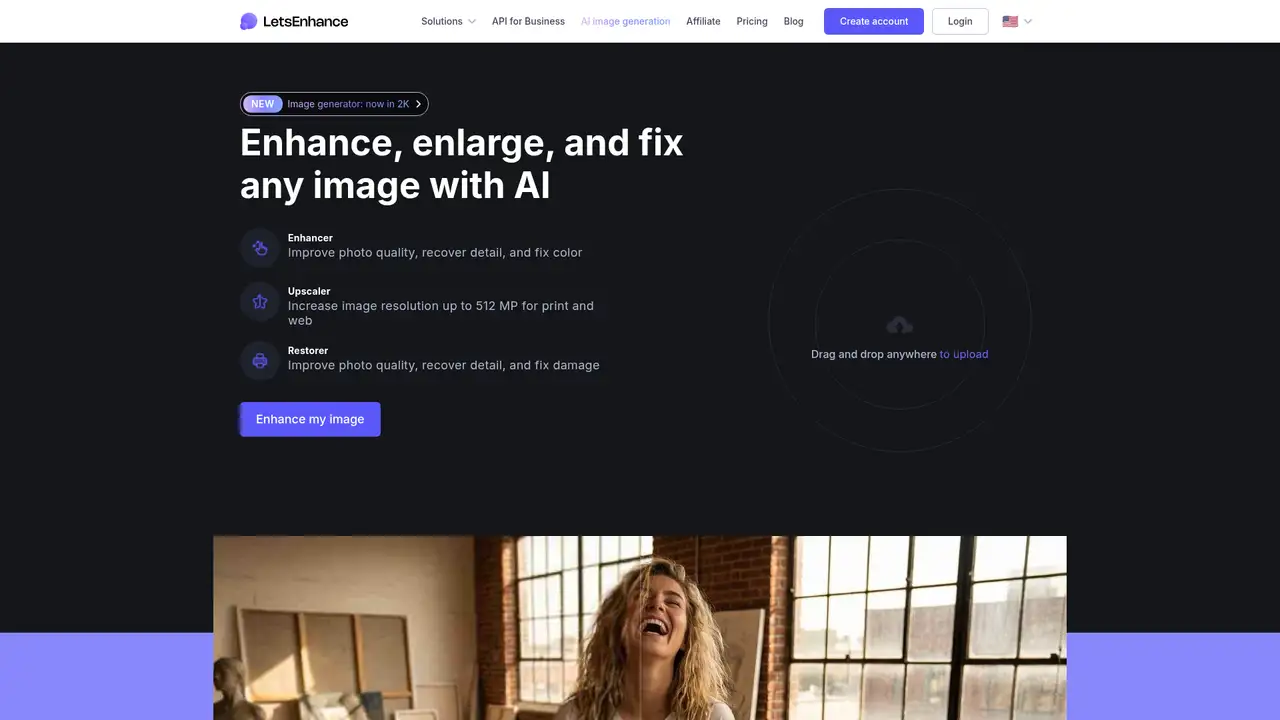
Let's Enhance is a hosted AI image upscaling and restoration service created by Ukrainian founders Sofi Shvets and Vlad Pranskevičius. Company histories place its founding in 2017 or 2018. The original product focused on enlarging and repairing low-quality photos, while later company work expanded toward Claid, an automated image-processing platform for marketplaces. Tech.eu reported a $3 million 2021 seed round led by Chamaeleon with Hype Ventures and Acrobator, more than $1 million in annual revenue, and customers including Mixtiles, Pollinate, and Vente-privee. The company has identified ecommerce, real estate, travel, foodtech, and professional photography as target markets. Let's Enhance remains a hosted service rather than open-source software, with browser access for consumer and business image work.
The typical workflow starts with an upload, followed by an enhancement or enlargement choice, an output-size selection, and a download. Available operations include upscaling, sharpening, restoration, color and tone correction, background removal, and AI art generation. A standard image uses one credit at output sizes up to 8 megapixels. Larger Ultra outputs cost four credits up to 32 megapixels, eight credits up to 128 megapixels, or ten credits up to 512 megapixels. Input files can reach 64 megapixels or 50 MB. Background-removal jobs have a lower 16-megapixel limit for both input and output. These limits make the service practical for product catalogs, print preparation, and individual photo repairs, although large files can consume credits quickly.
Let's Enhance describes its technology as machine-learning image processing rather than exposing a selectable foundation model. Super-resolution reconstructs detail during enlargement, while separate operations handle enhancement, background removal, and generative work. The notable recent product change is the separation between the consumer web tool and Claid.ai, the company's advanced editing and developer platform. The official API page directs automated processing to Claid and offers 50 free credits for API testing. Claid charges credits according to output size, meaning an 8K result consumes more than a smaller image. The public Let's Enhance site therefore fits interactive work and modest batches more closely than application-embedded automation. The available material does not identify a named 2025 or 2026 model release.
The free tier supplies 10 signup credits, accepts images up to 24 megapixels or 50 MB, produces images up to 8 megapixels, stores files for six months, and adds a watermark. Starter costs $9 monthly for 100 credits, Pro costs $24 monthly for 300, and Max costs $34 monthly for 500. Annual billing is discounted, with the pricing page showing $32 monthly for Pro when billed monthly in one localized display. Personal credits roll over up to six times the monthly allowance while the subscription remains active. Business plans cover 1,000, 2,500, and 5,000 monthly credits, without accumulation. Pay-as-you-go bundles contain 20, 50, or 120 credits and do not expire. Costs rise when output exceeds 8 megapixels.
Let's Enhance is more focused than Pixlr and less suitable for layer-based design composition. Topaz Photo AI offers a stronger desktop workflow for photographers, Adobe Lightroom and Photoshop provide broader editing and catalog tools, and Upscayl offers a free local alternative for users willing to manage hardware and model files. The terms grant a limited, revocable service license rather than transferring ownership of the platform. The privacy policy says submitted API media is processed to provide the requested service and that account data is not sold, rented, or shared for unrelated purposes. Claid is the better route for production API integration. Let's Enhance is the better pick for fast web upscaling and ecommerce batches, and ecommerce teams and photographers should pick it when browser convenience matters most.
Who is Let's Enhance best for?
- Ecommerce teams cleaning and enlarging product images.
- Photographers preparing low-resolution files for print.
- Marketers needing browser-based batch enhancement.
- Occasional users preferring non-expiring credits.
Let's Enhance Pricing (2026)
Pricing model: Freemium. All prices in USD.
| Plan | Price | What you get |
|---|---|---|
| Free | $0 | 10 signup credits; input up to 24MP or 50MB, output up to 8MP, six months of storage, and watermark. |
| Starter | $9/month | 100 credits monthly, personal rollover up to 600 credits, output up to 256MP, and six months of storage. |
| Pro | $24/month or discounted annual billing | 300 credits monthly, personal rollover up to 1,800 credits, output up to 350MP, and six months of storage. |
| Max | $34/month or discounted annual billing | 500 credits monthly, personal rollover up to 3,000 credits, output up to 512MP, and six months of storage. |
| Business | Custom | Public business tiers include 1,000, 2,500, and 5,000 monthly credits; credits reset monthly and do not roll over. |
| Pay as you go | Custom bundle pricing | 20, 50, or 120 one-time credits; unused credits do not expire. |
Pros and Cons
Pros
- The free allowance makes basic upscaling easy to assess.
- Max supports output sizes up to 512 megapixels.
- Personal credits roll over up to six months of allowance.
- Pay-as-you-go credits remain available without expiry.
Cons
- Large output sizes consume multiple credits quickly.
- Subscription credits expire after cancellation and the paid period.
- Developer processing is redirected to the separate Claid platform.
Who should look elsewhere?
- Users wanting a full layer-based design editor.
- Teams needing local processing without uploads.
- Developers expecting a standalone Let's Enhance API.
Technical Details
Frequently Asked Questions
How much does Let's Enhance cost?
Let's Enhance starts with 10 free signup credits. Personal subscriptions cost $9 per month for Starter with 100 credits, $24 per month for Pro with 300, and $34 per month for Max with 500. Annual billing is discounted. Business plans provide 1,000, 2,500, or 5,000 credits monthly, with pricing presented separately from the personal tiers.
Is Let's Enhance free?
Yes. The free account includes 10 credits, six months of storage, input up to 24 megapixels or 50 MB, and output up to 8 megapixels. Free results carry a watermark. Paid plans remove the watermark and raise image-size limits. A single image can cost more than one credit when the requested output exceeds 8 megapixels.
Let's Enhance or Topaz Photo AI, which is better?
Let's Enhance suits browser use, occasional work, and ecommerce teams processing images without installing software. Topaz Photo AI suits photographers wanting a desktop workflow, local file handling, and dedicated enhancement controls. Let's Enhance uses credits and cloud processing, while Topaz uses a software license and follows a different upgrade and hardware model.
Does Let's Enhance use uploaded images to train models?
Let's Enhance's privacy policy says it stores submitted API data to detect file types and deliver or process requested media, and says it does not sell, share, or rent account data for unrelated purposes. It also says customers can recover, modify, or delete data through the service. The policy does not promise that every uploaded image is excluded from all service-improvement activity.
Can Let's Enhance results be used commercially?
The service is marketed to commercial photography, ecommerce, real estate, travel, and food businesses. Its terms let customers use the hosted service during a limited, non-exclusive, revocable license. Users retain rights in their own data and must have permission to upload it. The terms do not transfer ownership of the software, and customers remain responsible for third-party rights in source images and outputs.
Best Let's Enhance Alternatives in 2026
These tools do the same job as Let's Enhance, with different pricing, limits and trade-offs.