
Topaz Photo AI Review, Pricing & Alternatives (2026)
Local-first AI restoration for difficult photographs
rebranded: Topaz Photo AI was discontinued in September 2025. Version 4.0.4 is final. Topaz Photo is its subscription-only successor, while existing perpetual licenses remain usable.
Last updated: October 26, 2026
What is Topaz Photo AI?
Topaz Photo AI is Topaz Labs’ discontinued desktop application for denoising, sharpening, face recovery and enlargement. It suits photographers who already own a perpetual license and want local processing on Windows or macOS. The successor, Topaz Photo, starts at $39/month or $199/year, while promotional charges may differ.
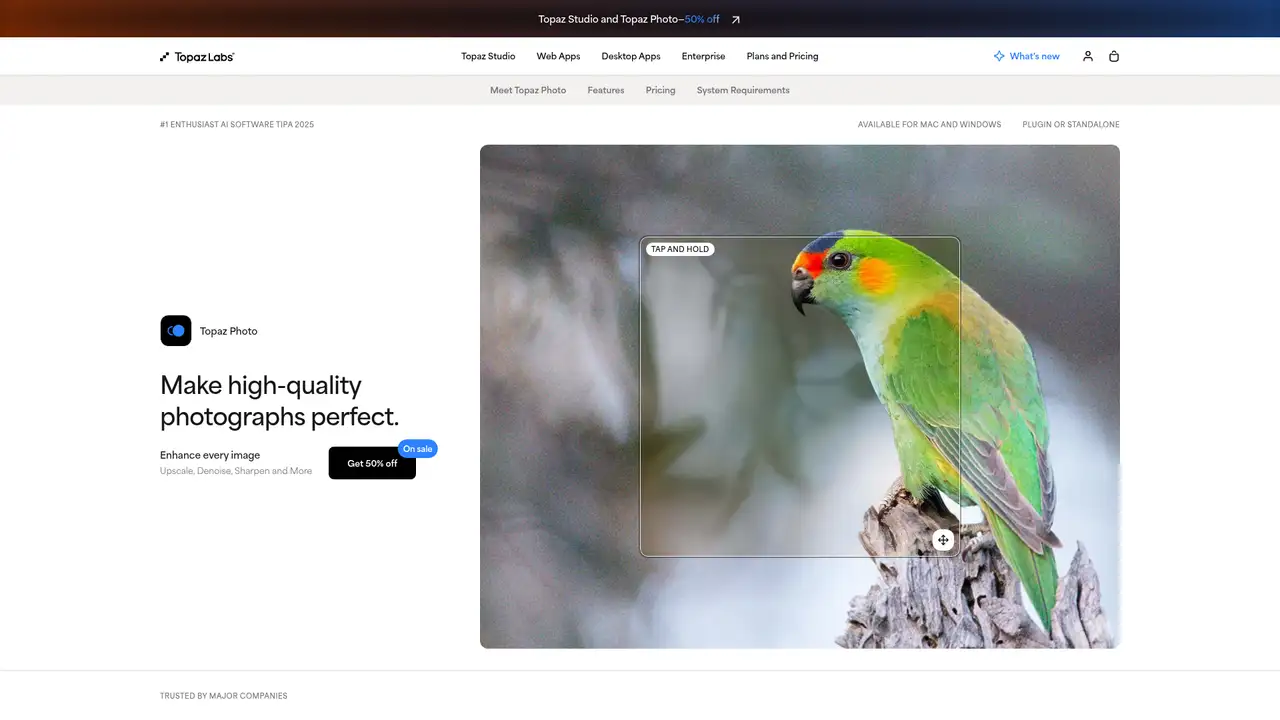
Topaz Photo AI is a Windows and macOS desktop image-enhancement application made by Topaz Labs. It combines automatic analysis with focused models for noise, blur, faces, text and enlargement. Topaz identifies version 4.0.4 as the final release and discontinued the application in September 2025. The successor is Topaz Photo, a separate subscription product that carries forward the restoration workflow and adds newer models. Photo AI remains usable for customers who own a perpetual license. Topaz says those licenses cover a specific version, support use on two computers simultaneously, require authentication every six months and permit up to six months of offline use. The installer remains in the account Legacy section.
A typical Photo AI workflow starts by opening a photograph and allowing Autopilot to analyze it. The editor can then apply Denoise, Sharpen, Upscale, Recover Faces, Preserve Text, Remove, Dust and Scratch, Adjust Lighting, Balance Color or Healing Brush. Users can adjust the enhancements before exporting the result, and batch processing supports repeated work across multiple images. Most models render locally on the computer, which keeps the main processing step on local hardware. Topaz also supports optional cloud rendering for selected models when the computer is slow or lacks suitable graphics capacity. That choice affects both processing location and internet dependence. Photo AI is frozen, while Topaz Photo receives current development and model releases.
Topaz Photo AI uses specialized neural enhancement models rather than functioning as a full catalog manager or layered compositing editor. The successor adds Adjust Lighting v3, Denoise Max, Dust and Scratch v2, Recover Faces v3, Remove v2, Super Focus v3, newer Sharpen models, High Fidelity v3, Recover v3, Standard Max and Wonder. Topaz Photo launched on September 17, 2025, with Standard Max, Wonder, a standalone Healing Brush, opacity controls and Windows ARM support. Topaz says generative models need 8GB of graphics memory for local operation, although some systems may run them slowly with 6GB. Snapdragon systems use cloud processing for generative models, and Linux is unsupported.
Photo AI has no current public purchase plan because Topaz discontinued sales. Existing owners retain the version attached to their account. The replacement Topaz Photo Personal plan is listed at $39/month or $199/year, with a $25/month annual-commitment option. A promotional offer lists $19.50/month for the first three months or $99.50 for the first year, followed by standard renewal pricing. Personal includes unlimited local and cloud image rendering, with commercial use restricted to organizations below $1 million annual revenue. Pro costs $63/month billed for 12 months or $599/year and adds full commercial use, Pro models and seat management. Topaz Studio costs $69/month or $399/year and includes 300 monthly video credits.
Photo AI’s central limitation is age: version 4.0.4 receives no new models and is not optimized for newer operating systems or systems. Current Topaz Photo requires recurring authentication, a subscription and supported Windows or macOS hardware. Adobe Photoshop is the stronger choice for layered compositing, Lightroom is better for catalog-centered photo management, and DxO PureRAW concentrates on RAW noise reduction and lens correction. Topaz is narrower than Photoshop and Lightroom, but more directly focused on repair, sharpening and enlargement. Cloud rendering adds an internet and remote-processing consideration, while local rendering suits sensitive images. Choose Photo AI if you already own the legacy license; choose Topaz Photo if current models and ongoing development matter more.
Who is Topaz Photo AI best for?
- Existing owners seeking perpetual restoration software.
- Photographers repairing noise, blur, faces, text or undersized files.
- Users with compatible Windows or Mac hardware.
- Photographers who need current Topaz models.
Topaz Photo AI Pricing (2026)
Pricing model: Paid. All prices in USD.
| Plan | Price | What you get |
|---|---|---|
| Legacy Topaz Photo AI | Price shown at checkout | Version 4.0.4 is final. Existing licenses authenticate every six months and allow up to six months of offline use. |
| Topaz Photo Personal | $39/month or $199/year | Unlimited local and cloud image rendering. Commercial use is limited to organizations below $1 million annual revenue. |
| Topaz Photo Pro | $63/month or $599/year | Includes full commercial use, Pro models and seat management. |
| Topaz Studio | $69/month or $399/year | Includes Topaz Photo, Video, Gigapixel, mobile and web products, plus 300 monthly video credits. |
Pros and Cons
Pros
- The final perpetual version remains usable.
- Specialized models cover denoising and enlargement.
- Local rendering can keep processing on the computer.
- The successor includes unlimited image rendering.
Cons
- Photo AI receives no new models.
- Current Topaz Photo requires recurring payment.
- Cloud rendering requires internet access and remote processing.
Who should look elsewhere?
- Photographers needing catalog or layered compositing tools.
- Linux users of the current successor.
- Businesses above $1 million revenue using Personal.
Technical Details
Frequently Asked Questions
How much does Topaz Photo AI cost?
Topaz Photo AI has no current public purchase plan because Topaz discontinued it. Version 4.0.4 is final, and existing owners retain their licensed version through the account Legacy section. The replacement Topaz Photo is listed at $39/month or $199/year for Personal, while Pro is listed at $63/month or $599/year.
Is Topaz Photo AI free?
No. Photo AI was sold as paid perpetual software rather than as a continuing free tier. A license covers a particular version, and version 4.0.4 is the final release. Any trial, refund period or promotional offer for current Topaz Photo is separate from the discontinued Photo AI application.
Topaz Photo AI or Topaz Photo?
Photo AI is discontinued perpetual software for denoising, sharpening, face recovery and enlargement. Topaz Photo is subscription-only, receives ongoing development and adds newer models such as Standard Max and Wonder. Pick Photo AI for an owned legacy license and basic restoration needs. Pick Topaz Photo for current models, newer hardware support and continuing updates.
Does Topaz Photo AI train on photographs?
Topaz documents local processing and optional cloud rendering, but the cited product documentation does not describe a broad training policy for customer photographs. Local rendering keeps that operation on the computer. Cloud rendering sends selected processing to remote infrastructure, so users handling sensitive images should review Topaz’s current terms before using it.
Can Topaz Photo AI outputs be used commercially?
Current Topaz Photo Personal permits commercial use for organizations below $1 million in annual revenue, while Pro provides full commercial use. Legacy Photo AI follows the license terms attached to the purchased version. A business should select a current plan that matches its revenue, commercial requirements and seat needs.
Best Topaz Photo AI Alternatives in 2026
These tools do the same job as Topaz Photo AI, with different pricing, limits and trade-offs.