
LanguageTool Review, Pricing & Alternatives (2026)
Multilingual grammar, style, spelling, and paraphrasing assistance
Last updated: October 22, 2026
What is LanguageTool?
LanguageTool is a multilingual grammar and style checker for students, professionals, teams, and developers. Its open-source core supports local or cloud deployment, while hosted Premium adds larger text limits, advanced checks, style guides, and unlimited AI paraphrasing. Basic is free, while paid prices vary by locale, VAT, and billing cycle.
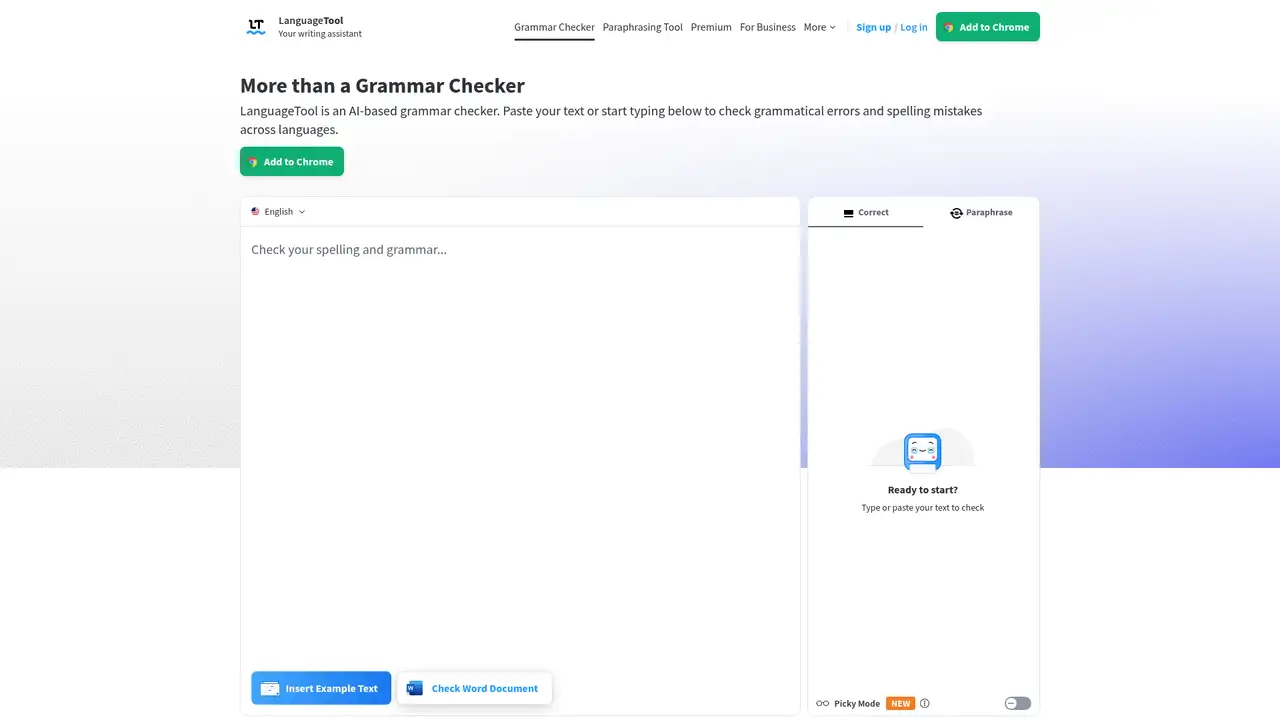
LanguageTool is a grammar, spelling, punctuation, style, and paraphrasing service that began as Daniel Naber’s computational-linguistics diploma project in 2003. It later became commercial and Learneo acquired it on April 5, 2023, for undisclosed financial terms. LanguageTool says its browser add-on has more than 2 million active installations, serves more than 150 companies, and improves more than 20 million texts daily. These figures are company claims. The product supports more than 30 languages and remains separate from Learneo’s other writing brands. Its open-source core can run locally or in the cloud. Hosted Premium and AI features are commercial services, giving users a choice between self-managed checking and expanded hosted capabilities for writing, editing, and paraphrasing.
A typical LanguageTool workflow begins in a browser extension, desktop application, mobile application, supported word processor, or the LanguageTool editor. The service identifies spelling, grammar, punctuation, word choice, style, typography, and some contextual issues, then offers suggestions users may accept or reject. Premium adds more than 20,000 additional checks for several major languages, a personal style guide, text statistics, larger fields, and unlimited sentence paraphrasing. Teams add user management, shared style guidance, and a shared dictionary. Developers can submit text through the HTTP API, while organizations can request a commercial API or run the server themselves. This range makes the product applicable to individual writing, managed team workflows, and developer integrations requiring programmatic checking.
LanguageTool publishes rules, dictionaries, and software rather than identifying a named commercial foundation model. Its about page describes AI-based analysis of style, tonality, typography, and context, while the hosted product provides AI sentence paraphrasing. The open-source release process changed in March 2025. Version 6.6, dated March 27, 2025, was the last fixed-version ZIP, followed by daily snapshots. Version 6.6 requires Java 17 and includes rule and dictionary improvements. For self-hosters, this distinction matters because snapshot users may receive changes more frequently than people maintaining a fixed package. The cited product pages do not identify a separately named 2026 foundation-model release, so the available description centers on functions rather than a model brand.
Basic costs $0 and limits every text field to 2,000 characters, with three AI sentence rephrasings per day and basic checking. Premium raises the field limit to 150,000 characters, adds advanced grammar, style, punctuation, and semantic checks, and removes the daily paraphrasing limit. Teams include Premium features plus shared administration and are described for teams of up to 20 users. A March 24, 2026 help page lists Premium at €19.90 monthly, €39.90 quarterly, €59.89 yearly, or €99.90 for two years. Teams are listed at €56.90 per user yearly. LanguageTool displays localized, VAT-inclusive prices, so the amount shown at checkout can differ by region, even when the billing period is otherwise comparable.
LanguageTool suits multilingual checking, open-source deployment, and writing through browsers or word processors. Grammarly is the closer consumer comparison, emphasizing English rewriting and business administration, while QuillBot focuses more heavily on paraphrasing. Microsoft Editor is convenient for Microsoft 365 users, but LanguageTool provides a self-hostable core and public checking API. The public API permits 20 requests per IP per minute, 75 KB of text per IP per minute, and 20 KB per request, while automated requests are prohibited. LanguageTool is therefore most suitable when language coverage, deployment control, or local hosting matters more than a larger proprietary suite. Users needing heavy automated traffic should note the public limits and consider the commercial API or self-hosting instead.
Who is LanguageTool best for?
- Multilingual writers needing grammar and style suggestions across more than 30 languages.
- Organizations needing a self-hostable proofreading core or commercial HTTP API.
- Professionals writing long documents above the free 2,000-character field limit.
- Teams needing shared style rules, dictionaries, and account administration.
LanguageTool Pricing (2026)
Pricing model: Freemium. All prices in USD.
| Plan | Price | What you get |
|---|---|---|
| Basic | $0 | 2,000 characters per text field, basic checking, and three AI sentence rephrasings per day. |
| Premium | Localized price | Up to 150,000 characters per field, advanced checks, a personal style guide, browser integrations, and unlimited AI sentence paraphrasing. Prices vary by locale, VAT, and billing cycle. |
| Teams | Localized price | Premium features plus user management, a shared style guide, and a team dictionary. Billing help describes teams of up to 20 users. |
Pros and Cons
Pros
- The core software is open source and can run locally or in a cloud environment.
- LanguageTool supports more than 30 languages and offers broad application integrations.
- Premium combines advanced checking, 150,000-character fields, style guides, and unlimited paraphrasing.
- The commercial API offers German hosting and says submitted API texts are not stored.
Cons
- The public API has low rate and text-volume limits and prohibits automated requests.
- LanguageTool shows prices by region, with no single fixed USD subscription price.
- LanguageTool does not publish a definitive customer-text AI-training policy in the cited material.
Who should look elsewhere?
- Users requiring a clearly published USD subscription price before checkout.
- Organizations seeking a published guarantee about AI training on hosted customer text.
- Developers needing an unrestricted public API with high request volumes.
Technical Details
Frequently Asked Questions
How much does LanguageTool cost?
LanguageTool has a free Basic plan. Paid Premium and Teams prices vary by locale, VAT, and billing cycle. A March 24, 2026 help page lists Premium at €19.90 monthly, €39.90 quarterly, €59.89 yearly, or €99.90 for two years. Teams are listed at €56.90 per user annually. Checkout may differ by country.
Is LanguageTool free?
Yes. Basic costs $0 and provides grammar and spelling checking, a 2,000-character limit per text field, and three AI sentence rephrasings per day. Users can access it through supported browsers and word processors. Premium is required for larger fields, advanced checks, personal style guides, and unlimited AI sentence paraphrasing.
How does LanguageTool compare with Grammarly?
LanguageTool has a documented multilingual and self-hosting advantage, with an open-source core, support for more than 30 languages, and a public checking API. Grammarly is a closer fit for users wanting a proprietary writing suite with generative features and business controls. Test both products with your languages and documents before choosing one for production work.
Does LanguageTool use customer text to train AI models?
LanguageTool says texts submitted to its proofreading API are not stored, and its API servers are hosted in Germany. That statement applies to the API and does not describe every hosted editor, browser extension, Premium feature, or AI paraphrase. The cited product pages do not publish a definitive general customer-text training warranty, so organizations should review current legal terms.
Can I use LanguageTool commercially?
Businesses can use LanguageTool through Premium, Teams, the commercial HTTP API, or a self-hosted deployment. The open-source core does not mean every Premium or AI component is open source. Hosted suggestions and paraphrase output may have separate contractual terms. Review the applicable open-source license, commercial API agreement, and service terms before redistribution or product integration.
Sources
- LanguageTool Premium pricing and features
- LanguageTool subscription prices and billing help
- LanguageTool about page
- LanguageTool developer and open-source information
- LanguageTool release roadmap
- LanguageTool public HTTP API limits
- LanguageTool commercial proofreading API
- Learneo acquisition coverage
- LanguageTool release process discussion
Best LanguageTool Alternatives in 2026
These tools do the same job as LanguageTool, with different pricing, limits and trade-offs.