
Kilo Code Review, Pricing & Alternatives (2026)
Open-source coding agents with any model, provider or local runtime
acquired: Anaconda acquired Kilo Code on July 15, 2026. Kilo remains available with existing products, plans and support unchanged at announcement.
Last updated: October 26, 2026
What is Kilo Code?
Kilo is an open-source, model-agnostic coding platform for developers using VS Code based IDEs, JetBrains, CLI and cloud workflows. Individual access starts free, with AI usage billed separately, while Teams costs $15 per user monthly for collaboration controls and shared billing. Teams adds shared billing and administration for groups using multiple model providers.
Kilo launched in early 2025 with founders including Scott Breitenother and Sid Sijbrandij, GitLab’s former CEO. Its open-source, model-agnostic platform supports VS Code-based IDEs, JetBrains, web and CLI workflows. Kilo’s December 2025 funding announcement reported more than 750,000 downloads, a monthly volume above 6 trillion processed tokens and an $8 million seed round led by Cota Capital, with Breakers, General Catalyst, Quiet Capital and Tokyo Black participating. CNBC also reported the round and identified the founders. Anaconda later said Kilo served more than 3 million developers and announced its acquisition of Kilo Code on July 15, 2026. At announcement, existing products, plans and support remained unchanged. Planned Anaconda integration was described as future work, leaving Kilo as the current product rather than an Anaconda replacement.
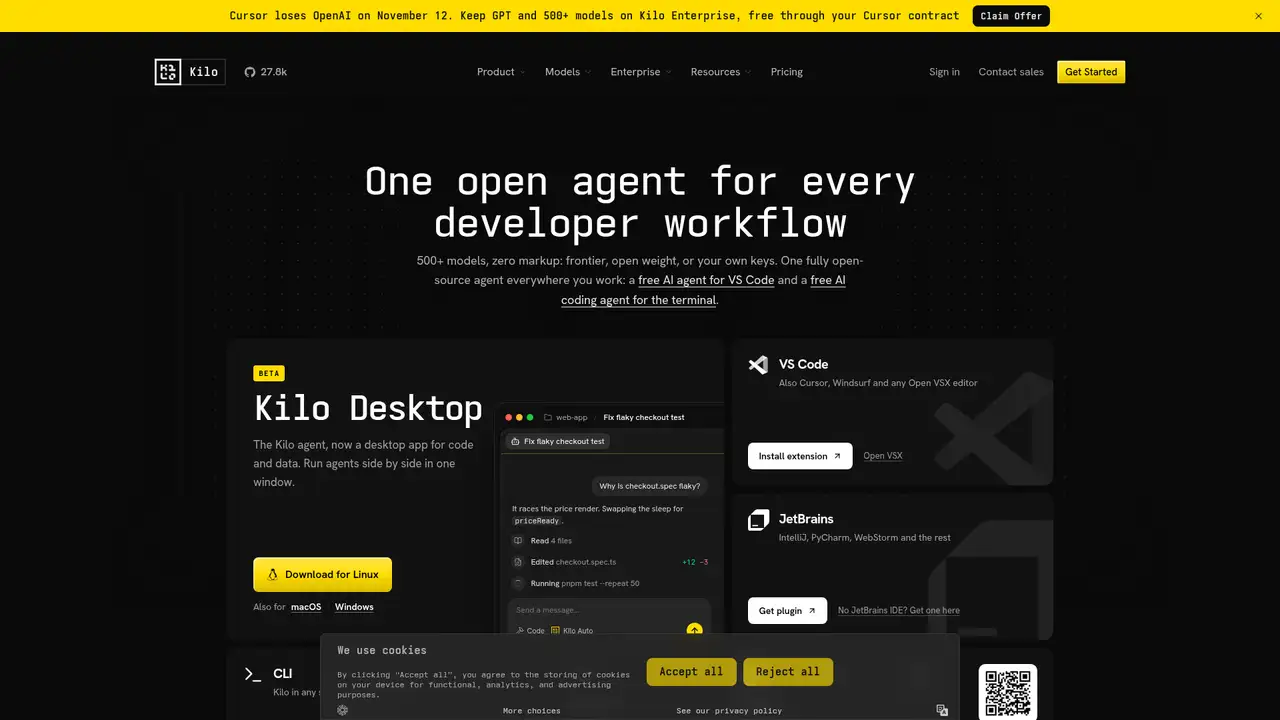
Kilo embeds an agent in VS Code-based IDEs, JetBrains products, the web and command-line workflows, combining local development with cloud agents, app building and code review. Developers can define custom modes, have agents inspect or modify repositories, run agents in parallel, use managed indexing and synchronize sessions and context across interfaces. Additional features include autocomplete, one-click deployment, voice prompting, memory, GitHub Actions automation and Slack access. Teams receive centralized billing, shared custom agent modes, usage analytics and reporting, while Enterprise capabilities include provider restrictions, audit logs, SSO, OIDC, SCIM, service commitments and dedicated support. Cloud agents and code review incur separate compute usage. The open-source plugin supports BYOK and local inference through providers including Ollama and LM Studio, while users can also use Kilo Gateway, OpenRouter, Vercel, Requesty, AWS Bedrock, Azure OpenAI or Google AI Studio.
Kilo’s complete plugin is licensed under Apache-2.0 and exposes model, context, and prompt details, supporting inspection and control rather than automatic model selection. Through Kilo Gateway, the platform offers more than 500 models from more than 60 providers, with BYOK and local execution through Ollama or LM Studio. Named pathways include Anthropic, OpenAI, Google, AWS Bedrock, Azure OpenAI, Mistral, OpenRouter, Vercel, and Requesty. Pricing materials describe Auto Model routing among Frontier, Efficient, and Free choices, while the open-source documentation also supports manual model selection. Users can pay provider rates through Gateway, use credits, or connect their own keys and local runtimes. Official Ollama guidance recommends qwen3-coder:30b or devstral:24b, while noting that local results depend on hardware. The releases page records version 7.8.17 on October 23, 2026, and cloud capability remains separate from the open-source plugin.
The Individual plan costs $0 per month and includes Kilo’s VS Code and JetBrains extensions plus its CLI, while users pay separately for AI usage. It is open source, supports custom agent modes, provides community Discord support and has no vendor lock-in. Teams costs $15 per user monthly and adds centralized billing, team management, analytics and reporting, shared custom agent modes, priority support and no training on team data by default. Enterprise pricing is not publicly listed; stated capabilities include model and provider restrictions, audit logs, SSO, OIDC, SCIM, SLA commitments and dedicated support channels. Kilo Gateway charges exact provider list prices without commission, markup or hidden fees. Kilo Pass is optional and can provide bonus credits, with Starter listed at $19 monthly or $588 annually and Pro at $49 monthly. Cloud compute and model usage remain separate charges.
Kilo suits developers who want an open-source, model-agnostic agent platform with provider choice, local execution and workflows spanning VS Code-based IDEs, JetBrains, web and CLI environments. It supports BYOK, Ollama, LM Studio, Kilo Gateway and other provider pathways, while parallel agents, code review, autocomplete, custom modes, managed indexing, shared team modes and cross-interface session synchronization broaden its scope. Individual access costs $0 monthly, with AI usage billed separately at provider cost; Teams costs $15 per user monthly and adds centralized administration, analytics and shared modes. Tradeoffs include variable provider bills, separate cloud compute charges, hardware requirements for local models and vendor privacy claims. Cursor offers a focused hosted editor, Cline a comparable open-source agent workflow and Claude Code Anthropic’s command-line experience. Choose Kilo for model flexibility, BYOK or local inference and team controls; choose another tool for a narrower workflow or single-provider experience.
Who is Kilo Code best for?
- Developers switching between many AI models
- Teams needing shared coding agents
- Local model and BYOK workflows
- CLI, IDE and cloud agent users
Kilo Code Pricing (2026)
Pricing model: Usage-based. All prices in USD.
| Plan | Price | What you get |
|---|---|---|
| Individual | $0/month | VS Code, JetBrains and CLI extensions; AI inference billed separately; community support; custom agent modes. |
| Teams | $15/user/month | Individual features plus centralized billing, team management, analytics, shared custom agents, privacy controls and priority support. |
| Enterprise | Custom | Teams features plus provider restrictions, shared private gateway BYOK, audit logs, SSO, OIDC, SCIM, SLA commitments and dedicated support. |
| Auto Free, BYOK or local | $0/month | Free models where available, provider keys or local Ollama and LM Studio execution. |
| Kilo Gateway | $0/month plus usage | Pay provider rates for more than 500 models across more than 60 providers; cloud compute is separate. |
| Kilo Pass Starter | $19/month | Monthly credits with up to 50 percent bonus credits; annual billing costs $588 and provides 50 percent bonus credits. |
| Kilo Pass Pro | $49/month | Monthly credits with up to 50 percent bonus credits; bonus credits expire at the monthly cycle end. |
| Kilo Pass | $199/month | Additional Kilo Pass tier listed without a published tier name; bonus credit terms follow the Kilo Pass offer. |
Pros and Cons
Pros
- Kilo supports many providers and local runtimes.
- The plugin is Apache 2.0 licensed.
- Teams includes shared billing and agents.
- Kilo works across IDE, CLI and cloud surfaces.
Cons
- Inference and cloud compute costs vary.
- Local models require suitable hardware.
- Privacy statements are vendor claims.
Who should look elsewhere?
- Users wanting one fixed monthly AI quota
- Teams requiring verified Kilo cloud self-hosting
- Developers avoiding variable usage charges
Technical Details
Frequently Asked Questions
How much does Kilo cost?
Kilo’s Individual platform plan is free, with AI inference billed separately. Teams costs $15 per user monthly, while Enterprise pricing is custom. Kilo Gateway uses provider rates, and Kilo Pass starts at $19 monthly, with a $49 Pro tier and an additional $199 tier. Cloud compute is separate and billed by usage.
Can I use Kilo for free?
Yes. The Individual plan costs $0 monthly and includes the open source VS Code, JetBrains and CLI extensions. You can use local models, provider keys or free Gateway models where available. Hosted inference, Kilo Pass credits and cloud compute can create separate charges.
What is Kilo’s closest competitor?
Cursor is a close commercial alternative because both support agentic coding workflows across repositories. Cline is closer in open source and provider flexibility, while Claude Code centers on Anthropic’s command line models. Kilo differs through its broad provider gateway, local model support and shared team controls.
Does Kilo train on my code?
Kilo’s Teams page says there is no training on team data by default and claims that code stays private. Those statements describe the vendor’s policy position. Data handling can also depend on the selected inference provider, BYOK configuration, local runtime or cloud feature.
Can I use Kilo commercially?
The plugin is licensed under Apache 2.0, and Kilo’s pricing page lists commercial use of more than 40,000 Anaconda Core packages. Commercial use of the software does not guarantee ownership of generated code, and model providers may impose separate terms. Review applicable provider and package licenses.
Best Kilo Code Alternatives in 2026
These tools do the same job as Kilo Code, with different pricing, limits and trade-offs.
AI coding workspace with repository context and software agents

Open coding agent for editors, terminals, desktops, and custom apps
An agentic coding assistant for terminal, IDE, desktop, and web
AI coding assistance across editors, terminals, and GitHub