
H2O.ai Review, Pricing & Alternatives (2026)
Open-source machine learning with enterprise deployment and governance options
Last updated: October 26, 2026
What is H2O.ai?
H2O.ai provides H2O-3, a free Apache 2.0 distributed machine learning platform, alongside the paid H2O AI Cloud enterprise suite. It suits data science teams that need Python, R, REST, Kubernetes, and deployment choices across managed, private, on-premises, or hybrid environments. H2O-3 starts at $0, while commercial products use written agreements rather than public list pricing.
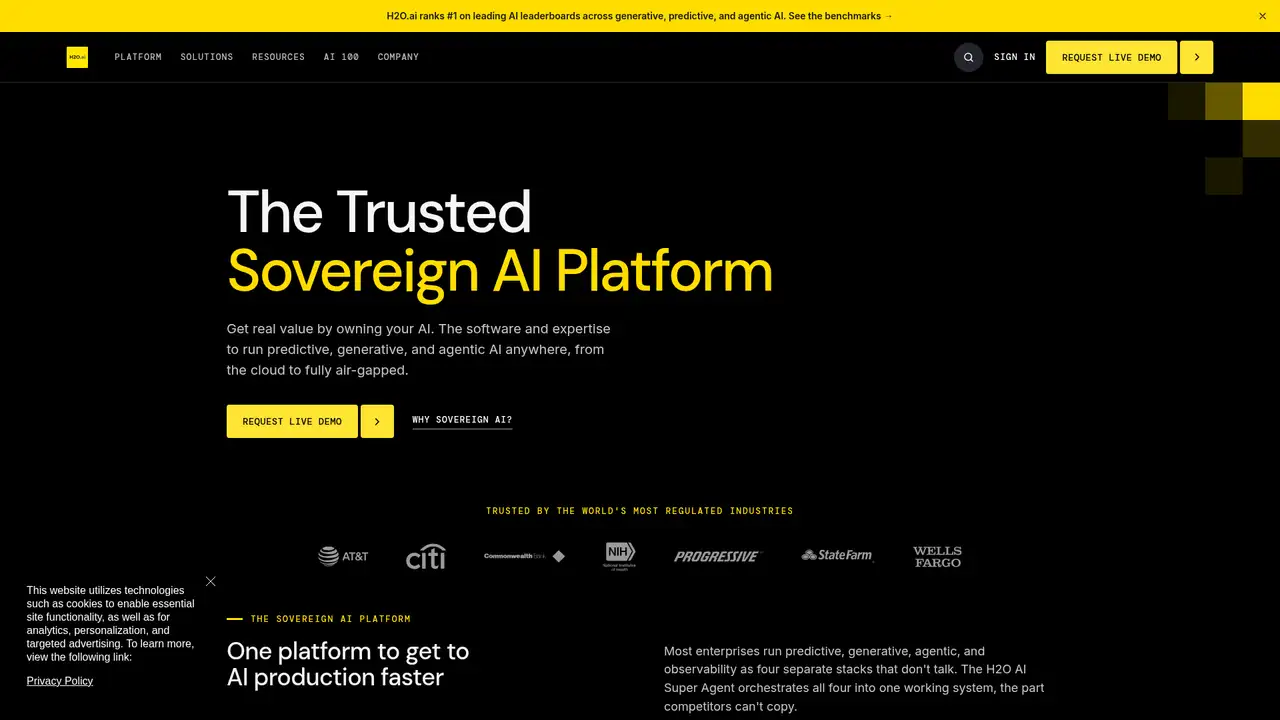
H2O.ai is a machine learning company founded in Mountain View in 2012 by Sri Ambati. Its products cover open-source distributed machine learning, automated model development, lifecycle management, and enterprise generative AI. Reuters reported that Goldman Sachs, Ping An, and other investors put in $72.5 million in 2019. In a March 2025 release, H2O.ai said it had raised $256 million, served more than 20,000 organizations, and supported a community of 2 million data scientists. Those scale figures are company claims. H2O-3 is the free Apache 2.0 core, while H2O AI Cloud is the paid enterprise platform. That split gives individual developers and infrastructure teams a lower-cost starting point, while larger organizations can buy managed operations, governance, support, and deployment choices.
H2O-3 runs distributed machine learning in memory and exposes the same platform through Flow, Python, R, and REST. A typical workflow imports data, prepares training inputs, fits models, evaluates results, and scores new records. Flow is a browser interface, while the REST API also controls Flow and supports automation from applications or scripts. H2O AI Cloud combines H2O-3 with Driverless AI, MLOps, AI App Store, H2O AI Engine Manager, Wave SDK, workflows, and platform services. Customers can deploy it in H2O-hosted managed cloud, private cloud, on premises, or hybrid infrastructure. Enterprise LLM Studio adds fine-tuning, evaluation, and deployment, while related paid components include Document AI, Feature Store, Hydrogen Torch, Label Genie, LLM Data Studio, and LLM Eval Studio.
H2O-3 is Apache 2.0 licensed, self-hostable, and designed around distributed machine learning rather than a closed hosted endpoint. H2O AI Hybrid Cloud release 26.04.0, dated April 23, 2026, added H2O Workflows as a YAML workflow engine replacing Orchestrator, plus Enterprise LLM Studio, Session Server, Sandbox API, and rebuilt scoring infrastructure. Enterprise LLM Studio supports fine-tuning, evaluation, and deployment for Llama, Qwen, Gemma, Mistral, DeepSeek, and H2O Danube. Its listed capabilities include LoRA, quantization, multimodal training, AutoML, role-based access control, APIs, an SDK, and Hugging Face integration. Enterprise h2oGPTe 1.6.x added agent tool use with code execution, custom GPTs, RBAC, OpenAPI REST bindings, and OpenAI-compatible APIs. H2O.ai described Enterprise LLM Studio in March 2025 as Fine-Tuning-as-a-Service on Dell infrastructure.
H2O-3 is free under the Apache 2.0 license, giving teams a self-hostable entry point without a published subscription charge. H2O.ai does not publish a universal public dollar price for H2O AI Cloud, Driverless AI, or Enterprise LLM Studio. The AI Cloud EULA says fees are agreed in writing, and evaluation terms normally run for 30 days. H2O.ai also does not publish a universal self-serve tier or standard usage quota for these paid products. Costs therefore depend on the selected components, deployment arrangement, infrastructure, support, and negotiated agreement. AI Cloud is the practical route for governance, managed deployment, and lifecycle operations. H2O-3’s REST control port is powerful, but production administrators must keep it private, authenticated, and protected with TLS. Buyers wanting predictable monthly checkout pricing will find the commercial process less transparent.
H2O-3’s main limitation is operational responsibility: customers must secure the control interface, manage infrastructure, and plan scaling. Driverless AI and H2O AI Cloud reduce that work, although custom enterprise pricing can slow purchasing. Compared with DataRobot, H2O.ai offers a clearer Apache-licensed core and more infrastructure choice, while DataRobot presents a more packaged commercial experience. Compared with Dataiku, H2O.ai is stronger for distributed model engineering and deployment infrastructure, while Dataiku is stronger for collaborative visual workflows, governance, and mixed analyst and data-scientist teams. Databricks Mosaic AI is another direct alternative for organizations centered on Databricks data and compute. H2O.ai suits teams that want an open machine learning core, self-hosting, broad deployment control, and enterprise options when those operational and purchasing tradeoffs fit.
Who is H2O.ai best for?
- Teams building distributed machine learning workflows with Python, R, REST, or Flow.
- Organizations requiring self-hosted, private-cloud, on-premises, or hybrid deployment options.
- Data science groups that want an Apache 2.0 machine learning core.
- Enterprises needing managed governance, deployment, and lifecycle operations.
H2O.ai Pricing (2026)
Pricing model: Paid. All prices in USD.
| Plan | Price | What you get |
|---|---|---|
| H2O-3 | $0 | Free under the Apache 2.0 license. Self-hosting, infrastructure, security, and scaling remain the customer's responsibility. |
| H2O AI Cloud | Custom | Fees are agreed in writing. Evaluation terms normally run 30 days; H2O.ai publishes no universal monthly, annual, or usage quota. |
| Driverless AI | Custom | H2O.ai does not publish a universal public dollar price or standard monthly and annual limits. |
| Enterprise LLM Studio | Custom | Available as a paid enterprise component or add-on; H2O.ai publishes no universal public dollar price or quota. |
Pros and Cons
Pros
- H2O-3 provides a free Apache 2.0 distributed machine learning platform.
- Python, R, REST, and Flow interfaces support several operating styles.
- H2O AI Cloud supports managed, private, on-premises, and hybrid infrastructure.
- Enterprise products add governance, deployment, fine-tuning, evaluation, and lifecycle capabilities.
Cons
- Commercial pricing is custom rather than publicly listed.
- Self-hosted H2O-3 requires customers to secure, operate, and scale the platform.
- The full commercial suite is not wholly open source.
Who should look elsewhere?
- Small teams seeking transparent commercial SaaS pricing and self-service quotas.
- Buyers unwilling to manage security and infrastructure around a self-hosted engine.
- Analyst teams prioritizing visual collaboration over model engineering and deployment.
Technical Details
Frequently Asked Questions
How much does H2O.ai cost?
H2O-3 is free under the Apache 2.0 license. H2O AI Cloud, Driverless AI, and Enterprise LLM Studio do not have universal public dollar prices. The H2O AI Cloud license says fees are agreed in writing, and evaluation terms normally run 30 days. Commercial cost depends on products, infrastructure, deployment, support, and the negotiated agreement.
Does H2O.ai have a free plan?
H2O-3 is the free option. It is an open-source, self-hostable, distributed machine learning platform licensed under Apache 2.0, with Flow, Python, R, and REST interfaces. H2O.ai does not publish a universal free quota for H2O AI Cloud or its commercial components. Running H2O-3 still leaves infrastructure, security, and scaling responsibilities with the customer.
What is the closest alternative to H2O.ai?
DataRobot is a close commercial alternative because both products support enterprise machine learning workflows and deployment. H2O.ai differentiates itself with the Apache-licensed H2O-3 core and infrastructure choices including self-hosted and hybrid arrangements. DataRobot generally presents a more packaged commercial experience. Dataiku, Databricks Mosaic AI, SageMaker, and Vertex AI are also direct alternatives.
Does H2O.ai train on customer data or protect private data?
H2O.ai publishes deployment options including private cloud, on-premises, and hybrid infrastructure for H2O AI Cloud. H2O-3 can be self-hosted, and its REST control port should be private, authenticated, and TLS-protected in production. The cited product and license pages do not state a universal policy that customer data is used to train H2O.ai models.
Can businesses use H2O.ai commercially?
Businesses can use H2O-3 under its Apache 2.0 license, while H2O AI Cloud and enterprise components are paid products governed by written commercial agreements. The commercial suite is not wholly open source. Enterprise LLM Studio, Enterprise h2oGPTe, Document AI, Feature Store, and related components may be paid or add-on products, so commercial users should review the applicable agreement.
Best H2O.ai Alternatives in 2026
These tools do the same job as H2O.ai, with different pricing, limits and trade-offs.