
Guru Review, Pricing & Alternatives (2026)
Verified company knowledge with AI search and governed answers
Last updated: October 26, 2026
What is Guru?
Guru combines maintained company knowledge, enterprise search, and AI answers for teams that need information employees can trust and reuse. It adds verification and ownership to the retrieval workflow rather than relying only on generated responses. Guru's current US pricing is custom, so organizations need a scoped quote instead of a public dollar entry price.
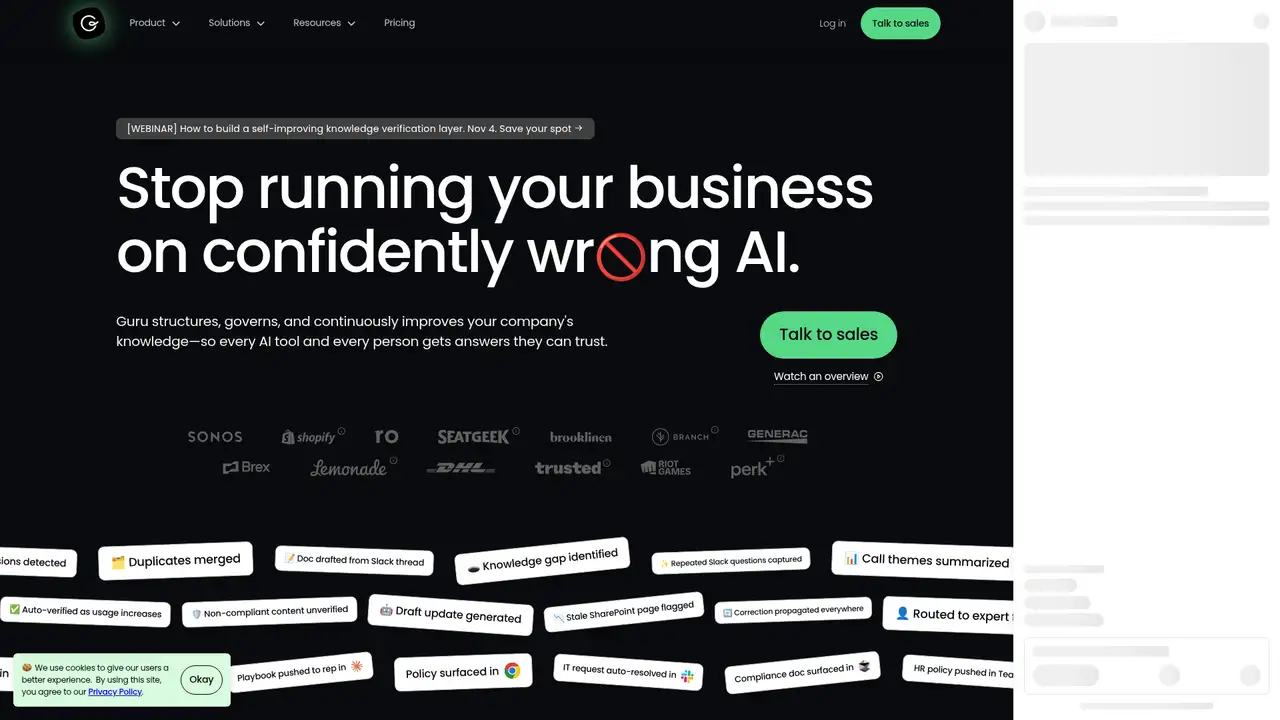
Guru is a Philadelphia enterprise knowledge company founded in 2013 by Rick Nucci and Mitchell Stewart. The company announced a $30 million Series C in 2020. Its product combines knowledge management with search and AI access rather than serving as a general public chatbot.
Teams connect workplace information and maintain knowledge with ownership and verification. Employees can then retrieve information through search or ask AI questions. This creates an ongoing operational requirement: someone must own the quality and review of the underlying knowledge, not merely connect documents once.
Guru introduced Knowledge Agents, Research Mode, and MCP interoperability in September 2025. Its 2026 updates include Microsoft Work IQ connections and shared versus personal MCP connections. The developer surface includes REST APIs, webhooks, an SDK, and integration tools.
The current US pricing page uses custom packaging rather than a public dollar entry price. Older plan names and localized starting offers should not be treated as a complete current US price sheet. Buyers need to scope the platform, organization size, integrations, and rollout requirements with sales.
Guru competes with Glean for enterprise knowledge access, Microsoft 365 Copilot for suite-centered workflows, and Atlassian Rovo for connected workplace assistance. Its distinction is the combination of verification, knowledge ownership, and AI retrieval. Pick Guru when maintaining trusted internal knowledge is as important as finding it.
Who is Guru best for?
- Knowledge owners can maintain verified internal content.
- Support teams can search organizational information.
- Administrators can apply inherited permissions to answers.
- Developers can connect workflows through APIs and MCP.
Guru Pricing (2026)
Pricing model: Paid. All prices in USD.
| Plan | Price | What you get |
|---|---|---|
| Platform package | Custom | Organization-specific pricing and rollout scope. |
| Enterprise | Custom | Contact sales for enterprise requirements and commercial terms. |
Pros and Cons
Pros
- Verification is part of the knowledge workflow.
- Answers can cite connected organizational content.
- MCP connects knowledge to other assistants.
- The developer surface includes APIs and webhooks.
Cons
- Current US prices require a sales conversation.
- Knowledge verification creates ongoing maintenance work.
- Integration quality affects answer coverage.
Who should look elsewhere?
- Individuals cannot choose a published dollar entry plan.
- Unmaintained knowledge still needs human ownership.
- Self-hosted search buyers need a different product.
Technical Details
Frequently Asked Questions
How much does Guru cost?
Guru's current US pricing page uses custom packaging rather than a public dollar entry price. Organizations need a scoped quote. Older Builder or Expert prices and localized starting offers should not be treated as the current US price sheet. Include deployment, integrations, users, and enterprise requirements when requesting an offer.
Does Guru have a free plan?
The current US pricing page does not present a generally available free subscription as the main commercial offer. It directs organizations toward a scoped platform discussion. Buyers should distinguish a sales evaluation from a permanent free plan and avoid relying on historical pricing pages when budgeting a new deployment.
How does Guru compare with Glean?
Both offer enterprise search and AI access to organizational information. Guru's proposition includes verified knowledge, content ownership, and maintained internal information. Glean emphasizes cross-application search and agent workflows. Compare how each handles your connectors, permissions, answer citations, content maintenance, and commercial scope rather than selecting solely on chatbot behavior.
Does Guru train public AI models on company data?
Guru says customer data is not used to train public language models. Its security documentation also describes retention protections for model processing, including zero-day retention for relevant GPT API use. Organizations should review those protections alongside connector permissions, access controls, and their own contractual requirements for confidential information.
Can Guru connect to other AI assistants?
Guru introduced MCP interoperability alongside Knowledge Agents and Research Mode in September 2025. Its developer surface also includes REST APIs, webhooks, and an SDK. These features support using organizational knowledge across tools, but they do not remove the need to configure permissions or maintain the underlying information.
Best Guru Alternatives in 2026
These tools do the same job as Guru, with different pricing, limits and trade-offs.

Permission-aware enterprise search, answers, and agents

AI assistance built into Microsoft apps, work data, and everyday tasks.
AI search, chat and agents across Jira, Confluence and connected work apps
Enterprise AI search, generative answers and recommendations for commerce and service
Search and vector database company behind Elasticsearch, with Agent Builder for AI agents