
Gumloop Review, Pricing & Alternatives (2026)
No-code agents for connected business workflows
Last updated: October 22, 2026
What is Gumloop?
Gumloop is a hosted, model-agnostic agent and workflow builder for teams automating work across business applications. It targets nontechnical builders and IT-controlled organizations, with REST and MCP interfaces, a 14-day Pro trial, a Free plan with 5,000 monthly credits, Pro at $37/month, and custom Enterprise deployment with VPC options.
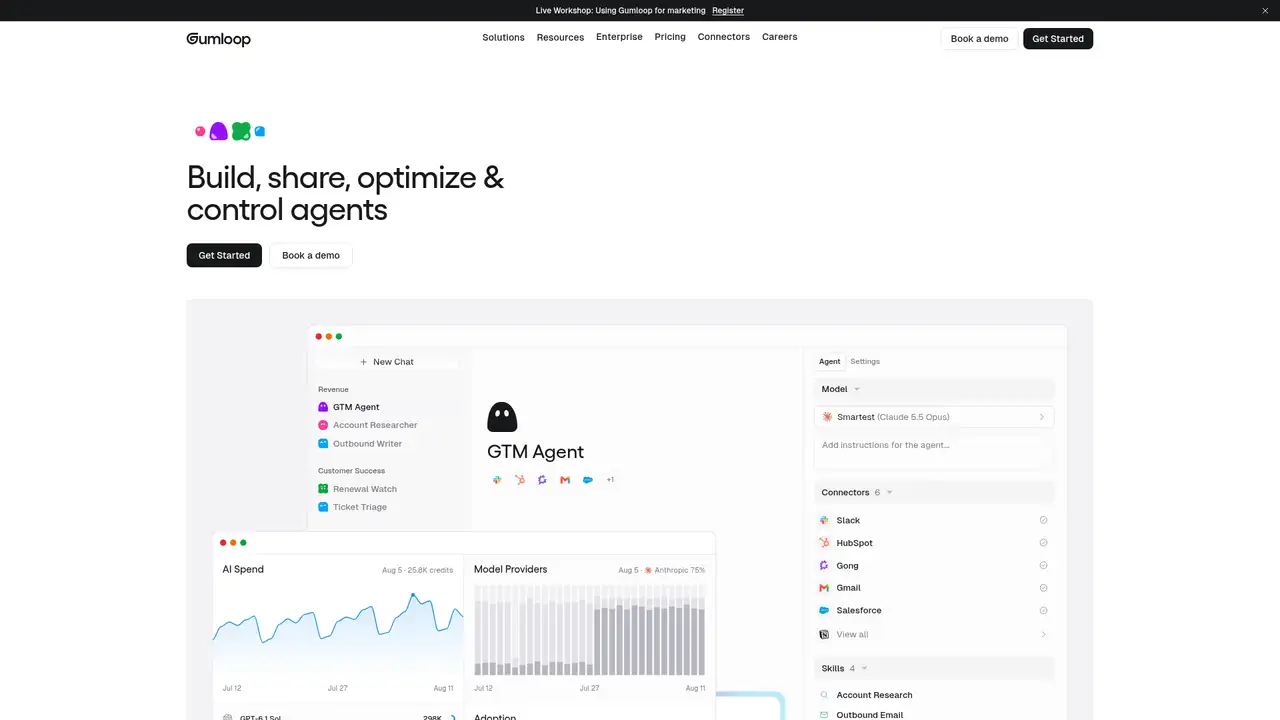
Gumloop is a hosted agent and workflow builder made by AgentHub Inc., founded in April 2023 by McGill classmates Max Brodeur-Urbas and Rahul Behal under the name AgentHub. The company changed its name to Gumloop in 2024. BetaKit reported a $3.1 million seed round in July 2024, while TechCrunch and BetaKit reported a $17 million Series A in January 2025. The reported funding total reached about $20 million. Gumloop presents its product as a multiplayer AI agent builder for company operations. People create agents that connect to business applications, run from schedules or triggers, and produce reports, documents, dashboards, or web apps. The product is a commercial SaaS service rather than an open-source platform.
A typical Gumloop workflow starts on a visual canvas, where a user combines instructions, connectors, and reusable skills. Agents can read or write in Slack, Gmail, Salesforce, HubSpot, Notion, Linear, GitHub, and Google Sheets, with additional tools available through MCP. Users can run agents interactively, schedule them, call them with a webhook, or invoke them through the REST API. Gumloop also provides an MCP server for compatible clients. Documented use cases include lead enrichment, CRM updates, meeting briefs, support triage, monitoring, data analysis, research, and scheduled reports. Teams share usage through an organization credit pool. Developers can add logic through Python or JavaScript alongside visual workflow steps, while business users can build and revise agents without maintaining a separate orchestration service.
Gumloop supports Auto, Balanced, Smartest, and specific model selection. Auto routes requests according to task difficulty, while Balanced and Smartest are maintained presets whose underlying models can change. The October 2026 model catalog lists providers including Anthropic, OpenAI, Google, DeepSeek, MiniMax, Z.ai, and xAI. Listed models include Claude 5.5 Opus, GPT-6 variants, Gemini 3.1 Pro, Grok 4.7, DeepSeek V4 Pro, MiniMax M3, and GLM-5.3. Gumloop describes this catalog as dynamic, so model names and mappings can change. BYOK is available for eligible Pro and Enterprise model calls and can remove model-credit charges, although orchestration fees can remain. The product documentation and changelog describe continuing changes to providers, models, connectors, and workflow behavior during 2025 and 2026.
Gumloop's Free plan costs $0/month and includes 5,000 credits monthly, with up to two concurrent runs. New accounts receive a one-time, card-required 14-day Pro trial that converts unless canceled. Pro costs $37/month and includes 20,000 credits monthly. The current credit documentation lists $0.005 per credit, with charges based on model calls, connector calls, compute time, and an orchestration fee. A successful connector call costs one credit plus any third-party charge, compute costs five credits per session-minute, and orchestration adds 8% of the other listed charges. Pro overage costs $0.005 per credit, with a default ceiling of 1,000,000 overage credits per billing period. Enterprise pricing and allocations are custom, and unused credits roll over there.
Gumloop fits business teams that want agents to act across existing SaaS tools without running orchestration infrastructure. Its usage pricing requires closer monitoring than fixed per-task plans, especially when agents use expensive models, many connectors, or long compute sessions. Compared with Zapier, Gumloop offers deeper agent behavior and MCP access. Compared with n8n, Gumloop is more managed and business-user oriented, while n8n offers greater deployment control. Compared with Dify, Gumloop focuses more on connected operational work than on building self-hosted RAG applications. Gumloop is less suitable for teams seeking broad self-hosting or predictable task pricing. Choose it for collaborative SaaS automation, API access, and enterprise governance, especially when the intended user is a business or IT team.
Who is Gumloop best for?
- Operations teams automating work across CRM, email, chat, and productivity tools.
- Nontechnical builders creating agents with triggers, skills, and reusable workflows.
- IT teams requiring SSO, audit logging, monitoring, and enterprise controls.
- Developers needing REST, Python, JavaScript, or MCP access to agents.
Gumloop Pricing (2026)
Pricing model: Usage-based. All prices in USD.
| Plan | Price | What you get |
|---|---|---|
| Free | $0/month | 5,000 credits/month and up to 2 concurrent runs. Usage varies by model, tools, compute, and orchestration. |
| Pro | $37/month | 20,000 credits/month. Overage costs $0.005/credit and has a default 1,000,000-credit billing-period ceiling. |
| Enterprise | Custom | Custom credits, rollover, governance, support, and VPC deployment. Compute can run on customer infrastructure. |
Pros and Cons
Pros
- Agents can read and write across business applications and MCP tools.
- REST, SDKs, webhooks, triggers, and MCP support enable programmatic operation.
- BYOK can remove eligible model-credit charges on Pro and Enterprise plans.
- Enterprise supports governance features and customer VPC deployment.
Cons
- Variable credits make heavy agent runs harder to budget than fixed task pricing.
- The product is hosted, with self-hosting limited to Enterprise VPC arrangements.
- Model names and preset mappings change as the catalog is updated.
Who should look elsewhere?
- Teams needing an open-source platform they can modify and self-host.
- Workloads requiring fixed per-task costs despite variable usage.
- One-off text generation without tools, integrations, or automation.
Technical Details
Frequently Asked Questions
How much does Gumloop cost?
Gumloop has a Free plan priced at $0/month with 5,000 monthly credits. Pro costs $37/month with 20,000 monthly credits. Enterprise is custom. Additional credits cost $0.005 each, while total run costs vary with model calls, connector calls, compute time, and the 8% orchestration fee applied to those charges.
Does Gumloop have a free plan?
Yes. The Free plan costs $0/month, includes 5,000 credits per month, and permits up to two concurrent runs. New accounts receive a one-time 14-day Pro trial that requires a card and converts to paid Pro unless canceled. Credits do not roll over monthly on Free or Pro plans.
Gumloop or n8n: which is better?
Gumloop is a hosted agent builder for collaborative business automation, with model routing, SaaS connectors, and MCP. n8n provides a broader automation canvas and more deployment choice, including self-hosting. Choose Gumloop for managed agents across business applications. Choose n8n when infrastructure control, custom nodes, and explicit workflow logic matter more.
Does Gumloop train on user data?
Gumloop documents model-serving and retention policies, including provider hosting labels and a 30-day retention exception for Claude Fable models. Provider behavior can differ by model, and BYOK changes which provider receives a request. Organizations should review Gumloop's current privacy terms, model retention labels, and Enterprise agreement before sending confidential information.
Can Gumloop be self-hosted or used commercially?
Gumloop is a commercial hosted service, not an open-source package for general self-hosting. Enterprise customers can deploy Gumloop in their own VPC, where compute runs on customer infrastructure. Commercial use is supported through paid plans. Enterprise adds governance, support, custom credit allocations, and deployment options for larger organizations.
Best Gumloop Alternatives in 2026
These tools do the same job as Gumloop, with different pricing, limits and trade-offs.