
Google Imagen Review, Pricing & Alternatives (2026)
Managed image generation with 2K output and SynthID watermarking
Last updated: October 26, 2026
What is Google Imagen?
Google Imagen is a proprietary image-generation family from Google DeepMind for developers, cloud teams and organizations using hosted generation, editing and governance. It is available through Gemini, AI Studio and Vertex AI rather than as a standalone app. Imagen 4 costs $0.04 per output image, while Google Cloud lists Imagen 4 Fast at $0.02 per image.
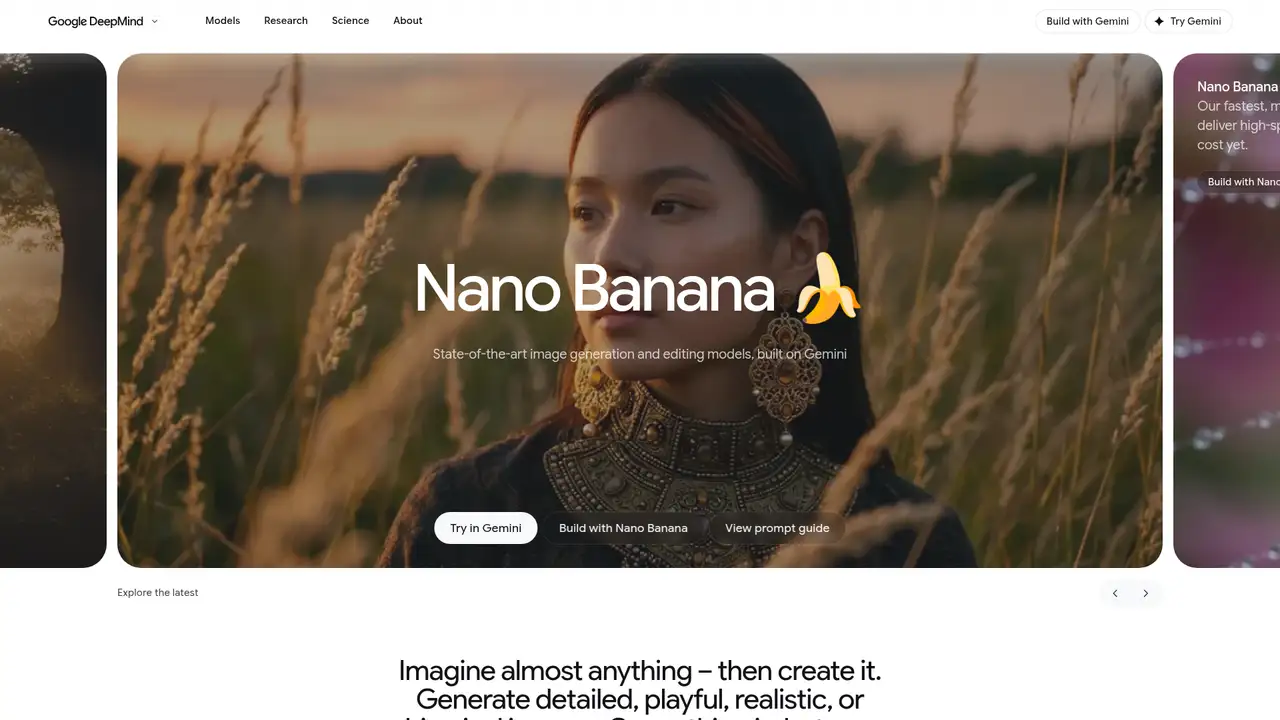
Google Imagen is a proprietary image-generation family from Google DeepMind, with Imagen 4 as its latest documented iteration. Google announced Imagen 4 on May 20, 2025, and exposes it through Gemini, AI Studio, Whisk, Workspace and Google Cloud Vertex AI rather than a standalone Imagen subscription. The company describes output up to 2K resolution, improved typography, stronger detail and a fast mode that can render up to 10 times faster than the prior model. Google does not publish a separate Imagen company, funding round or standalone founding year. Its positioning is clearest for developers, cloud teams and organizations already using Google services. Creators can access some capabilities through Google products, but Imagen is primarily a managed model family rather than a dedicated creative workspace.
A typical Imagen workflow starts with a text prompt in Gemini, AI Studio, an API request or Vertex AI. Imagen 4 supports multiple aspect ratios and targets photorealistic and abstract images, with Google highlighting better typography than earlier releases. Vertex AI adds hosted tools for editing, masking, upscaling, subject fine-tuning and watermark verification. Available controls vary by product and endpoint, so an AI Studio user does not receive the same operational surface as a Vertex AI developer. Google describes filtering, dataset labeling, red teaming and safety evaluations as part of its process. The company also lists weaknesses, including complicated compositions, small faces, small text, thin structures, centered-image requests and nonsensical prompts.
Imagen 4 is the principal recent release, announced in May 2025, with Imagen 4 Ultra and Gemini API availability following in June 2025. Google says the model improves fine detail, typography, colors and styles, while the Fast variant prioritizes rendering speed. Imagen remains hosted rather than downloadable. Google does not publish official open weights or a self-hosting route, and Vertex AI provides managed cloud access instead of local model files. A Google Cloud notice says some Imagen 4 endpoints are deprecated and recommends migration before June 30, 2026. The family continues in successor Google Cloud documentation, but endpoint names and availability depend on the deployment path. Google has not announced a separate 2026 Imagen successor in its current model documentation.
Imagen uses pay-as-you-go pricing instead of a monthly Imagen subscription. The Gemini API announcement lists Imagen 4 at $0.04 per output image and Imagen 4 Ultra at $0.06 per image. Google Cloud lists Imagen 4 Fast at $0.02 per image, alongside rates for earlier models and related operations. These figures can depend on model, endpoint, region and product. Gemini API access has Free, Paid and Enterprise tiers, but Google does not publish a fixed monthly Imagen credit allowance. Free access has limited model availability, and Google says free-tier content may be used to improve products. Paid access offers higher rate limits and says content is not used to improve products. Enterprise adds support, security and compliance features, provisioned throughput and volume discounts.
Imagen’s main limitation is its dependence on Google-hosted products, with endpoint migration and account-specific limits adding operational work. Reve is more creator-focused, combining generation with natural-language editing, compositing and collaboration features, although its API was sunset in August 2026. Midjourney is a dedicated consumer creative service, while FLUX offers model options suited to varied deployment arrangements. Imagen instead combines Vertex AI integration, multilingual prompting, managed safety controls and SynthID watermarking. Google’s quality and speed statements are dated product claims, not permanent guarantees. Developers needing Google Cloud controls should pick Imagen; users wanting a creator-first workspace or broader deployment flexibility should pick Midjourney or FLUX.
Who is Google Imagen best for?
- Google Cloud teams building managed image generation into applications.
- Developers who need per-image API billing instead of a consumer subscription.
- Organizations requiring hosted safety controls and SynthID watermarking.
- Creators already working inside Gemini, AI Studio or Workspace.
Google Imagen Pricing (2026)
Pricing model: Usage-based. All prices in USD.
| Plan | Price | What you get |
|---|---|---|
| Imagen 4 Fast | $0.02/image | Vertex AI image-generation price. Usage-based billing; no fixed monthly image allowance. |
| Imagen 4 | $0.04/image | Vertex AI image-generation price. Upscaling is separately listed at $0.06 per image. |
| Imagen 4 Ultra | $0.06/image | Vertex AI image-generation price. Billing depends on generated output, not a monthly consumer subscription. |
Pros and Cons
Pros
- Imagen 4 supports output up to 2K resolution.
- Google Cloud lists Imagen 4 Fast at $0.02 per image.
- SynthID adds invisible watermarking to generated images.
- Vertex AI provides managed editing, masking and upscaling tools.
Cons
- Google does not offer official open weights or self-hosting.
- Free Gemini API content may be used to improve products.
- Some Imagen 4 endpoints require migration before June 30, 2026.
Who should look elsewhere?
- Users seeking downloadable weights or self-hosted image generation.
- Artists wanting a dedicated consumer workspace with extensive collaboration tools.
- Teams requiring a fixed monthly Imagen credit allowance.
Technical Details
Frequently Asked Questions
How much does Google Imagen cost?
Imagen uses usage-based pricing. Google lists Imagen 4 at $0.04 per output image, Imagen 4 Ultra at $0.06 per image and Imagen 4 Fast at $0.02 per image through Google Cloud. Charges can vary by model, endpoint, region and product. Imagen has no separate monthly subscription or published monthly image allowance.
Does Google Imagen have a free plan?
Limited free Imagen access is available through Gemini API or AI Studio, but Google does not publish a fixed monthly Imagen credit allowance. Free access has model and rate limits, and Google says free-tier content may be used to improve products. Availability depends on the account, model, product and region.
How does Google Imagen compare with Midjourney?
Imagen is a Google-hosted model family available through Gemini, AI Studio and Vertex AI, with API billing, cloud controls and SynthID watermarking. Midjourney is a dedicated consumer creative service. Imagen fits developers and cloud teams needing managed integration, while Midjourney suits users creating images inside a focused creative product.
Does Google train on Imagen or Gemini API data?
Google distinguishes between access tiers. Gemini API pricing says free-tier content may be used to improve products, while paid-tier content is not used for that purpose. Paid-service terms still allow limited logging for abuse prevention and legal or security reasons. Vertex AI has separate data-governance commitments and deployment-specific retention controls.
Can I use Imagen images commercially?
Commercial use is governed by the applicable Google API, Cloud and product terms rather than an open-source license. Google’s terms address customer rights and service use, while copyright and permissions remain relevant to outputs and inputs. SynthID helps detect provenance, but it does not grant copyright ownership or legal clearance.
Sources
- Google DeepMind Imagen model page
- Google announcement for Imagen 4
- Google Cloud Imagen 4 announcement
- Imagen 4 Gemini API and AI Studio availability
- Google Cloud generative AI pricing
- Gemini API pricing and access tiers
- Gemini API terms
- Gemini API data retention guidance
- Imagen 4 endpoint documentation and migration notice
Best Google Imagen Alternatives in 2026
These tools do the same job as Google Imagen, with different pricing, limits and trade-offs.
High-control image generation for visual development and concept work
Text-accurate image generation for creators and design teams

Brand-aware raster and vector creation for professional design

A web workspace for generating, editing and arranging images
Open-weight image generation with strong prompt adherence