Foundry Local Review, Pricing & Alternatives (2026)
Microsoft's embedded runtime for offline AI on Windows, macOS, and Linux
Last updated: October 26, 2026
What is Foundry Local?
Foundry Local is Microsoft's on-device runtime and SDK for teams building offline chat, transcription, and tool-calling features into applications. It targets Windows, Apple Silicon macOS, and Linux, with SDKs for C#, JavaScript, Python, and Rust. Local execution costs $0, requires no Azure subscription, and leaves model licensing and device storage to the developer.
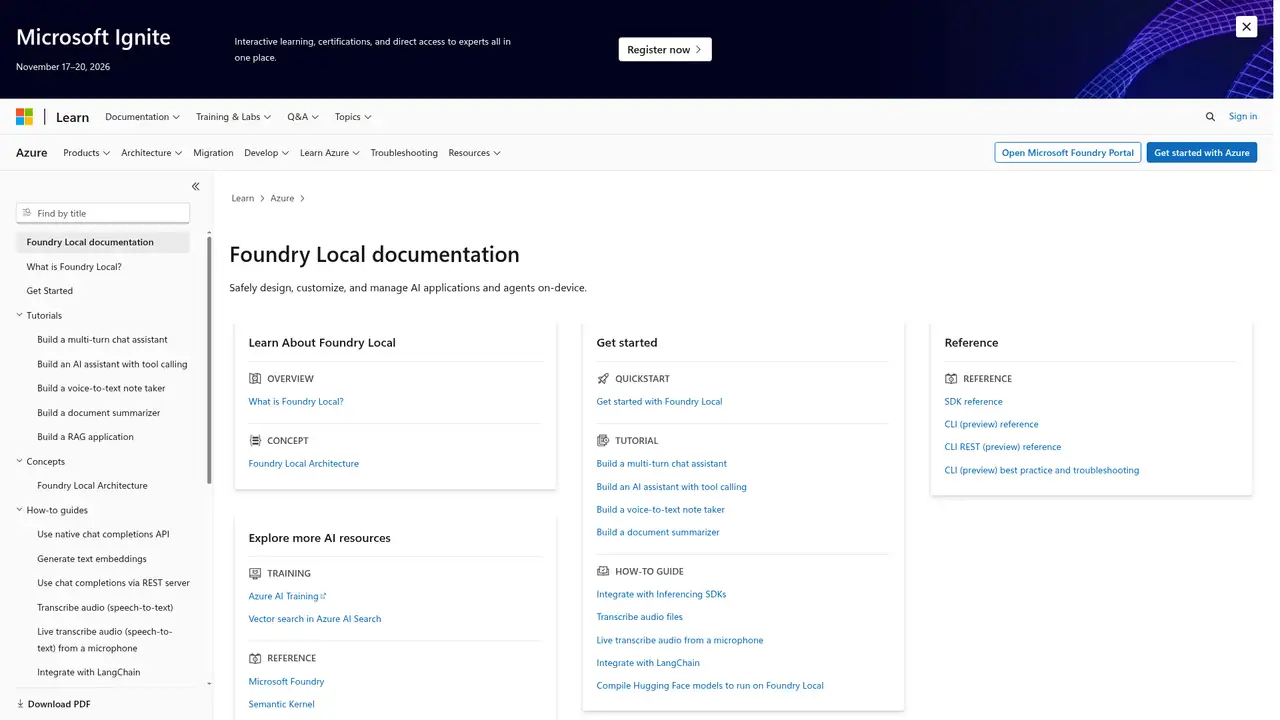
Foundry Local is Microsoft’s end-to-end solution for embedding local AI features in applications that run on a user’s device. Microsoft announced its general availability on April 9, 2026, making 2026 its documented launch year. The product combines a runtime, SDKs, a curated model catalog, and optional local service components, with support for Windows, Linux, macOS, and other device types described by Microsoft. Its SDK is available for C#, JavaScript, Python, and Rust, while the repository also documents C and C++ interfaces. Microsoft describes the runtime as approximately 20 MB, separate from downloaded model files. The public repository records 2,596 stars, 377 forks, and 128 open issues, and as a Microsoft product it has no separate funding or valuation.
A typical integration starts by initializing the SDK, inspecting the available execution providers and catalog entries, then requesting a model by identifier or alias. The runtime downloads the selected package, reports progress, loads it into device memory, and exposes chat or transcription calls. Chat responses can stream incrementally, while applications can combine speech to text, tool calls, and responses through the same SDK. When the application exits, it can unload the model; later launches reuse the local cache rather than repeating acquisition. The SDK runs in the application process, so end users do not need the CLI. For multi-process access or existing integrations, developers can instead configure the optional server and send OpenAI-format requests, including chat completions, audio transcriptions, streaming, and tool definitions.
Its underlying stack is a native Foundry Local Core implemented in C++, exposed through a stable C ABI and language bindings, with ONNX Runtime handling inference. The SDK can register execution providers such as CUDA, QNN, OpenVINO, TensorRT, and WebGPU, while Windows uses Windows ML and macOS uses Metal through WebGPU. The October 23, 2026 version 2.2.1 release updated ONNX Runtime to 1.31.0 and ONNX Runtime GenAI to 0.18.0, added catalog version 2, coding-model support, Linux ARM64 CUDA registration, stricter tool-call validation, and cleanup for damaged caches. CUDA and cuDNN must be installed separately. These choices make deployment dependent on provider libraries and platform configuration, while versioned catalog metadata helps match models to compatible runtime versions.
Foundry Local has no subscription, Azure requirement, per-token fee, or documented hosted usage tier for device execution. The free SDK is MIT licensed, but that does not grant equivalent rights to every catalog model. Model-specific licenses may govern redistribution, commercial use, attribution, or other obligations, so shipping a model requires reviewing its catalog metadata and license rather than treating the runtime license as sufficient. The roughly 20 MB runtime also understates distribution needs: models download separately, remain cached on the user’s storage, and may require additional provider components. Hardware is therefore an indirect cost. Microsoft does not publish a full list of supported GPUs, NPUs, or CPUs, and some CUDA deployments require separately installed CUDA and cuDNN runtimes. Teams should budget storage, bandwidth, device eligibility, licensing review, and packaging work instead of assuming software is the only expense.
Foundry Local’s curated catalog limits arbitrary checkpoint use, so teams needing broad model selection or frequent custom-model testing may prefer Ollama or Lemonade. Ollama provides a simpler local experimentation workflow, while Lemonade offers a community-oriented server and AMD-focused control. Windows ML is a lower-level alternative for Windows applications, giving developers more direct platform integration but requiring more responsibility for runtime details. Foundry Local’s SDK can avoid installing its CLI for end users, yet its optional CLI and REST interface remain preview components, with possible breaking changes. First-run model downloads, cache storage, hardware compatibility, and individual model licenses still need to be handled in deployment planning. Choose Foundry Local for supported-language applications that need embedded, offline inference across Windows, macOS, and Linux with managed model acquisition.
Who is Foundry Local best for?
- Teams embedding offline inference for end users.
- Developers using C#, JavaScript, Python, or Rust.
- Products needing automatic hardware selection and caching.
- Privacy-sensitive apps that cannot use cloud inference.
Foundry Local Pricing (2026)
Pricing model: Free. All prices in USD.
| Plan | Price | What you get |
|---|---|---|
| Foundry Local SDK | Free | No per-token charge or Azure subscription. Device capability, storage, catalog availability, and model licenses limit deployment. |
| Foundry Local CLI | Free | Publicly available, but Microsoft labels the CLI preview and warns APIs and behavior can change. |
Pros and Cons
Pros
- The SDK supports four mainstream languages.
- Inference works offline without Azure or token charges.
- Automatic hardware selection reduces device-specific code.
- The SDK and model lifecycle can be embedded.
Cons
- The catalog is narrower than general runtimes.
- The CLI remains preview with possible breaking changes.
- Model licenses and downloads complicate redistribution.
Who should look elsewhere?
- Researchers needing every Hugging Face checkpoint.
- Teams seeking hosted, centrally scaled inference.
- Products unable to review model licenses.
Technical Details
Frequently Asked Questions
How much does Foundry Local cost?
Foundry Local has a $0 software price for local inference, with no per-token charge and no Azure subscription requirement. You still provide storage and bandwidth for model downloads, and model licenses remain separate. Microsoft also says the repository may collect usage data, so operating cost and privacy review extend beyond the runtime's purchase price.
Does Foundry Local have a free plan?
Foundry Local is offered as free software rather than as a metered hosted plan. The SDK and local runtime run on the user's device, and Microsoft documents no usage tiers or per-token billing. The free price does not remove device requirements, model-download costs, model-license conditions, or the need to review telemetry.
How does Foundry Local compare with Ollama?
Foundry Local is aimed at embedding a self-contained runtime in applications, with native SDKs, automatic hardware selection, and a curated catalog. Ollama is commonly used as a local model server for interactive development and application integrations. Choose Foundry Local for shipped cross-platform client software, or Ollama when a straightforward local server workflow matters more.
Does Foundry Local train on user data?
Foundry Local performs inference on the device, and Microsoft says prompts and outputs do not leave the device during local inference. The repository says the product may collect usage data to improve Microsoft products. That statement concerns telemetry, not model training, so applications should review the privacy statement, telemetry configuration, and their own logs.
Can I use Foundry Local commercially?
Commercial use depends on the component. The SDK is MIT licensed, while the CLI uses Microsoft Software License Terms, and every catalog model has separate licensing terms. Products should identify which runtime components and model files they distribute, preserve required notices, and check restrictions before shipping or redistributing a model.
Best Foundry Local Alternatives in 2026
These tools do the same job as Foundry Local, with different pricing, limits and trade-offs.