
Fish Audio Review, Pricing & Alternatives (2026)
Expressive speech, voice cloning, and transcription through web tools, APIs, and open models.
Last updated: October 22, 2026
What is Fish Audio?
Fish Audio provides expressive text to speech, voice cloning, voice design, transcription, APIs, and open models. Web access starts at $0, while hosted TTS API usage starts at $15 per million UTF-8 bytes. It also offers pay-as-you-go ASR, streaming, SDKs, and self-hosting with commercial licensing.
Fish Audio began as Fish Speech, a project by former Nvidia researcher Shijia Liao, who trained a voice-generation model on one GPU and open-sourced it. The company later rebranded as Fish Audio, with Rissa Cao serving as CEO and co-founder. Its public history records the first Fish Speech release in December 2023. The company launched five models in the year before July 2026, including four speech-generation systems and one speech-to-text model. TechCrunch reported that Fish Audio raised a $52 million seed round in July 2026, led by Coreline Ventures and Capital Today. The report also cited more than eight million users across hosted and open-source models, $21 million in annual recurring revenue, and a GitHub repository exceeding 31,000 stars.
A typical Fish Audio workflow begins by selecting a voice or creating one through cloning or Voice Design, then entering a script and adding bracketed directions such as [whisper] or [laugh]. Users generate audio, review it, and download or share the result. For production integrations, developers send text to the REST TTS endpoint or use WebSocket streaming through Python or TypeScript SDKs. S2.1-Pro supports multi-speaker dialogue and 83 languages; s2.1-pro-free suits development under fair-use limits. For transcription, teams upload a recording to /v1/asr and specify the transcribe-1-pro header to receive speaker markers, turns, timestamps, and vocal-event cues. Live applications instead keep a realtime WebSocket open with transcribe-stream-1, billed by session duration.
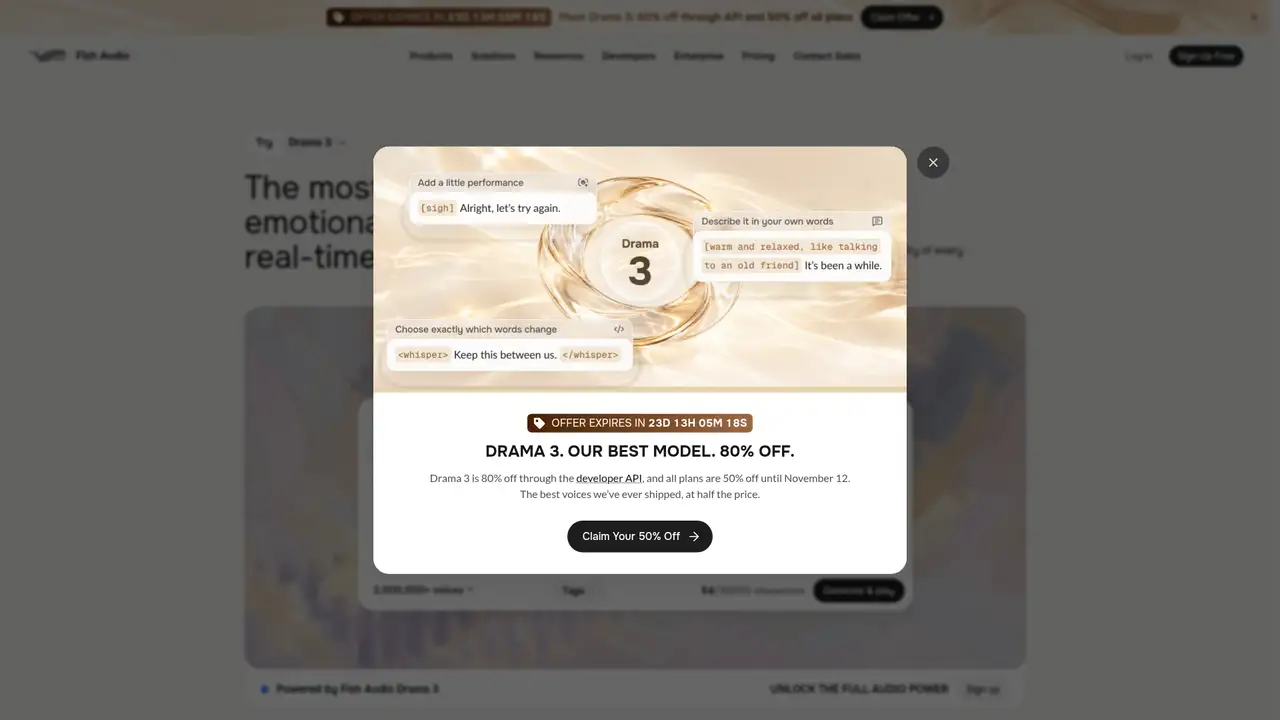
Fish Audio’s 2025-2026 releases center on increasingly steerable speech models. S1, introduced in June 2025 as a 4-billion-parameter model with 64-plus emotional expressions, is now deprecated and scheduled for retirement on December 31, 2026. The March 2026 S2 release added multi-speaker dialogue, 80-plus languages, and bracket-based cues such as [whisper] and [laugh], using a Qwen3-4B backbone. S2.1 Pro, released in June 2026, improves quality, latency, and throughput, supports 83 languages, and is the recommended production TTS model. Its free counterpart offers the same model for development through November 30, 2026, without TTFA or DPA guarantees. Transcribe-1 Pro, released in September, adds long-recording and multi-speaker transcription, while Drama 3 arrived in October for plain-language direction.
Fish Audio separates consumer subscriptions from API billing, so practical costs depend on workflow. The Free web plan costs $0 and includes 8,000 credits monthly, up to seven minutes of generation, 500 characters per request, and three public voice slots. Plus costs $15 monthly, or $11 annually, for 250,000 credits and up to 200 minutes; Pro costs $100 monthly, or $75 annually, for 2 million credits and up to 1,620 minutes. Max costs $999 monthly, or $749 annually, for 25 million credits and up to 6,250 minutes. Credits reset each billing cycle and do not roll over. API TTS costs $15 per million UTF-8 bytes, ASR $0.36 per audio hour, and concurrency begins at five requests.
Fish Audio differs from ElevenLabs, Cartesia, and PlayHT in its combination of expressive controls, open models, and deployment options. S2.1 Pro offers 83 languages, multi-speaker dialogue, and free development access, while bracket-based direction and open-weight models provide control over delivery and deployment. The $15-per-million-UTF-8-byte API price differs from credit-based web plans, complicating budgeting across products. Starter API accounts allow five concurrent requests, and long recordings can occupy a slot for minutes. Its terms permit use of Usage Data and Content to develop or enhance models, while voice submissions and public content carry licensing and consent responsibilities. Fish Audio suits creators and engineering teams prioritizing expressive control, multilingual output, and self-hosting.
Who is Fish Audio best for?
- Creators producing expressive narration, dubbing, podcasts, stories, or game dialogue.
- Developers needing TTS, ASR, streaming, SDKs, cloning, or voice design.
- Teams evaluating open models, self-hosting, private infrastructure, or multilingual delivery.
- Businesses comparing web subscriptions with byte-based API billing.
Fish Audio Pricing (2026)
Pricing model: Usage-based. All prices in USD.
| Plan | Price | What you get |
|---|---|---|
| Free | $0/month | 8,000 credits monthly, up to 7 minutes, 500 characters per generation, 3 public voice slots. |
| Plus | $15/month or $11/month annually | 250,000 credits monthly, up to 200 minutes, 15,000 characters per generation, 10 private voice slots. |
| Pro | $100/month or $75/month annually | 2,000,000 credits monthly, up to 1,620 minutes, 30,000 characters per generation, 3 team seats. |
| Max | $999/month or $749/month annually | 25,000,000 credits monthly, up to 6,250 minutes, 10 team seats, 15 professional voice slots. |
| Enterprise | Custom annual pricing | Organization controls, zero data retention, on-premise deployment, SOC 2 compliance, and custom terms. |
| API TTS | $15 per million UTF-8 bytes | s2.1-pro and s2-pro; s2.1-pro-free is $0 under fair-use limits. |
| API ASR | $0.36 per audio hour | File transcription uses transcribe-1-pro or transcribe-1; realtime ASR is $0.36 per session hour. |
| API Voice Design | $0.01 per successful request | One successful voice-design-1 request is charged once, including when it returns multiple candidates. |
Pros and Cons
Pros
- Fish Audio offers web plans, APIs, SDKs, WebSocket streaming, open models, and self-hosting.
- S2.1 Pro supports 83 languages and natural-language control of emotion, pacing, and delivery.
- The API publishes usage prices without subscription fees or monthly minimums.
- Web tiers publish commercial-use, credit, voice, generation, and team-seat limits.
Cons
- Web credits, API bytes, model access, and fair-use rules create separate billing systems.
- Voice rights, model licenses, and community permissions require careful review.
- Capabilities and guarantees vary by model, tier, release stage, and enterprise agreement.
Who should look elsewhere?
- Buyers needing one permanent billing basis across web and API use.
- Teams unable to verify consent and rights for cloned or community voices.
- Organizations requiring fixed enterprise terms before completing procurement review.
Technical Details
Frequently Asked Questions
What does Fish Audio cost?
Web plans are Free at $0, Plus at $15 monthly, Pro at $100 monthly, and Max at $999 monthly. Annual equivalents are $11, $75, and $749 monthly. The API is separate: TTS costs $15 per million UTF-8 bytes for s2.1-pro, ASR costs $0.36 per audio hour, and Voice Design costs $0.01 per successful request.
Is Fish Audio free?
Yes. The web Free plan includes 8,000 credits monthly, up to seven minutes, 500 characters per generation, three public voice slots, and commercial use. The API lists s2.1-pro-free at $0 per million UTF-8 bytes under fair-use limits. That model has no TTFA or DPA guarantees, and its published free period ends November 30, 2026.
How does Fish Audio compare with ElevenLabs or Cartesia?
Fish Audio emphasizes natural-language direction, open models, multilingual speech, self-hosting, and published byte-based API pricing. ElevenLabs and Cartesia are direct alternatives with different model catalogs, controls, pricing, and latency characteristics. Buyers should compare voice quality, languages, consent requirements, licensing, throughput, guarantees, and deployment needs for the intended workload.
How does Fish Audio handle privacy?
Fish Audio’s privacy policy describes profile, content, payment, device, analytics, and other data categories, plus sharing, retention, and user rights. Its enterprise materials list zero-data-retention and on-premise options. The policy says content may be retained as needed for service operation. Buyers should confirm current retention and deployment terms contractually.
Can I use Fish Audio commercially?
Paid services are licensed for commercial uses under the service terms, and the listed web plans identify commercial use. Commercial use still requires rights for input text, reference recordings, cloned voices, and other submissions. Open-model and self-hosting rights depend on the applicable commercial license. Users also remain responsible for lawful content and disclosure obligations.
Best Fish Audio Alternatives in 2026
These tools do the same job as Fish Audio, with different pricing, limits and trade-offs.
Expressive speech, dubbing, music and realtime voice agents

Low-latency text-to-speech, transcription and voice agents on state space models
Text-to-speech with ultra-realistic voice cloning at scale
Former voice-cloning startup now selling deepfake detection, watermarking and voice ID