
DISCO Review, Pricing & Alternatives (2026)
Cloud eDiscovery, legal holds, depositions, timelines, and AI
Last updated: October 26, 2026
What is DISCO?
DISCO is a cloud eDiscovery and litigation platform from CS Disco, Inc. for law firms, corporate legal departments, governments, and litigation service providers. It combines collection, processing, review, legal holds, depositions, timelines, and Cecilia AI. The company does not publish a self-serve entry price. Platform pricing is based on processed data, while Auto Review is charged per document.
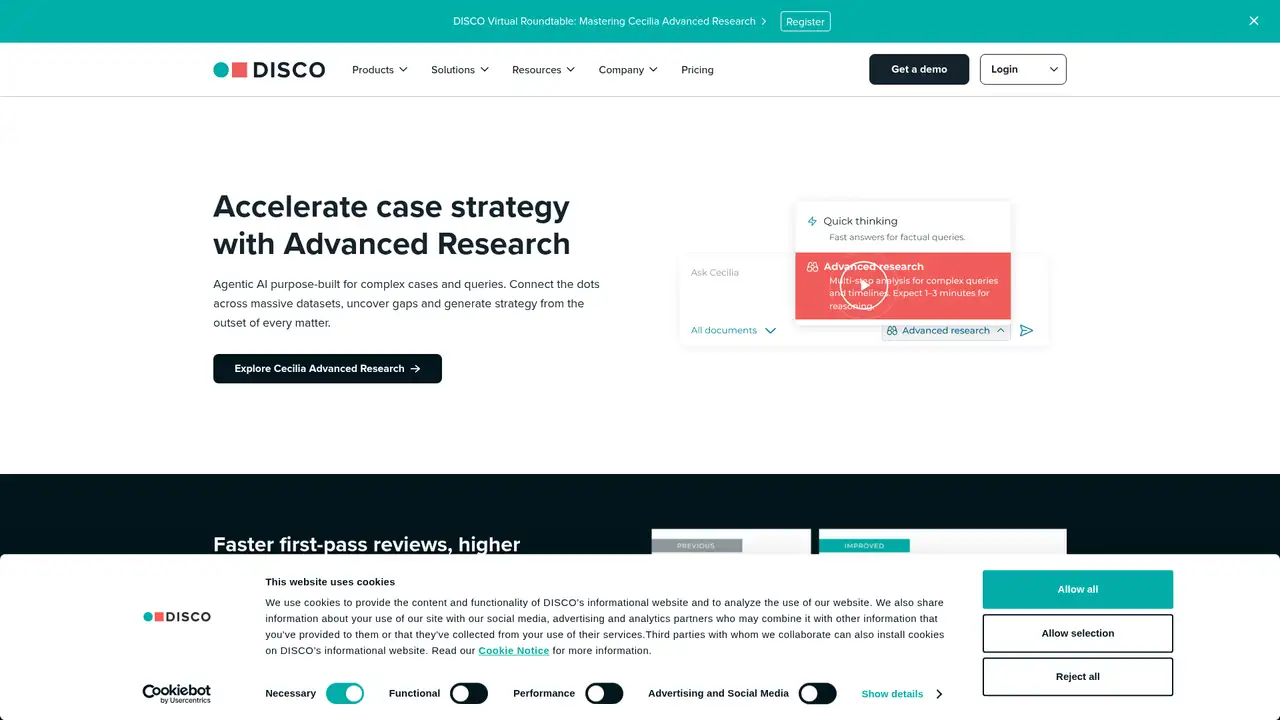
DISCO is a cloud eDiscovery and litigation platform made by CS Disco, Inc., which launched its software in March 2013 after growing from the Camara & Sibley litigation practice. The company reported more than 1,400 customers in 2023. Its 2021 SEC filing reported $161.1 million raised by March 2021, while a 2019 company announcement reported $135 million in cumulative investment. CS Disco trades on the NYSE under LAW. The product serves law firms, corporations, legal service providers, and government organizations handling litigation, investigations, and regulatory matters. Its scope places it closer to a full matter platform than a standalone document-review application. The company remains active as of October 2026. Teams should therefore assess both discovery functionality and the vendor’s continuing public-company support model when evaluating it for long-running matters.
A typical DISCO matter begins with data transfer into a hosted database, followed by processing, search, filtering, early case assessment, review, and production. The platform also includes legal holds, custodian notices, preservation workflows, audit trails, high-speed upload, search visualization, collaborative review, timelines, deposition transcript management, and production tools. Cecilia can answer questions, summarize documents, define terms, summarize depositions, and create timelines from matter data. DISCO says its uploader can reach up to 180 GB per hour and 4 TB per day. The read-only API supports organization metrics and billing analysis. These components let litigation teams move from preservation through discovery and deposition preparation without exporting every matter to separate products. That consolidation can reduce handoffs, but teams should still map permissions, export needs, and review protocols before deployment.
DISCO uses cloud infrastructure and AI models for processing, predictive workflows, and Cecilia features. The company says Cecilia vendors do not retain customer data after responding and do not train general models on it. DISCO describes encryption at rest and in transit, AWS hosting, SOC 2 Type 2, ISO 27001, GDPR compliance, two-factor authentication, and SSO. Recent releases include contextual Cecilia follow-up and native Microsoft Teams processing in September 2025, searchable audio and video transcriptions in December 2025, and an organization-data API documented in July 2026. Auto Review launched in Europe and the UK in June 2025. Advanced Research became generally available on August 13, 2026, adding multi-step investigation, cited results, memos, deposition outlines, and timelines. Buyers should validate regional availability and contractual AI controls for each matter.
DISCO does not publish a self-serve free tier, seat price, or universal dollar-per-gigabyte rate. According to its pricing page, the platform bills on processed data, with rates determined by contract and matter requirements. The platform rate includes Ediscovery, Hold, Case Builder, timelines, productions, and unlimited Cecilia use, with no separate ingest, processing, or user fees listed there. Auto Review has a separate per-document charge. Storage costs still rise with hosted data, even where the company describes storage as having no fixed limit. Monthly bills can reflect peak hosted data and true-ups. Prospective customers therefore need a sales quote, and the practical entry cost depends on data volume, review state, storage duration, and services. A procurement comparison should request modeled scenarios for ingestion, hosting, productions, and AI-assisted review rather than rely on a single headline rate.
DISCO's main limitation is commercial opacity: buyers must model data volume and storage before they know their contracted rate. Cloud hosting also rules out teams that require self-hosted discovery software, and AI output requires attorney review. RelativityOne offers a larger partner and deployment partner network, while Everlaw provides cloud review with Storybuilder and Deep Dive corpus questioning. Logikcull is aimed at simpler collection and review workflows. DISCO is more cohesive when a matter needs holds, review, depositions, timelines, and AI in one environment, but its broader feature set can exceed the needs of small cases. Smaller teams should test whether its matter-wide breadth offsets implementation effort and negotiated billing complexity. Law firms and legal departments managing complex, high-volume litigation should pick DISCO when integrated workflows matter more than public pricing or self-hosting.
Who is DISCO best for?
- Law firms managing large litigation databases need an integrated matter platform.
- Corporate legal teams can combine legal holds and review in one workflow.
- Litigation groups wanting Cecilia use without separate platform token charges.
- Organizations needing professional services alongside discovery software benefit from DISCO.
DISCO Pricing (2026)
Pricing model: Paid. All prices in USD.
| Plan | Price | What you get |
|---|---|---|
| DISCO Platform | Custom | Billed on processed data and review state. Includes Ediscovery, Hold, Case Builder, timelines, productions, unlimited users, and unlimited Cecilia use under contract terms. |
| Auto Review | Custom | Charged per document. DISCO says the feature can review up to 32,000 documents per hour. |
Pros and Cons
Pros
- Cecilia use is included without separate platform token charges.
- Legal holds, review, timelines, and depositions share matter data.
- SOC 2 Type 2 and ISO 27001 support sensitive litigation work.
- The read-only API supports organization usage and billing analysis.
Cons
- Platform and Auto Review prices require a sales quote.
- DISCO is cloud hosted rather than self-hosted.
- AI output remains subject to attorney verification.
Who should look elsewhere?
- Small matters needing a public monthly price should consider simpler tools.
- Organizations requiring self-hosted discovery software should look elsewhere.
- Teams seeking general-purpose document management will find DISCO too specialized.
Technical Details
Frequently Asked Questions
How much does DISCO cost?
DISCO does not publish a universal price list. The platform bills on processed data and review state under a tailored contract. Ediscovery, Hold, Case Builder, timelines, productions, and Cecilia are included in the platform rate, while Auto Review has a separate per-document charge. The final quote depends on data volume, storage, matter requirements, and services.
Does DISCO have a free plan?
DISCO does not advertise a general free plan or public trial. Its platform is sold through a quote, with billing tied to processed and hosted data rather than a self-serve subscription. Customers should expect a sales discussion covering rates, expected matter volume, storage duration, review requirements, and professional services before adoption.
How does DISCO compare with Everlaw?
Both products support cloud eDiscovery, review, analytics, AI, and productions. DISCO emphasizes legal holds, Case Builder depositions, timelines, Cecilia, and professional services. Everlaw emphasizes collaborative review, Storybuilder, public-sector deployments, and Deep Dive corpus questioning. Both use quote-based pricing, so workflow fit and contract terms matter more than a published plan comparison.
Does DISCO train AI on customer data?
DISCO says Cecilia's large language models do not train on or retain client data after a response. Its AI principles describe vendor requirements intended to prevent client data from training a general model. Customers should still review contractual terms for controlled predictive models, retention, security responsibilities, and any matter-specific processing before enabling AI features.
Does DISCO have an API?
Yes. Authorized organizations can use DISCO's read-only API for organization data, including usage and billing analysis. Access uses API keys, authorized users, and trusted IP sources. The API does not make DISCO open source or self-hostable. Customers should confirm the endpoints, authentication requirements, and permitted use cases before building operational reporting around it.
Best DISCO Alternatives in 2026
These tools do the same job as DISCO, with different pricing, limits and trade-offs.

Cloud eDiscovery with AI, collaboration, investigation, and courtroom storytelling
Self-service eDiscovery with drag-and-drop uploads, culling and Reveal's ASK AI

AI-assisted review and case intelligence inside RelativityOne
Data risk platform for eDiscovery, legal hold, forensics and privacy, with agentic AI
Cloud eDiscovery and litigation software priced per user with unlimited data hosting