
/dev/agents Review, Pricing & Alternatives (2026)
A personal platform for discovering and building AI agents
rebranded: The company publicly introduced Dreamer in March 2026, replacing its earlier /dev/agents identity. Latent Space reported on March 23, 2026 that the interview preceded the team's announcement that it was joining Meta Superintelligence Labs.
Last updated: October 22, 2026
What is /dev/agents?
/dev/agents was a 2024 startup founded by former Google, Stripe, Meta, and ChromeOS leaders. It proposed a cloud-based operating system for AI agents and later emerged as Dreamer, a consumer platform centered on a personal Sidekick. Public reports described beta access, agent building, community tools, and hosted execution, but no current pricing or continuing independent availability is confirmed.
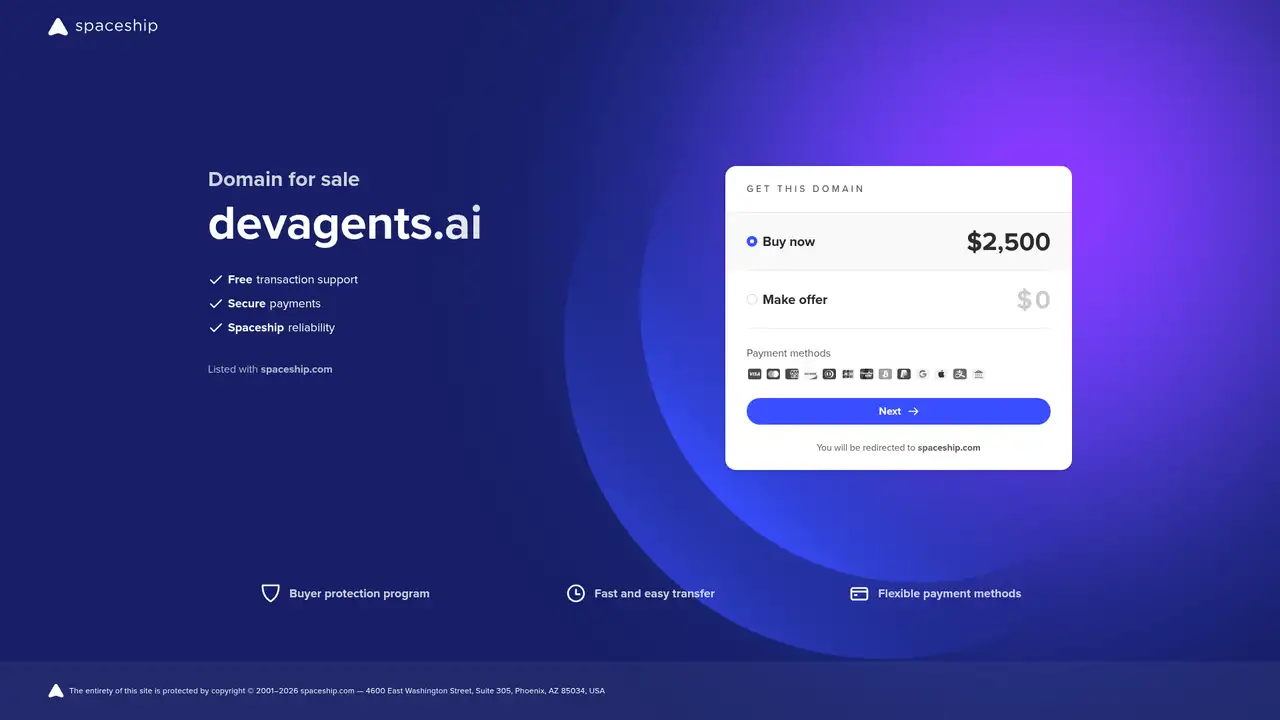
/dev/agents began in 2024 under founders David Singleton, Hugo Barra, Ficus Kirkpatrick, and Nicholas Jitkoff. Public coverage described Singleton as a former Stripe chief technology officer and Google Android engineering leader, Barra as a former Google Android product executive and Meta Oculus leader, Kirkpatrick as a former Android engineer and Meta augmented-reality executive, and Jitkoff as a former ChromeOS designer. The company said it was developing a cloud-based operating system for trusted AI agents. Its stated goals included new interface patterns, a revised privacy model, and a developer platform for agent applications. SiliconANGLE reported a $56 million seed round in November 2024. In March 2026, the project emerged from stealth under the Dreamer name, making /dev/agents primarily a historical identity.
Dreamer was presented as a consumer service for discovering, building, and using AI agents and agentic applications. Its main interface was a personal Sidekick that users could name, customize, and address in natural language. The Sidekick could help users find community-built agents, modify existing experiences, and create new applications through conversation. The reported beta included a gallery of agents, an Agent Studio, and tools built by the company or outside developers. Demonstrated examples included calendar research, news monitoring, daily briefings, conference scheduling, and information management. Latent Space reported that the product used a waitlist during its beta period. The company does not publish a current product manual or independently verified service documentation.
The technical proposition extended beyond prompt templates. Latent Space described an SDK, logging, observability, prompt management, databases, storage, serverless functions, and hosted virtual machines capable of running arbitrary code. The platform also included tools and a gallery where community members could publish agents or integrations. Singleton said tool builders could receive payments based on usage, while premium tools could charge users per use after a trial. A reported demonstration showed the Sidekick producing a conference application from structured event information. Another account said builds could take about 10 to 15 minutes because the system iterated, tested, and corrected output. That timing was an interview statement rather than a performance guarantee. The company does not publish a post-transition release schedule.
No current consumer subscription, developer plan, API rate card, or hosted-runtime price is published by the company. During the Dreamer beta, prospective users were directed to a waitlist. The company described free trials for premium tools and usage-based charges for certain tools, including a web research integration, but did not provide a general tariff. Tool builders were told that usage could generate payments, yet no payout formula or settlement terms were published. In September 2026, the public site lacked product documentation, a signup flow, deployment instructions, and pricing. The reported $56 million financing round describes company funding rather than customer pricing. Historical promotional incentives, including a reported $10,000 builder prize, should not be treated as current purchasing options.
The project was aimed at a different audience from several developer-focused agent products. Dreamer emphasized a consumer Sidekick, a community gallery, and conversational creation, while OpenAI AgentKit, Google Agent Development Kit, and Microsoft Copilot Studio present more explicit developer or business entry points in their respective product materials. Replit Agent is a closer comparison for natural-language software creation, while Salesforce Agentforce addresses business agent deployment. Dreamer's strengths are broad platform scope, hosted code execution, community publishing, and tool-builder incentives. It also supports concerns about beta access, incomplete public documentation, unclear pricing, and uncertain continuity after the reported Meta move. Treat the project as a subject for research, not a confirmed procurement option.
Who is /dev/agents best for?
- Researchers studying consumer agent interfaces and platform strategy.
- Developers reviewing historical approaches to hosted agent creation.
- Builders investigating usage-based tool payments and community publishing.
- Teams comparing conversational agent creation with developer platforms.
/dev/agents Pricing (2026)
Pricing model: Usage-based. All prices in USD.
| Plan | Price | What you get |
|---|---|---|
| No public plan | N/A | Dreamer announced beta access in March 2026 without public subscription prices. The team subsequently announced it was joining Meta Superintelligence Labs. |
Pros and Cons
Pros
- The reported design combined agent creation with storage, logs, prompts, and hosted execution.
- The Sidekick offered conversational assistance for agent creation.
- Community tool builders were offered usage-based payments.
- The platform supported consumer discovery through an agent gallery.
Cons
- The product rebranded as Dreamer and its team reportedly joined Meta.
- No current subscription, API, or hosted-runtime price is documented.
- Public documentation and continuing access remain uncertain.
Who should look elsewhere?
- Teams needing confirmed ownership, support commitments, and procurement pricing.
- Developers requiring a documented public API and deployment workflow.
- Organizations unwilling to evaluate uncertain beta continuity.
Technical Details
Frequently Asked Questions
What is /dev/agents called now?
The company introduced Dreamer in March 2026 as the public successor to its /dev/agents identity. Latent Space later reported that the team announced it was joining Meta Superintelligence Labs. The company does not publish confirmation of an independently operating Dreamer service after that announcement, so current ownership and access should be confirmed before evaluation.
How much did Dreamer or /dev/agents cost?
No current public subscription, developer plan, API rate card, or hosted-runtime price is documented. During the reported beta, users joined a waitlist, and some premium tools could charge per use. Builders reportedly received free trials for premium tools, but the company did not publish a general price table or fixed customer plan.
Was there a free plan?
Dreamer does not publish a free plan with defined quotas. Dreamer reportedly offered beta access through a waitlist and allowed builders to try certain premium tools before subscribing. Those arrangements do not establish a continuing free tier. Availability became uncertain after the team's reported move to Meta Superintelligence Labs.
How did it compare with OpenAI AgentKit?
Dreamer was described as a consumer service centered on a personal Sidekick, an agent gallery, and community-published tools. OpenAI AgentKit is presented as a developer-oriented product with clearer platform materials. The companies do not publish enough information to compare performance, reliability, pricing, or feature superiority.
What happened to user data and commercial rights?
The company describes privacy as an important design issue, but it does not publish a complete current privacy policy, data-processing agreement, retention schedule, commercial license, or training-data commitment. Prospective builders should avoid confidential workloads until ownership, data handling, export, payment, intellectual-property, and service-continuity terms are confirmed in writing.
Best /dev/agents Alternatives in 2026
These tools do the same job as /dev/agents, with different pricing, limits and trade-offs.