
Default Review, Pricing & Alternatives (2026)
Revenue data, routing, enrichment, scheduling, and agent workflows in one system.
Last updated: October 26, 2026
What is Default?
Default is a go-to-market operations platform for revenue teams that combines lead routing, scheduling, enrichment, workflow automation, and a data layer for agents. Growth costs $12,000 per year, before seats and extra credits. It fits B2B teams with complex assignment rules that want these functions connected rather than managed through separate tools.
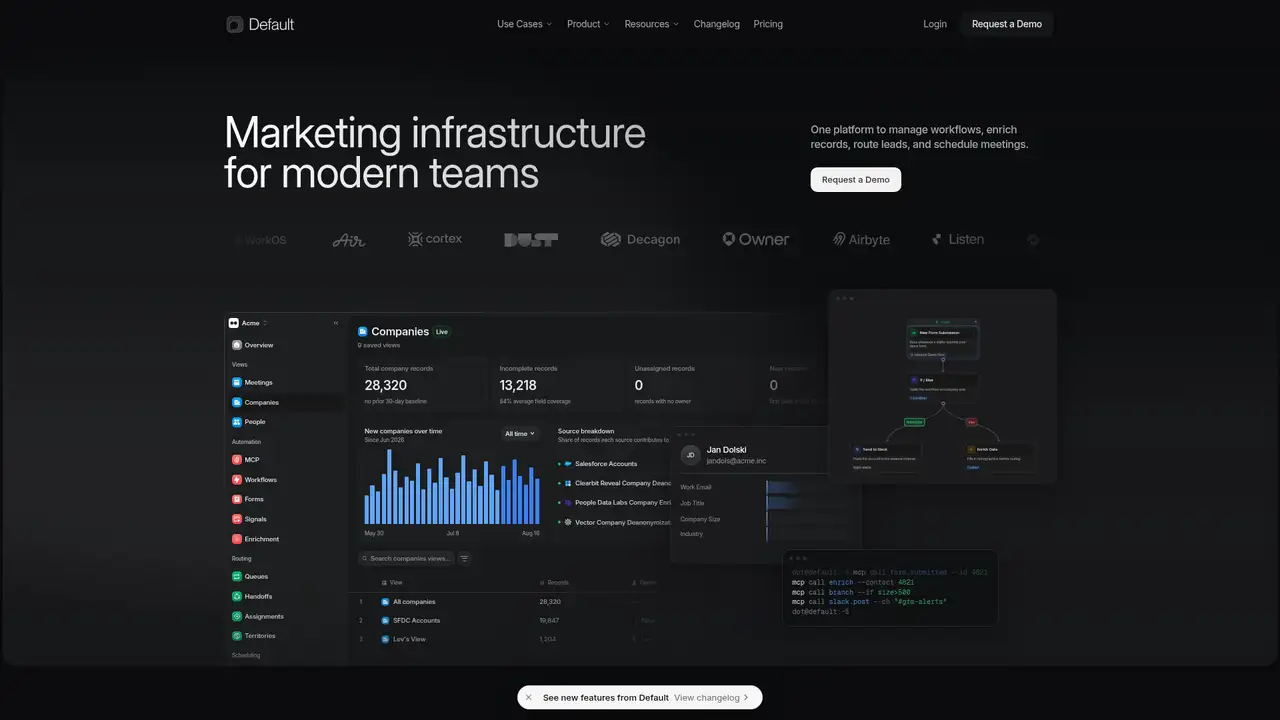
Default is a go-to-market operations platform from Tomo HQ, Inc., founded in 2019, for B2B revenue teams. The company says it spent more than a year building before its public launch and had supported hundreds of companies by May 2026. Named customers include Perplexity, Owner, Cortex, Hex, OpenPhone, Bland, and StackBlitz. Default announced an additional $4 million led by 8VC in December 2025, then announced a Series A led by 8VC with Craft and Jack Altman in May 2026. That announcement put total funding at $20 million. PitchBook lists 44 employees. Default is built for teams managing routing, enrichment, scheduling, and workflow operations across several revenue systems, rather than for individual salespeople seeking a standalone calendar.
A typical Default workflow starts with data from a CRM, marketing system, product, call recorder, sales engagement tool, or advertising platform. A form submission or website signal can trigger matching and enrichment, after which rules score the record and assign it by ownership, territory, capacity, work schedule, calendar availability, recency, or round robin. Default can create a booking path, update CRM fields, and start follow-up workflows. Tables give teams a shared record view, while the Chrome extension supports enrichment and booking tasks. Routing pages describe versioned assignment logs, attributed rule changes, one-click rollback, and audit logs for agent actions. The public API supports server-to-server access, with permissions for triggers and scheduling, and a rate limit of 30 requests per minute per API key.
Default 2.0, announced in December 2025, added website intent, session tracking, AI routing agents, waterfall enrichment, and inbound orchestration. The company says its routing agent made assignment decisions in under 400 milliseconds during internal benchmarking. Its May 2026 product announcement introduced a real-time revenue data layer, a revenue Agent, native routing, scheduling, workflows, enrichment, and MCP access. Teams can connect Claude, ChatGPT, or their own agents through Default MCP, while field-level permissions control what an agent reads, writes, or changes. MCP is beta, and some features are enabled per workspace. Default does not identify a foundation model of its own. Its technology centers on synchronized revenue records, identity resolution, provider calls, workflow execution, and tools that agents can use against governed company data.
Growth costs $12,000 per year and includes 24,000 enrichment credits, 200,000 workflow runs, unlimited workflow building, website visitor identification, and Slack support. Enterprise costs $25,000 per year and includes 60,000 credits, 600,000 workflow runs, dedicated support, migration services, and custom integrations. A Routing plus Scheduling seat costs $540 per user per year, while a Scheduling seat costs $240. Extra enrichment credits cost $0.10 each. One credit equals one provider call, and a full waterfall can use six or more credits. Website visitor identification uses one, two, or three credits depending on the provider. Included credits and workflow runs roll over through the annual agreement. Default has no published free plan, and website intent providers cost extra.
Default's annual platform commitment limits its appeal for small teams needing a calendar link or occasional enrichment. Website intent adds cost, MCP remains beta, and the public API is limited to 30 requests per minute per key. Chili Piper is a closer fit for meeting conversion, qualification, and handoff. LeanData is more focused on Salesforce-centered routing, while Calendly costs less for straightforward scheduling. Default covers more ground by combining data, enrichment, routing, scheduling, agent access, and workflow execution, though that breadth also brings more configuration and usage decisions. Its privacy policy describes processing for service delivery, improvement, administration, security, and legal compliance, but does not say customer data is never used for model training. Teams should pick Default when they will use its connected revenue operations scope.
Who is Default best for?
- Revenue operations teams consolidating routing, enrichment, scheduling, and workflows.
- B2B companies with territories, capacity rules, and calendar-aware assignment.
- Teams automating inbound qualification from form submission to booking.
- Organizations connecting agents to governed revenue data.
Default Pricing (2026)
Pricing model: Paid. All prices in USD.
| Plan | Price | What you get |
|---|---|---|
| Growth | $12,000/year | 24,000 enrichment credits and 200,000 workflow runs yearly, unlimited workflow building, website visitor identification, and Slack support. Annual credits and runs roll over through the agreement. |
| Enterprise | $25,000/year | 60,000 enrichment credits and 600,000 workflow runs yearly, dedicated support, migration services, and custom integrations. Annual credits and runs roll over through the agreement. |
| Routing + Scheduling seat | $540/user/year | Queues, object routing, round robins, booking links, handoff, and the Chrome extension. Annual billing applies. |
| Scheduling seat | $240/user/year | Booking links, queues, and handoff. Annual billing applies. |
| Extra enrichment credits | $0.10/credit | A credit is one provider call. Website visitor identification uses one to three credits by provider, and a full waterfall can use six or more. |
Pros and Cons
Pros
- Combines enrichment, routing, scheduling, and workflow execution.
- Assignment logs record and version routing changes.
- Annual credits and workflow runs roll over through the agreement.
- Field-level permissions govern agent access to revenue data.
Cons
- Annual platform pricing starts at $12,000 before seats.
- Website intent providers cost extra.
- MCP is beta and some features require workspace enablement.
Who should look elsewhere?
- Small businesses needing only a free scheduling link.
- Teams unwilling to make an annual platform commitment.
- Companies without CRM or marketing data to connect.
Technical Details
Frequently Asked Questions
How much does Default cost?
Default Growth costs $12,000 per year and includes 24,000 enrichment credits plus 200,000 workflow runs. Enterprise costs $25,000 per year and includes 60,000 credits plus 600,000 runs. Routing plus Scheduling seats cost $540 per user annually, Scheduling seats cost $240, and extra credits cost $0.10 each.
Does Default have a free plan?
Default does not publish a free plan. Public pricing begins with the $12,000-per-year Growth platform, which includes annual enrichment credits and workflow runs. Teams also pay for the seats their users need. The pricing page directs prospective customers to a demo for configuration and migration planning.
How does Default compare with Chili Piper?
Chili Piper focuses on meeting conversion, qualification, routing, and handoff. Default includes those workflows, then adds a revenue data layer, enrichment, website intent, agent access, and downstream workflow execution. Default therefore suits teams consolidating more of their revenue operations, while Chili Piper fits teams centered on inbound meeting conversion.
Does Default train models on customer data?
Default's privacy policy says it processes information to provide, improve, and administer its services, and may share information with categories of service providers. The policy does not state that customer data is never used for model training. Buyers should review the contract, data-processing terms, retention settings, and controls governing connected revenue data.
Can companies use Default commercially?
Yes. Default sells its platform to go-to-market organizations and publishes Growth and Enterprise business plans. Commercial customers should review the order form, data-processing terms, connected-provider conditions, and licensing restrictions for enrichment and website visitor data before deploying workflows in production.
Best Default Alternatives in 2026
These tools do the same job as Default, with different pricing, limits and trade-offs.