
Composio Review, Pricing & Alternatives (2026)
Authenticated actions and sessions for agents across business software
Last updated: October 26, 2026
What is Composio?
Composio is a developer platform for building agents that call business software through toolkits, OAuth connections, triggers, sessions, and MCP. It targets teams using Python or TypeScript SDKs and supported agent frameworks. The Hobby plan costs $0/month, while Pro costs $29/month and adds a $29 usage credit.
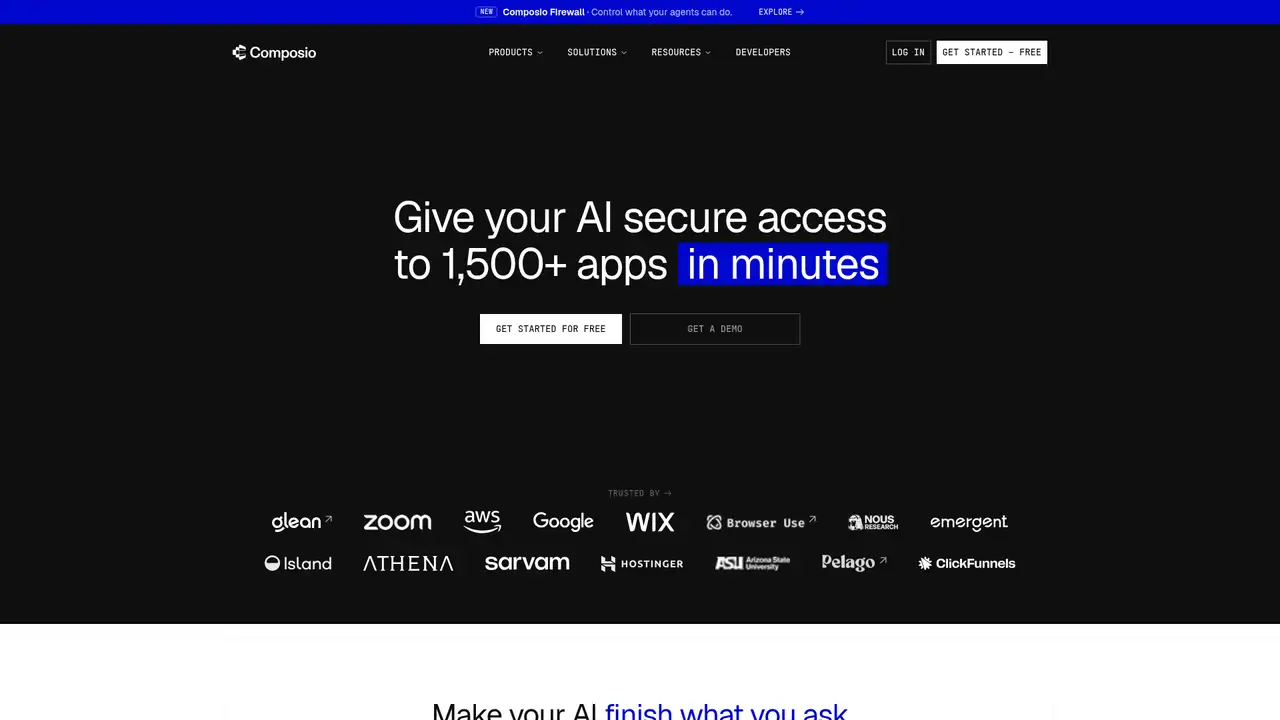
Composio is an agent integration platform from Sampark Inc., founded in 2023 by Soham Ganatra and Karan Vaidya. In July 2025, the company announced a $25 million Series A led by Lightspeed, bringing reported total funding to $29 million. Lightspeed reported more than 100,000 developers and over 10,000 tools at that time, while the current repository describes more than 1,000 toolkits. The MIT licensed repository contains TypeScript and Python SDKs, provider adapters, a CLI, and documentation. Hosted Composio adds account management, execution, sessions, usage billing, and enterprise controls. Its purpose is to give agents authenticated actions across applications including Gmail, GitHub, Slack, Salesforce, Notion, and Linear. This places it between application APIs and agent frameworks, with identity and execution handled in one service.
A typical integration creates a session for a user, discovers or preloads the required tools, connects an account, and passes the resulting schemas to an agent. Sessions handle tool discovery, authentication, toolkit versioning, and execution context. Each session can expose an MCP endpoint, allowing MCP clients to use connected tools without a provider package. Triggers deliver events from connected applications to a webhook, while the CLI supports searching, linking, executing, and scripting tools. Python and TypeScript SDKs include adapters for OpenAI, Anthropic, Google, LangChain, LlamaIndex, CrewAI, AutoGen, and other frameworks. Developers can add custom tools, external MCP servers, or self managed credentials. They remain responsible for prompts, permissions, argument validation, error handling, and downstream application behavior.
The platform's recent direction centers on sessions, versioned tools, and constrained execution rather than loading a complete catalog into every model context. Tool Router became generally available in December 2025, after MCP and experimental ToolRouter arrived in September. Sessions became first class in June 2026, followed by preloaded tools, direct tool presets, session policies, scoped permissions, credential redaction, file transfer hardening, observability APIs, and multi account aliases. April 2026 introduced API version 3.1 with current toolkit versions by default. October releases added session approvals, Python 3.15 support, free form arguments in AutoGen, Google ADK, and OpenAI Agents, plus SDK and CLI updates. Composio supplies authentication, discovery, and execution, but it is not an underlying language model or complete agent runtime.
Hobby costs $0 per month and includes 100,000 tool calls, 50,000 trigger events, unlimited connected accounts, three team members, custom tools and MCP, and 1 million Sandbox LLM tokens monthly. Hobby pauses at included limits, which avoids unexpected charges but also stops work. Pro costs $29 per month and includes a $29 monthly usage credit, unlimited team members, spend controls, and add ons. Unused credit expires monthly. Pro overages are $0.0003 per tool call, $0.003 per trigger event, and $3.75 per million Sandbox LLM tokens. Composio managed OAuth apps have lower allowances and can charge $0.0005 per tool call after their included share. Premium tools add provider charges plus 5 percent. Enterprise uses custom terms and adds SSO, SCIM, customer managed keys, advanced branding, and dedicated support.
Composio reduces repeated OAuth and tool schema work, but it adds a hosted control plane for credentials, execution, sessions, logs, and billing. ZDR is unavailable on Hobby, paid ZDR costs $0.0001 per tool call plus $0.0005 per trigger event, and coverage excludes triggers, files, Sandbox data, some hosted applications, and third party retention. Payloads may remain in ordinary execution logs for up to one year, while audit logs and telemetry still exist. Compared with Nango, Composio places more emphasis on agent actions, sessions, and tool discovery. Compared with Pipedream, it presents a more explicit toolkit and authentication layer for agents. Compared with Zapier, it exposes lower level SDK, MCP, and execution primitives. Choose Composio when developers need agents to act across many authenticated SaaS systems and can accept managed infrastructure.
Who is Composio best for?
- Developers connecting agents to many SaaS applications.
- Teams needing managed OAuth, token refresh, and scopes.
- Teams using MCP or SDK sessions for agent workflows.
- Enterprises requiring SSO, keys, DPA, BAA, or SLA terms.
Composio Pricing (2026)
Pricing model: Freemium. All prices in USD.
| Plan | Price | What you get |
|---|---|---|
| Hobby | $0/month | 100,000 tool calls, 50,000 trigger events, 1 million Sandbox LLM tokens, unlimited connected accounts, and 3 team members monthly. |
| Pro | $29/month | Includes a $29 monthly usage credit, unlimited team members, spend controls, and add-ons; unused credit expires monthly. |
| Enterprise | Custom | Committed volume, discounts, annual invoicing, SSO, SCIM, customer-managed keys, white-labeling, DPA, BAA, support, and SLA options. |
| Tool-call overage | $0.0003/tool call | Pro overage is $0.0003 per tool call. Trigger events cost $0.003 each, and Sandbox LLM tokens cost $3.75 per million. |
Pros and Cons
Pros
- More than 1,000 toolkits reduce custom API integration work.
- Managed OAuth handles consent, storage, refresh, and scopes.
- Sessions, MCP, triggers, and Tool Router fit agent runtimes.
- MIT-licensed SDKs support customization beside the hosted service.
Cons
- Hosted credentials and execution remain dependencies for the full product.
- Premium tools and add-ons complicate the $29 headline price.
- Toolkit schemas and coverage vary across connected applications.
Who should look elsewhere?
- Teams requiring every component to run fully self-hosted.
- Small scripts making one API call without credential management.
- Workloads unable to absorb per-call or premium-tool charges.
Technical Details
Frequently Asked Questions
How much does Composio cost?
Composio Hobby costs $0/month and includes 100,000 tool calls, 50,000 trigger events, unlimited connected accounts, three team members, and 1 million Sandbox LLM tokens monthly. Pro costs $29/month with a $29 usage credit. Pro overages cost $0.0003 per tool call and $0.003 per trigger event. Enterprise pricing is custom.
Is Composio free?
Yes. Hobby requires no credit card and includes 100,000 tool calls, 50,000 trigger events, unlimited connected accounts, three team members, custom tools and MCP, and 1 million Sandbox LLM tokens monthly. Usage pauses at Hobby limits. Composio-managed apps have lower allowances, and premium tools or connected providers can create separate charges.
How does Composio compare with Nango?
Nango focuses on embedded integrations, OAuth, and data synchronization, while Composio combines authentication with agent tool execution, sessions, triggers, MCP, and framework adapters. Composio fits agents discovering and calling typed actions across applications. Nango can fit products whose primary requirement is synchronizing customer data rather than exposing actions to an agent.
Does Composio train on customer data?
Composio says it does not use payload data to develop, train, or improve artificial intelligence or machine learning models. It may use de-identified execution metadata for platform improvement and model training. Its policy also says Google user data is not used to build or improve models. Zero Data Retention removes payloads from covered execution logs, while metadata and third-party policies remain relevant.
Can I use Composio commercially, and is it open source?
The Composio SDK repository is MIT-licensed, which permits commercial use subject to the license terms. The hosted service is separate and includes managed authentication, catalog access, sessions, execution, and metering. Commercial users must also account for connected application terms, model or provider charges, premium tools, and any required data-processing or healthcare agreements.
Best Composio Alternatives in 2026
These tools do the same job as Composio, with different pricing, limits and trade-offs.