Chegg Review, Pricing & Alternatives (2026)
Textbook-linked study help expanding into skills and employability
Last updated: October 26, 2026
What is Chegg?
Chegg is a textbook-linked study service that grew from textbook rentals into solutions, Expert Q&A, writing support, math tools, and AI-assisted learning. U.S. entry pricing is $15.95 per month for Chegg Study, with Study Pack at $19.95. It is also expanding toward workforce skills, internships, job applications, and commercial AI-data services, though newer features may vary by user or market.
Chegg was founded by Iowa State University students Aayush Phumbhra and Osman Rashid as an affordable textbook-rental company for college students. Its history later expanded from rentals into eTextbooks, Chegg Study, writing support, and other learning services. In 2026, company materials describe Chegg as an active learning and workforce-skilling business serving students, lifelong learners, employers, and institutions. It continues operating Chegg Study while developing Chegg Skills, language learning, employability services, and commercial AI-related offerings. Chegg is publicly held and trades on the New York Stock Exchange under CHGG. Its identity now combines a familiar student-help subscription with a broader focus on skills, internships, employment, and career outcomes. Its 2007 launch of online print rentals preceded the subscription study tools that now define its consumer offering.
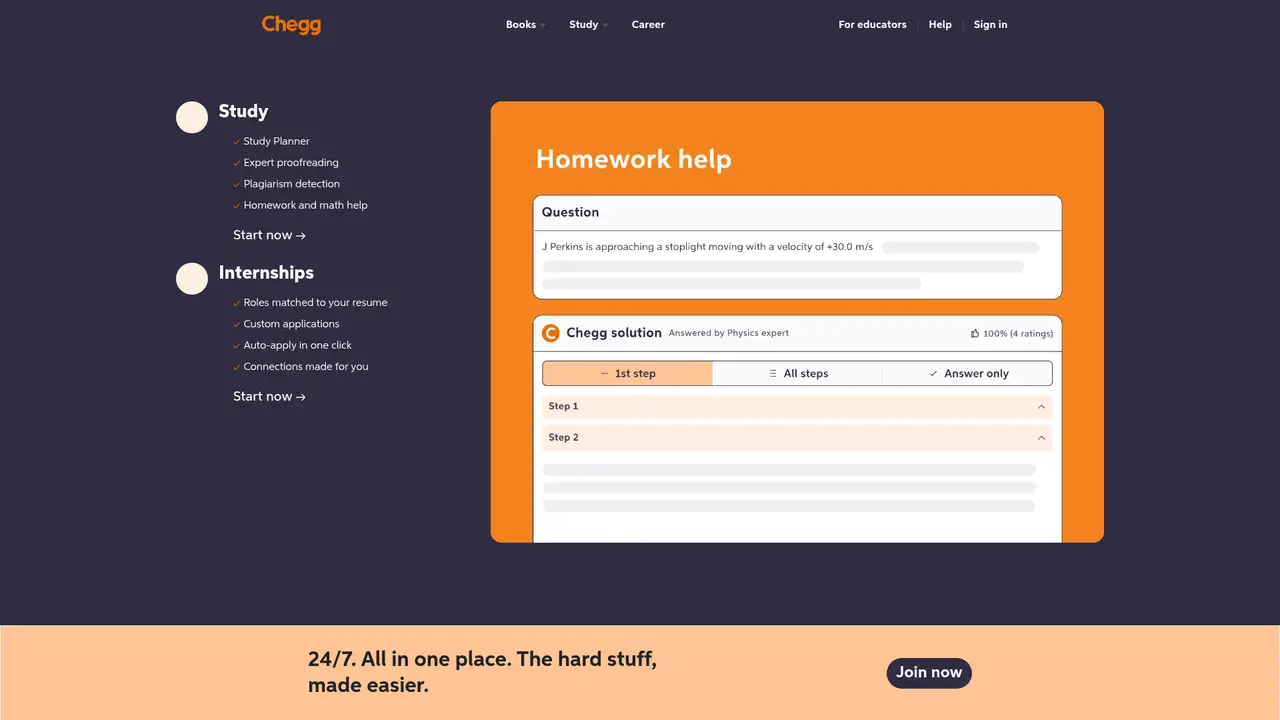
Chegg Study supports self-paced learning through web and mobile access. Students can search textbook-linked solutions, submit questions through Expert Q&A, read step-by-step explanations, complete practice questions, and use tools such as Chegg Create. Study Pack adds writing and math features listed on the public study page. The service is positioned as coursework support rather than live classroom instruction. Chegg also describes tools that can personalize study assistance around notes and course needs. This workflow suits students who already know an assigned textbook or subject, but answer-oriented services require care so explanations are not submitted as copied work. Subscription access varies according to the chosen plan and applicable product terms. A textbook solution and an AI explanation serve different purposes, so students should choose the format that matches their assignment.
In 2026, Chegg says its AI systems support personalized learning, study assistance, and product development. The company also announced commercial licensing for proprietary academic data, alongside subject-matter expertise used to train and evaluate AI models. Its second-quarter announcement describes a soft launch beginning in the third quarter for internships and jobs, with job matching, resume tailoring, cover letters, application autofill, interview preparation, and targeted skill building. These offerings may be rolling, so availability can differ by market or user. Chegg has not published model names for its consumer AI features. Its privacy policy, updated June 26, 2026, addresses data processing across Chegg websites, applications, and services, including uploaded content and AI-related uses. The AI-data business is a separate commercial direction, rather than a promise that every subscriber receives a new tutoring feature.
The U.S. study page lists Chegg Study at $15.95 per month and Chegg Study Pack at $19.95 per month. Study includes relevant study solutions and step-by-step assistance, while Study Pack adds expert proofreading, plagiarism detection, and math help. Chegg also advertises free tools, though it does not provide one complete public price table for every product, textbook, eTextbook, skills service, language service, or future employability feature. Promotions, taxes, availability, renewal terms, and platform differences may change the amount shown at checkout. Some subscriber partner benefits have separate terms, so they should not be treated as permanent core features of either primary plan. Moving from Study to Study Pack costs another $4 monthly at the advertised rates, before any applicable taxes or promotions.
Chegg is strongest for college students seeking textbook-linked explanations and broad subject support within one paid service. Course Hero is a direct alternative for uploaded course documents, Quizlet is better suited to flashcards and study sets, and Khan Academy provides free structured lessons. Chegg's limits include recurring cost, uneven relevance across courses, academic-integrity risks, and a business direction still developing around skills and employability. Its AI and career announcements matter, but several features are described as rolling or soft-launched rather than universally established. Choose Chegg when assigned-textbook coverage and repeated study help justify the subscription. Neither a subscription nor a detailed explanation grants permission to submit another party's solution as original coursework. Choose a rival when free lessons, flashcards, or class documents matter more.
Who is Chegg best for?
- College students using assigned textbooks can benefit from searchable step-by-step explanations.
- Students studying several subjects may value broad coverage in one subscription.
- Writers needing proofreading and plagiarism tools may prefer Study Pack.
- Learners wanting occasional math and exam support can use the combined toolkit.
Chegg Pricing (2026)
Pricing model: Freemium. All prices in USD.
| Plan | Price | What you get |
|---|---|---|
| Chegg Study | $15.95/month | Textbook-linked study solutions and step-by-step support; advertised U.S. monthly price. |
| Chegg Study Pack | $19.95/month | Study features plus expert proofreading, plagiarism detection, and math help; advertised U.S. monthly price. |
| Free tools | $0 | Chegg advertises free tools, without one universal published feature set or usage quota. |
Pros and Cons
Pros
- Chegg covers many college subjects and textbook-linked problems.
- Study Pack combines study help with writing and math tools.
- The company is adding AI-supported personalization and career features.
- Free tools allow limited exploration before subscribing.
Cons
- Recurring subscription prices may strain limited student budgets.
- Answer access can create academic-integrity risks when misused.
- Newer services lack one complete public price table.
Who should look elsewhere?
- Students requiring fully free structured courses should look elsewhere.
- Students seeking live classroom teaching will not find a conventional class here.
- Students unwilling to manage recurring subscriptions should avoid relying on a paid plan.
Technical Details
Frequently Asked Questions
How much does Chegg cost?
The U.S. study page lists Chegg Study at $15.95 per month and Chegg Study Pack at $19.95 per month. Chegg also advertises free tools and operates products with separate pricing. Taxes, promotions, renewal terms, availability, and platform differences may affect the amount shown at checkout.
Can I use Chegg for free?
Chegg advertises free tools, but its core textbook solutions and subscription benefits are paid. Free access is not presented as unlimited access to the full answer library. Exact free features may change, so users should review the current product page before assuming a particular tool or feature is included.
What is Chegg's closest competitor?
Course Hero is the closest direct comparison for paid academic help, though the services emphasize different material. Chegg focuses on textbook solutions, Expert Q&A, and writing support, while Course Hero emphasizes uploaded course documents and notes. Quizlet is closer for flashcards and study sets than for every Chegg feature.
How does Chegg handle privacy?
Chegg's privacy policy updated June 26, 2026 describes collection, use, disclosure, retention, security, regional rights, and controller or processor roles. It covers websites, applications, and product data. The policy also describes processing of uploaded content for product improvement and artificial-intelligence or machine-learning model training.
Does Chegg offer a commercial license or API?
Chegg announced commercial licensing of proprietary academic data to organizations training and evaluating AI models. Chegg does not offer a general developer API, an open-source license, or a self-hosting option. Commercial users should contact Chegg about scope, rights, pricing, data handling, and permitted uses.
Best Chegg Alternatives in 2026
These tools do the same job as Chegg, with different pricing, limits and trade-offs.

Course-specific study materials with answers and tutor help

Flashcards, adaptive practice, and AI study tools for students
Scan a problem, then follow the working one step at a time

A guided AI tutor and teacher assistant built into Khan Academy
Peer answers and AI tutoring in one study service