
Photomath Review, Pricing & Alternatives (2026)
Scan a problem, then follow the working one step at a time
Last updated: October 22, 2026
What is Photomath?
Photomath is a camera-based mathematics homework app for students, parents, and independent learners. Its free plan scans symbolic math and returns step-by-step explanations, while Photomath Plus adds deeper instructional features through paid subscriptions. It suits learners wanting immediate worked examples, rather than live tutoring or a course platform.
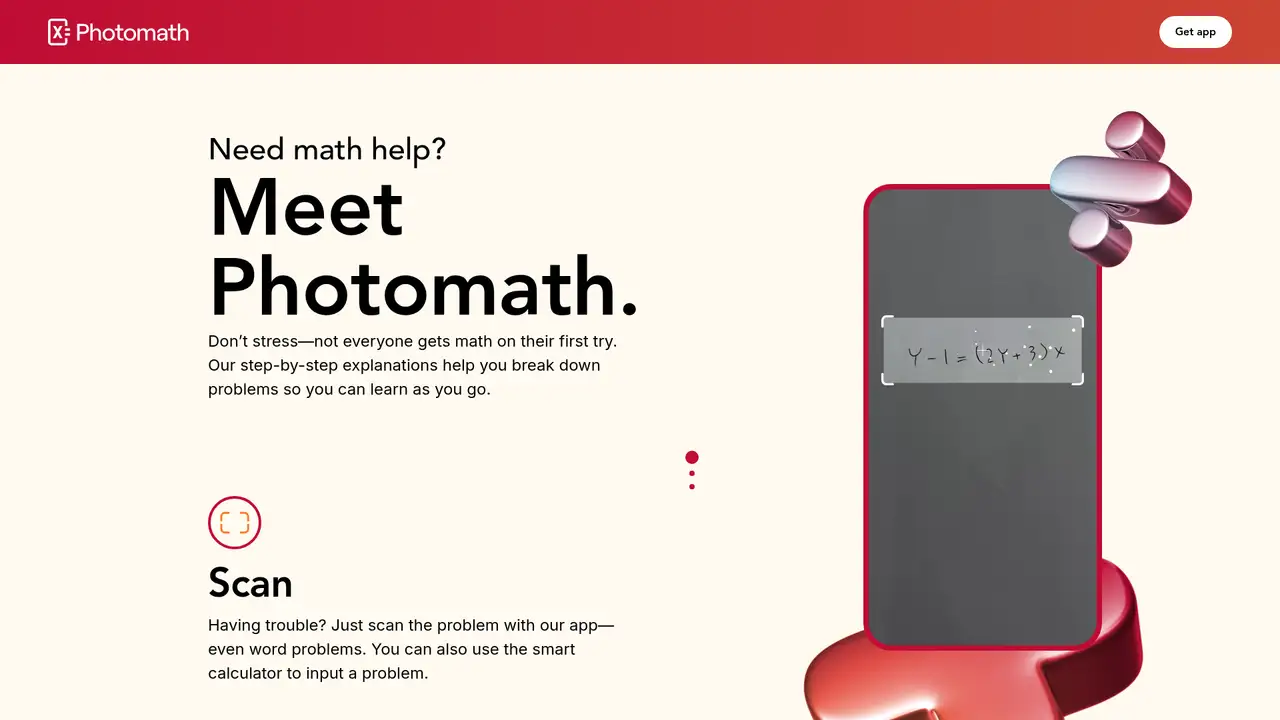
Photomath’s identity rests on a focused promise: point a camera at a math problem and receive a step by step explanation. Founded in 2014 by Damir Sabol and initially developed by Microblink, the service grew from a homework utility into a consumer education product for students, parents, and independent learners. Its free version scans printed, handwritten, or on screen symbolic problems, while Plus adds deeper explanations, contextual hints, animated tutorials, and textbook solutions. The company does not disclose a named foundation model, instead emphasizing image recognition, symbolic math capabilities, and educational content developed by mathematicians and former teachers. Google agreed to acquire Photomath in May 2022, and the European Commission cleared that purchase unconditionally on March 28, 2023. Today, Google is listed as the App Store developer, while Photomath remains a distinct product.
Photomath’s typical workflow begins with scanning a printed, handwritten, or on-screen problem through the mobile app. Users can crop the image, correct the recognized expression, or enter it with the smart calculator. The service then presents a solution with step-by-step explanations, and may offer multiple teacher-approved methods, definitions, word-problem instructions, interactive graphs, or animated steps. Its free version includes core symbolic-math explanations, calculator access, and support ranging from arithmetic through calculus. Photomath Plus adds deeper explanations, contextual hints, custom visual aids, animated tutorials, and textbook solutions, with subscriptions billed through the relevant app store. This makes Photomath useful for checking homework and reviewing a missed transformation at the learner’s pace. It remains a problem-solving aid, not a platform for assignments, grading, class rosters, or live human tutoring.
Photomath’s consumer documentation does not identify a named foundation model. Instead, the product describes a camera-based recognition system paired with symbolic-math solving, expert-developed educational content, and teacher-approved methods. Its App Store listing says the app handles printed, handwritten, and on-screen problems, then provides step-by-step explanations, multiple methods, graphs, and newer Animated Steps showing progression within a step. Photomath Plus adds deeper explanations, contextual hints, textbook solutions, and more than 400 AI-powered animated tutorials, according to Photomath Help. Those tutorials simulate a teacher’s whiteboard explanation, but the documentation does not specify their underlying model or training data. The company describes its instructional features in terms of solution steps, visual explanations, and tutorials rather than a named conversational model. Photomath is therefore best characterized as a recognition and symbolic-solving service with structured instructional content, not a general-purpose chatbot.
Photomath’s free Basic plan costs $0 and provides symbolic-math scanning, a calculator, and core step-by-step explanations, with no published quota for ordinary scans. That is a meaningful baseline: users can scan equations, expressions, and functions or solve them through the calculator without paying, according to Photomath Help. The paid escalation is Photomath Plus, listed on the US website at $9.99 per month or $69.99 per year, with annual billing charged upfront. Help documentation also describes six-month subscriptions, while prices and offers may vary by country, platform, taxes, or checkout. Plus adds deeper explanations, contextual hints, custom visual aids, animated tutorials, and textbook solutions, including more than 400 AI-powered tutorials. Purchases run through Google Play or Apple’s App Store and renew automatically unless cancelled. Thus, free access is broad, but richer instruction carries recurring cost.
Photomath’s main limitation is scope: it explains a submitted problem, but it is not a complete curriculum, live tutoring marketplace, or classroom assessment system. Camera recognition may also need a clean crop and correction when notation is unclear. Compared with Microsoft Math Solver, Photomath places more emphasis on polished visual explanations and a paid tier; compared with Symbolab, it favors camera capture and school-oriented guidance; compared with Khan Academy, it provides immediate worked solutions rather than a sequenced course. Its free plan includes core step-by-step explanations, while Plus adds deeper explanations, contextual hints, animated tutorials, and textbook solutions. Photomath is best for students who want a quick, visual second explanation for math homework. Learners needing sustained practice, teacher feedback, assignment management, or subjects beyond mathematics should choose Khan Academy, a tutor, or another course platform instead.
Who is Photomath best for?
- Students checking algebra, geometry, or calculus homework steps.
- Parents seeking a visual explanation of a child’s math problem.
- Learners preferring camera input over typed equations.
- Users wanting an inexpensive first explanation before tutoring.
Photomath Pricing (2026)
Pricing model: Freemium. All prices in USD.
| Plan | Price | What you get |
|---|---|---|
| Basic | $0 | Step-by-step explanations, calculator access, and symbolic-math solving; no published scan quota. |
| Photomath Plus monthly | $9.99/month | Deeper explanations, custom visual aids, contextual hints, animated tutorials, and textbook solutions; billed in-app. |
| Photomath Plus annual | $69.99/year | Plus features billed upfront for 12 months; prices, taxes, and offers may vary by checkout. |
Pros and Cons
Pros
- The free plan includes core step-by-step explanations.
- Camera capture supports printed, handwritten, and on-screen problems.
- Plus includes more than 400 AI-powered animated tutorials.
- The product covers arithmetic through calculus.
Cons
- Some instructional features require a recurring subscription.
- Recognition may need correction for unclear or ambiguous notation.
- The app does not replace a curriculum or live tutor.
Who should look elsewhere?
- Classes needing grading, rosters, or assignment analytics.
- Learners seeking live human tutoring and back-and-forth diagnosis.
- People needing writing, science, or broad subject coverage.
Technical Details
Frequently Asked Questions
How much does Photomath cost?
Photomath Basic is free. The US website lists Photomath Plus at $9.99 per month or $69.99 per year, with the annual subscription charged upfront. Photomath Help also describes six-month billing. Prices, taxes, promotions, and availability can vary by checkout, platform, and country.
Can I use Photomath for free?
Yes. Core symbolic-math solving, calculator access, and step-by-step explanations are available without a Plus subscription. Paid features include deeper explanations, contextual hints, animated tutorials, and textbook solutions. The free plan has no published ordinary scan quota, though feature availability can change over time.
Photomath or Symbolab: which is better?
Photomath is a strong fit for camera capture and visual homework explanations. Symbolab is a direct alternative for typed equations and step-by-step math tools. Choose Photomath for a camera-first workflow and choose Symbolab when typed input is your priority. Neither replaces teacher feedback or a structured course.
Does Photomath train on my problems?
Photomath’s privacy policy says images, videos, text, usage information, and math problems may be collected for service operation, indexing, testing, and improvement. It also says submitted images and feedback can improve problem-solving capabilities and related machine-vision technologies. The policy does not identify a training model or promise that every submission is used for training.
Can Photomath be used commercially?
Photomath is presented as a consumer service with subscriptions billed through Google Play or the App Store. Its public product pages do not advertise a commercial API or separate business license. Organizations planning to embed solutions, redistribute output, or operate at scale should review the current terms and obtain written permission before proceeding.