
Buffer Review, Pricing & Alternatives (2026)
Affordable social publishing and engagement for small teams
Last updated: October 26, 2026
What is Buffer?
Buffer is a social media scheduling, publishing, engagement, analytics and link-in-bio platform for creators, freelancers, small businesses and agencies. Its free plan supports basic publishing and engagement, while paid access starts at $5 per connected channel per month with annual billing. The product suits teams that want straightforward multi-network publishing without enterprise social-care costs.
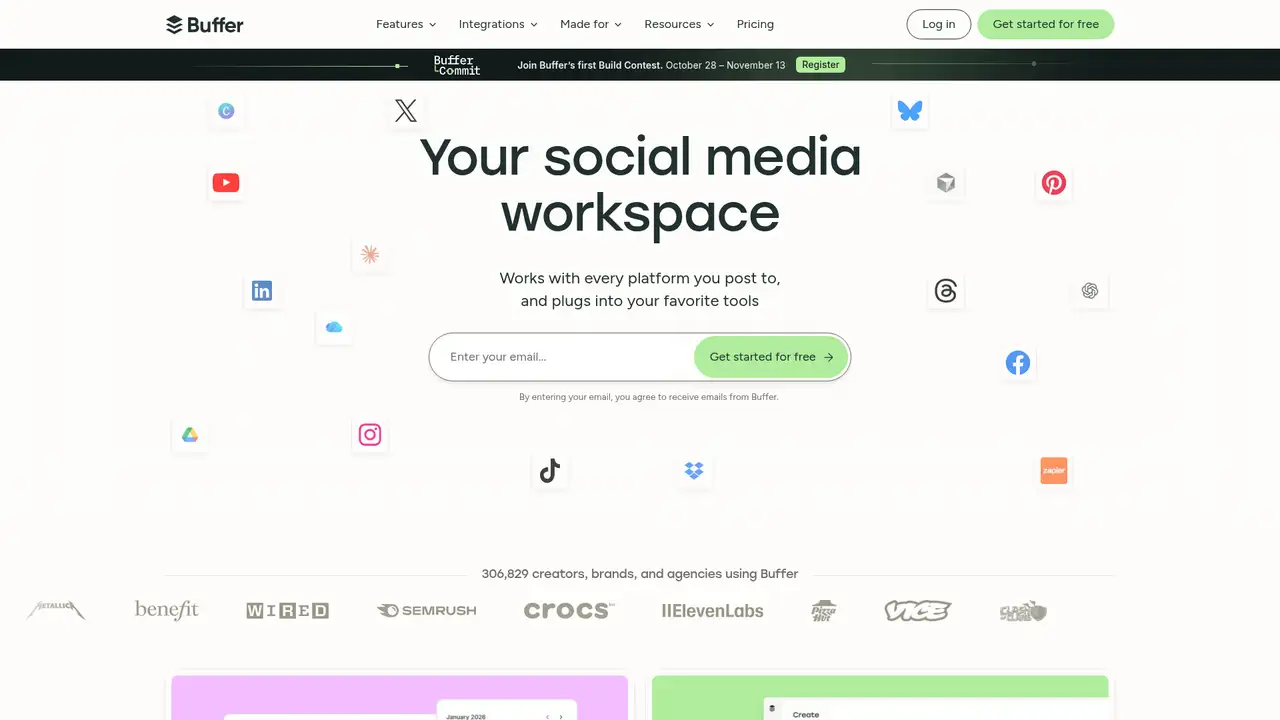
Buffer is an independent social media management company launched by Joel Gascoigne on November 30, 2010. Its software combines scheduling, publishing, engagement, analytics and link-in-bio tools for creators, freelancers, small businesses and agencies. Buffer’s Open dashboard reports 306,958 monthly active users, $2.3 million in monthly recurring revenue, $27.28 average revenue per user and $27.6 million in annual recurring revenue. A 2023 shareholder report recorded more than 55,000 paying customers, over 80,000 monthly signups and $4 million in total funding. The company received $120,000 from AngelPad in 2011, raised $3.5 million in a 2014 Series A and acquired Respondly in 2015. Buffer later bought out its main Series A investors for $3.3 million in 2018.
A typical Buffer workflow starts by connecting social profiles, defining a posting schedule and drafting content for one or more channels. Users can write captions, save ideas, organize content, schedule posts and review performance from one workspace. Bulk scheduling accepts CSV imports containing up to 100 posts. Community places comments from Instagram, Facebook, Threads, X, LinkedIn, TikTok, YouTube, Bluesky, Mastodon and Google Business Profiles in one free inbox. Feeds lets users collect RSS sources, browse articles and schedule selected items. Buffer also includes AI-assisted caption creation, rewriting, translation and repurposing. The network list suits small brands and creators, although publishing, analytics and engagement functions vary by platform. Agencies can use approval workflows and access levels on Team, while the free plan limits accounts to one user.
Buffer’s AI Assistant launched on February 15, 2023, using OpenAI through its API. It generates ideas, writes or rewrites captions, changes tone, translates posts and repurposes existing content. Buffer reported that the assistant had supported more than 33,300 posts for 8,850 users and generated 2.8 million AI words by May 2023. Recent releases include RSS feeds in March 2025, LinkedIn Profile Analytics in July 2025 and Community in November 2025. LinkedIn analytics covers impressions, reactions, comments, shares, engagement rate, views, watch time and unique video viewers. Buffer’s 2025 roundup also lists bulk scheduling, a redesigned iOS app and dark mode. Buffer announced a public API on May 27, 2026, covering publishing, scheduling, management, OAuth and an MCP server connecting Claude, ChatGPT and Cursor to Buffer accounts.
Buffer uses a freemium, per-channel pricing model. The Free plan includes 10 scheduled posts per channel, 100 ideas, one user, AI Assistant, Insights, Community and API access with one key and 3,000 requests monthly. Essentials costs $5 per channel monthly with annual billing, or $60 billed yearly, and adds unlimited scheduling plus advanced analytics. Team costs $10 per channel monthly with annual billing, or $120 billed yearly, and adds unlimited members, access levels and approval workflows. Monthly billing costs $6 for Essentials and $12 for Team. Annual billing is 20 percent cheaper, and channel discounts apply above 10 channels. Paid unlimited scheduling has a 5,000-post-per-channel fair-use cap. The pricing page does not show a separate Agency tier or price, while old AI credit allocations belong to 2023 beta plans.
Buffer’s free plan and low entry price suit small publishing operations, although per-channel billing becomes more expensive as profiles multiply. The free queue allows only 10 scheduled posts per channel, and Buffer offers lighter enterprise governance and analytics than Sprout Social or Hootsuite. Later and SocialBee are closer scheduling-focused alternatives, while Sprout Social adds deeper social care, listening and reporting at substantially higher prices. Buffer’s AI materials confirm OpenAI API use, but the company does not publish a current Buffer-specific statement establishing whether customer data trains models. Community Comment Insights were described as beta or coming soon, not as a confirmed shipped feature. Pick Buffer for affordable multi-network publishing when a small team values simple scheduling over enterprise reporting and governance.
Who is Buffer best for?
- Creators scheduling content across several social networks.
- Small businesses needing a free publishing queue.
- Agencies managing affordable per-channel plans.
- Teams combining comments and scheduling in one workspace.
Buffer Pricing (2026)
Pricing model: Freemium. All prices in USD.
| Plan | Price | What you get |
|---|---|---|
| Free | Free forever | 10 scheduled posts per channel, 100 ideas, 1 user, Community inbox, 1 API key and 3,000 API requests per month. |
| Essentials | $5/month per channel billed annually, or $6/month billed monthly | Unlimited scheduled posts and ideas, 1 user, advanced analytics, 3 API keys and 7,500 API requests per month. |
| Team | $10/month per channel billed annually, or $12/month billed monthly | Unlimited scheduled posts and ideas, unlimited team members, approval workflows, 5 API keys and 15,000 API requests per month. |
Pros and Cons
Pros
- The free plan includes publishing, analytics, Community and API access.
- Paid scheduling starts at $5 per channel with annual billing.
- Community combines comments from ten named networks.
- Bulk CSV imports support up to 100 posts.
Cons
- The free plan allows only 10 scheduled posts per channel.
- Paid pricing rises with every connected channel.
- Enterprise analytics and governance are lighter than Sprout Social.
Who should look elsewhere?
- Large enterprises needing advanced governance and social intelligence.
- Teams requiring more than 10 free queued posts per channel.
- Organizations seeking a self-hosted social media platform.
Technical Details
Frequently Asked Questions
How much does Buffer cost?
Buffer has a free plan. Essentials costs $5 per connected channel monthly with annual billing, or $60 billed yearly. Monthly billing costs $6. Team costs $10 per channel monthly with annual billing, or $120 billed yearly, with a $12 monthly option. Annual billing is 20 percent cheaper. Paid unlimited scheduling remains subject to a 5,000-post-per-channel fair-use cap.
Does Buffer have a free plan?
Yes. Buffer's free plan includes 10 scheduled posts per channel, 100 ideas, one user, AI Assistant, Insights, Community inbox and API access. It provides one API key and 3,000 API requests per month. Paid plans remove the scheduled-post limit, subject to the 5,000-post-per-channel fair-use cap.
How does Buffer compare with Hootsuite?
Buffer is aimed at creators, freelancers, small businesses and agencies, with a free plan and paid pricing beginning at $5 per channel monthly with annual billing. Hootsuite is a broader social-management alternative. Buffer emphasizes low entry pricing and publishing, while Hootsuite is better suited to teams seeking broader monitoring, collaboration and enterprise-oriented controls.
Does Buffer train AI models on customer data?
Buffer's AI Assistant uses OpenAI through its API, and Buffer describes features including caption writing, rewriting, translation and repurposing. Buffer's published AI material does not provide a current Buffer-specific statement confirming or denying training on customer data. Users handling sensitive information should review Buffer's current privacy, AI and terms documentation before using those features.
Can Buffer content be used commercially?
Buffer supports creators, freelancers, businesses and agencies using social content in professional workflows. Its 2025 terms say users retain copyright and proprietary rights in User Content. Commercial use still depends on rights to text, images, music, trademarks and other materials included in posts, along with the terms of each connected social network.
Best Buffer Alternatives in 2026
These tools do the same job as Buffer, with different pricing, limits and trade-offs.

Social publishing, engagement, analytics, and listening in one workspace

Social management with listening, care, analytics and enterprise controls
Visual social media planner with Link in Bio, AI captions and trend-based scheduling
Social scheduling, analytics and ads reports priced by brand, with a free plan and MCP
Category-based social scheduler with AI Copilot strategy and evergreen post recycling